

3.2 Alkaline solutions
61
these complexes in 0.1 M Bu 4 NPF 6 in CH 3 CN revealed a one-electron reversible
reaction of Tc 6 (24e/23e) core with the half-waves observed at 0.99 and 0.74 V
versus Ag/AgCl for S and Se containing clusters, respectively. These authors
reported that the replacements of the cyanide ligands with bromide ones lead
to an increase in the E 1/2 value. This is probably related to π-electron-donating
character of the bromides and π-electron-accepting properties of the cyanides. The
complexes containing sulfur are characterized by a higher E 1/2 value as compared
with those containing selenium due to differences in the electronegativity of the
face-capping chalcogenides. The cyanide complexes of octahetral technetium,
T c 6 (24e) or T c 6 (23e), are found to be more thermodynamic stable than their
rhenium analogs. This tendency is also observed for axial substituted halide ligands
in [Tc 6 S 8 X 6 ]
4−
(M = Re, Tc; X = Br, I) systems. Thiolate capped octahedral
hexanuclear technetium(III) clusters were described in next article of Yoshimura
et al. (2019). For [Tc 6 (μ 3 − S) 8 Br 6 ]
4− the authors observed one–electron reversible
reduction at 0.75 V versus Ag, AgCl in 0.1 M (Bu 4 N)PF 6 -CH 3 CN assigned to
Tc
III
6 /Tc
II Tc
III
5 couple. Irreversible oxidation of Tc
III
6 to Tc
IV Tc
III
5 was observed at
slightly higher potential of 1.05 V.
Trop et al. (1980b) investigated electrochemical properties of [Tc(NCS) 6 ]
2 or 3− .
These complexes were synthesized as products of a reaction between N H 4 N C S and
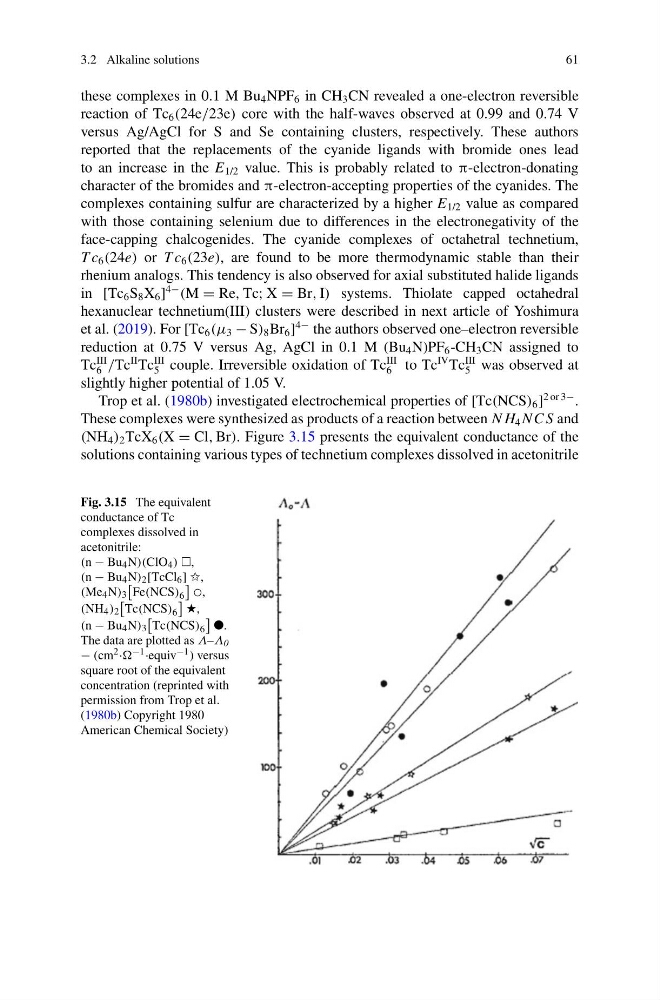
(NH 4 ) 2 TcX 6 (X = Cl, Br). Figure 3.15 presents the equivalent conductance of the
solutions containing various types of technetium complexes dissolved in acetonitrile
Fig. 3.15 The equivalent
conductance of Tc
complexes dissolved in
acetonitrile:
(n − Bu 4 N)(ClO 4 ) ,
(n − Bu 4 N) 2 [TcCl 6 ] ✩,
(Me 4 N) 3
Fe(NCS) 6
◯,
(NH 4 ) 2
Tc(NCS) 6
★,
(n − Bu 4 N) 3
Tc(NCS) 6
●.
The data are plotted as Λ–Λ 0
− (cm 2 · −1 ·equiv −1 ) versus
square root of the equivalent
concentration (reprinted with
permission from Trop et al.
(1980b) Copyright 1980
American Chemical Society)
61
these complexes in 0.1 M Bu 4 NPF 6 in CH 3 CN revealed a one-electron reversible
reaction of Tc 6 (24e/23e) core with the half-waves observed at 0.99 and 0.74 V
versus Ag/AgCl for S and Se containing clusters, respectively. These authors
reported that the replacements of the cyanide ligands with bromide ones lead
to an increase in the E 1/2 value. This is probably related to π-electron-donating
character of the bromides and π-electron-accepting properties of the cyanides. The
complexes containing sulfur are characterized by a higher E 1/2 value as compared
with those containing selenium due to differences in the electronegativity of the
face-capping chalcogenides. The cyanide complexes of octahetral technetium,
T c 6 (24e) or T c 6 (23e), are found to be more thermodynamic stable than their
rhenium analogs. This tendency is also observed for axial substituted halide ligands
in [Tc 6 S 8 X 6 ]
4−
(M = Re, Tc; X = Br, I) systems. Thiolate capped octahedral
hexanuclear technetium(III) clusters were described in next article of Yoshimura
et al. (2019). For [Tc 6 (μ 3 − S) 8 Br 6 ]
4− the authors observed one–electron reversible
reduction at 0.75 V versus Ag, AgCl in 0.1 M (Bu 4 N)PF 6 -CH 3 CN assigned to
Tc
III
6 /Tc
II Tc
III
5 couple. Irreversible oxidation of Tc
III
6 to Tc
IV Tc
III
5 was observed at
slightly higher potential of 1.05 V.
Trop et al. (1980b) investigated electrochemical properties of [Tc(NCS) 6 ]
2 or 3− .
These complexes were synthesized as products of a reaction between N H 4 N C S and
(NH 4 ) 2 TcX 6 (X = Cl, Br). Figure 3.15 presents the equivalent conductance of the
solutions containing various types of technetium complexes dissolved in acetonitrile
Fig. 3.15 The equivalent
conductance of Tc
complexes dissolved in
acetonitrile:
(n − Bu 4 N)(ClO 4 ) ,
(n − Bu 4 N) 2 [TcCl 6 ] ✩,
(Me 4 N) 3
Fe(NCS) 6
◯,
(NH 4 ) 2
Tc(NCS) 6
★,
(n − Bu 4 N) 3
Tc(NCS) 6
●.
The data are plotted as Λ–Λ 0
− (cm 2 · −1 ·equiv −1 ) versus
square root of the equivalent
concentration (reprinted with
permission from Trop et al.
(1980b) Copyright 1980
American Chemical Society)