

3.1 Acidic solutions
49
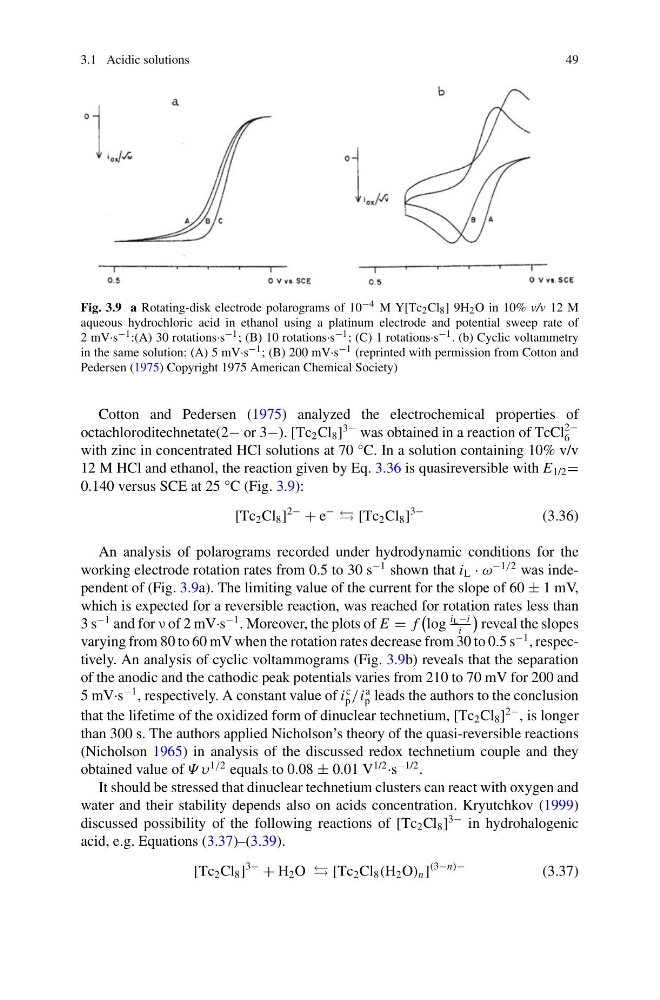
Fig. 3.9 a Rotating-disk electrode polarograms of 10 −4 M Y[Tc 2 Cl 8 ] 9H 2 O in 10% v/v 12 M
aqueous hydrochloric acid in ethanol using a platinum electrode and potential sweep rate of
2 mV·s −1 :(A) 30 rotations·s −1 ; (B) 10 rotations·s −1 ; (C) 1 rotations·s −1 . (b) Cyclic voltammetry
in the same solution: (A) 5 mV·s −1 ; (B) 200 mV·s −1 (reprinted with permission from Cotton and
Pedersen (1975) Copyright 1975 American Chemical Society)
Cotton and Pedersen (1975) analyzed the electrochemical properties of
octachloroditechnetate(2− or 3−). [Tc 2 Cl 8 ]
3− was obtained in a reaction of TcCl
2−
6
with zinc in concentrated HCl solutions at 70 °C. In a solution containing 10% v/v
12 M HCl and ethanol, the reaction given by Eq. 3.36 is quasireversible with E 1/2 =
0.140 versus SCE at 25 °C (Fig. 3.9):
[Tc 2 Cl 8 ]
2−
+ e
−
[Tc 2 Cl 8 ]
3−
(3.36)
An analysis of polarograms recorded under hydrodynamic conditions for the
working electrode rotation rates from 0.5 to 30 s
−1 shown that i L · ω
−1/2 was independent of (Fig. 3.9a). The limiting value of the current for the slope of 60 ± 1 mV,
which is expected for a reversible reaction, was reached for rotation rates less than
3 s
−1 and for ν of 2 mV·s
−1 . Moreover, the plots of E = f
log
i L −i
i
reveal the slopes
varying from 80 to 60 mV when the rotation rates decrease from 30 to 0.5 s
−1 , respectively. An analysis of cyclic voltammograms (Fig. 3.9b) reveals that the separation
of the anodic and the cathodic peak potentials varies from 210 to 70 mV for 200 and
5 mV·s
−1 , respectively. A constant value of i
c
p /i
a
p leads the authors to the conclusion
that the lifetime of the oxidized form of dinuclear technetium, [Tc 2 Cl 8 ]
2− , is longer
than 300 s. The authors applied Nicholson’s theory of the quasi-reversible reactions
(Nicholson 1965) in analysis of the discussed redox technetium couple and they
obtained value of Ψ υ
1/2 equals to 0.08 ± 0.01 V
1/2 ·s
−1/2 .
It should be stressed that dinuclear technetium clusters can react with oxygen and
water and their stability depends also on acids concentration. Kryutchkov (1999)
discussed possibility of the following reactions of [Tc 2 Cl 8 ]
3− in hydrohalogenic
acid, e.g. Equations (3.37)–(3.39).
[Tc 2 Cl 8 ]
3−
+ H 2 O [Tc 2 Cl 8 (H 2 O) n ]
(3−n)−
(3.37)
49
Fig. 3.9 a Rotating-disk electrode polarograms of 10 −4 M Y[Tc 2 Cl 8 ] 9H 2 O in 10% v/v 12 M
aqueous hydrochloric acid in ethanol using a platinum electrode and potential sweep rate of
2 mV·s −1 :(A) 30 rotations·s −1 ; (B) 10 rotations·s −1 ; (C) 1 rotations·s −1 . (b) Cyclic voltammetry
in the same solution: (A) 5 mV·s −1 ; (B) 200 mV·s −1 (reprinted with permission from Cotton and
Pedersen (1975) Copyright 1975 American Chemical Society)
Cotton and Pedersen (1975) analyzed the electrochemical properties of
octachloroditechnetate(2− or 3−). [Tc 2 Cl 8 ]
3− was obtained in a reaction of TcCl
2−
6
with zinc in concentrated HCl solutions at 70 °C. In a solution containing 10% v/v
12 M HCl and ethanol, the reaction given by Eq. 3.36 is quasireversible with E 1/2 =
0.140 versus SCE at 25 °C (Fig. 3.9):
[Tc 2 Cl 8 ]
2−
+ e
−
[Tc 2 Cl 8 ]
3−
(3.36)
An analysis of polarograms recorded under hydrodynamic conditions for the
working electrode rotation rates from 0.5 to 30 s
−1 shown that i L · ω
−1/2 was independent of (Fig. 3.9a). The limiting value of the current for the slope of 60 ± 1 mV,
which is expected for a reversible reaction, was reached for rotation rates less than
3 s
−1 and for ν of 2 mV·s
−1 . Moreover, the plots of E = f
log
i L −i
i
reveal the slopes
varying from 80 to 60 mV when the rotation rates decrease from 30 to 0.5 s
−1 , respectively. An analysis of cyclic voltammograms (Fig. 3.9b) reveals that the separation
of the anodic and the cathodic peak potentials varies from 210 to 70 mV for 200 and
5 mV·s
−1 , respectively. A constant value of i
c
p /i
a
p leads the authors to the conclusion
that the lifetime of the oxidized form of dinuclear technetium, [Tc 2 Cl 8 ]
2− , is longer
than 300 s. The authors applied Nicholson’s theory of the quasi-reversible reactions
(Nicholson 1965) in analysis of the discussed redox technetium couple and they
obtained value of Ψ υ
1/2 equals to 0.08 ± 0.01 V
1/2 ·s
−1/2 .
It should be stressed that dinuclear technetium clusters can react with oxygen and
water and their stability depends also on acids concentration. Kryutchkov (1999)
discussed possibility of the following reactions of [Tc 2 Cl 8 ]
3− in hydrohalogenic
acid, e.g. Equations (3.37)–(3.39).
[Tc 2 Cl 8 ]
3−
+ H 2 O [Tc 2 Cl 8 (H 2 O) n ]
(3−n)−
(3.37)