

48
3 Technetium Coordinated by Inorganic Ligands in Aqueous …
One-electron redox couples were recorded for all examinated Tc(V)/Tc(VI)
couples. Substitution of N
3− for O
2− in these types of technetium complexes
results strong decrease in E 1/2 . Based on the spectroelectrochemical results, the
authors concluded that five-coordinate geometry of [Tc(N or O)X 4 ]
− is preserved
(in contrast to aqueous solutions) during discussed redox reaction.
The problem of stability of oxochloro technetium (IV/III) complexes was of
interest to Said et al. (2000). Oxochlototechnetates(2−) slowly decompose in 1 M
HCl to TcCl m O n (OH) p (H 2 O)
(4−m−2n− p)+
q
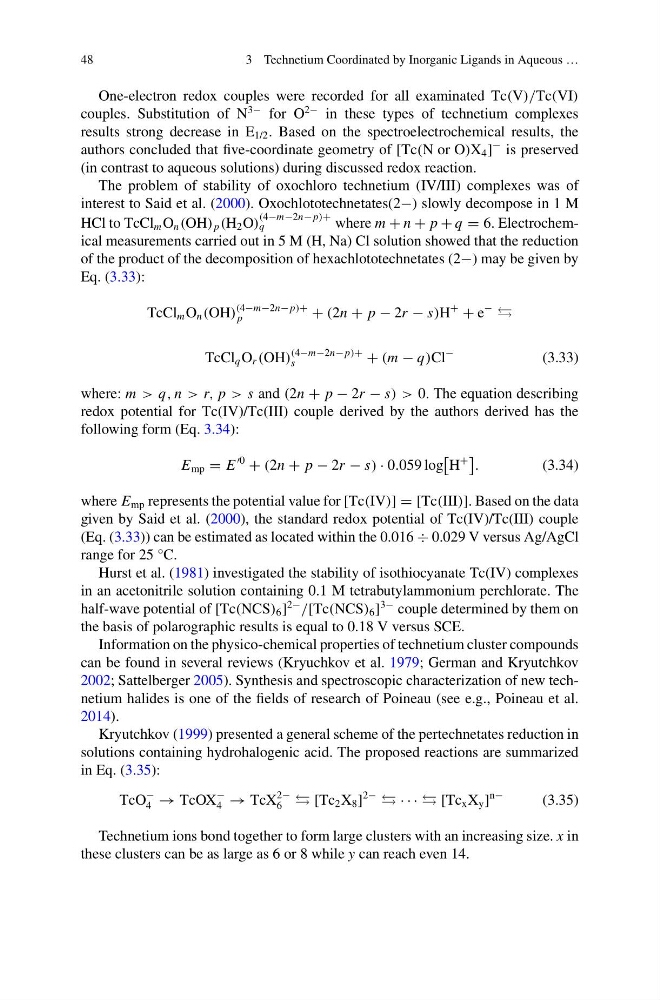
where m + n + p + q = 6. Electrochemical measurements carried out in 5 M (H, Na) Cl solution showed that the reduction
of the product of the decomposition of hexachlototechnetates (2−) may be given by
Eq. (3.33):
TcCl m O n (OH)
(4−m−2n− p)+
p
+ (2n + p − 2r − s)H
+
+ e
−
TcCl q O r (OH)
(4−m−2n− p)+
s
+ (m − q)Cl
−
(3.33)
where: m > q, n > r, p > s and (2n + p − 2r − s) > 0. The equation describing
redox potential for Tc(IV)/Tc(III) couple derived by the authors derived has the
following form (Eq. 3.34):
E mp = E
0
+ (2n + p − 2r − s) · 0.059 log
H
+
.
(3.34)
where E mp represents the potential value for [Tc(IV)] = [Tc(III)]. Based on the data
given by Said et al. (2000), the standard redox potential of Tc(IV)/Tc(III) couple
(Eq. (3.33)) can be estimated as located within the 0.016 ÷ 0.029 V versus Ag/AgCl
range for 25 °C.
Hurst et al. (1981) investigated the stability of isothiocyanate Tc(IV) complexes
in an acetonitrile solution containing 0.1 M tetrabutylammonium perchlorate. The
half-wave potential of [Tc(NCS) 6 ]
2−
/[Tc(NCS) 6 ]
3− couple determined by them on
the basis of polarographic results is equal to 0.18 V versus SCE.
Information on the physico-chemical properties of technetium cluster compounds
can be found in several reviews (Kryuchkov et al. 1979; German and Kryutchkov
2002; Sattelberger 2005). Synthesis and spectroscopic characterization of new technetium halides is one of the fields of research of Poineau (see e.g., Poineau et al.
2014).
Kryutchkov (1999) presented a general scheme of the pertechnetates reduction in
solutions containing hydrohalogenic acid. The proposed reactions are summarized
in Eq. (3.35):
TcO
−
4 → TcOX
−
4 → TcX
2−
6 [Tc 2 X 8 ]
2−
· · · [Tc x X y ]
n−
(3.35)
Technetium ions bond together to form large clusters with an increasing size. x in
these clusters can be as large as 6 or 8 while y can reach even 14.
3 Technetium Coordinated by Inorganic Ligands in Aqueous …
One-electron redox couples were recorded for all examinated Tc(V)/Tc(VI)
couples. Substitution of N
3− for O
2− in these types of technetium complexes
results strong decrease in E 1/2 . Based on the spectroelectrochemical results, the
authors concluded that five-coordinate geometry of [Tc(N or O)X 4 ]
− is preserved
(in contrast to aqueous solutions) during discussed redox reaction.
The problem of stability of oxochloro technetium (IV/III) complexes was of
interest to Said et al. (2000). Oxochlototechnetates(2−) slowly decompose in 1 M
HCl to TcCl m O n (OH) p (H 2 O)
(4−m−2n− p)+
q
where m + n + p + q = 6. Electrochemical measurements carried out in 5 M (H, Na) Cl solution showed that the reduction
of the product of the decomposition of hexachlototechnetates (2−) may be given by
Eq. (3.33):
TcCl m O n (OH)
(4−m−2n− p)+
p
+ (2n + p − 2r − s)H
+
+ e
−
TcCl q O r (OH)
(4−m−2n− p)+
s
+ (m − q)Cl
−
(3.33)
where: m > q, n > r, p > s and (2n + p − 2r − s) > 0. The equation describing
redox potential for Tc(IV)/Tc(III) couple derived by the authors derived has the
following form (Eq. 3.34):
E mp = E
0
+ (2n + p − 2r − s) · 0.059 log
H
+
.
(3.34)
where E mp represents the potential value for [Tc(IV)] = [Tc(III)]. Based on the data
given by Said et al. (2000), the standard redox potential of Tc(IV)/Tc(III) couple
(Eq. (3.33)) can be estimated as located within the 0.016 ÷ 0.029 V versus Ag/AgCl
range for 25 °C.
Hurst et al. (1981) investigated the stability of isothiocyanate Tc(IV) complexes
in an acetonitrile solution containing 0.1 M tetrabutylammonium perchlorate. The
half-wave potential of [Tc(NCS) 6 ]
2−
/[Tc(NCS) 6 ]
3− couple determined by them on
the basis of polarographic results is equal to 0.18 V versus SCE.
Information on the physico-chemical properties of technetium cluster compounds
can be found in several reviews (Kryuchkov et al. 1979; German and Kryutchkov
2002; Sattelberger 2005). Synthesis and spectroscopic characterization of new technetium halides is one of the fields of research of Poineau (see e.g., Poineau et al.
2014).
Kryutchkov (1999) presented a general scheme of the pertechnetates reduction in
solutions containing hydrohalogenic acid. The proposed reactions are summarized
in Eq. (3.35):
TcO
−
4 → TcOX
−
4 → TcX
2−
6 [Tc 2 X 8 ]
2−
· · · [Tc x X y ]
n−
(3.35)
Technetium ions bond together to form large clusters with an increasing size. x in
these clusters can be as large as 6 or 8 while y can reach even 14.