

3.1 Acidic solutions
47
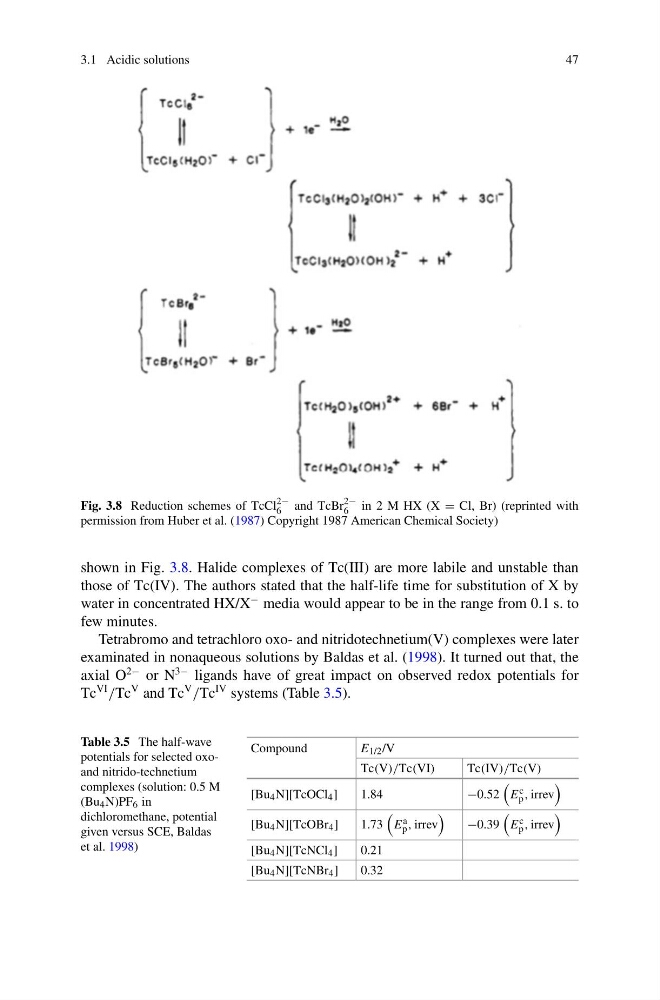
Fig. 3.8 Reduction schemes of TcCl
2−
6 and TcBr
2−
6 in 2 M HX (X = Cl, Br) (reprinted with
permission from Huber et al. (1987) Copyright 1987 American Chemical Society)
shown in Fig. 3.8. Halide complexes of Tc(III) are more labile and unstable than
those of Tc(IV). The authors stated that the half-life time for substitution of X by
water in concentrated HX/X
− media would appear to be in the range from 0.1 s. to
few minutes.
Tetrabromo and tetrachloro oxo- and nitridotechnetium(V) complexes were later
examinated in nonaqueous solutions by Baldas et al. (1998). It turned out that, the
axial O
2− or N
3− ligands have of great impact on observed redox potentials for
Tc
VI
/Tc
V and Tc
V
/Tc
IV systems (Table 3.5).
Table 3.5 The half-wave
potentials for selected oxoand nitrido-technetium
complexes (solution: 0.5 M
(Bu 4 N)PF 6 in
dichloromethane, potential
given versus SCE, Baldas
et al. 1998)
Compound
E 1/2 /V
Tc(V)/Tc(VI)
Tc(IV)/Tc(V)
[Bu 4 N][TcOCl 4 ]
1.84
−0.52
E c
p , irrev
[Bu 4 N][TcOBr 4 ]
1.73
E a
p , irrev
−0.39
E c
p , irrev
[Bu 4 N][TcNCl 4 ]
0.21
[Bu 4 N][TcNBr 4 ]
0.32
47
Fig. 3.8 Reduction schemes of TcCl
2−
6 and TcBr
2−
6 in 2 M HX (X = Cl, Br) (reprinted with
permission from Huber et al. (1987) Copyright 1987 American Chemical Society)
shown in Fig. 3.8. Halide complexes of Tc(III) are more labile and unstable than
those of Tc(IV). The authors stated that the half-life time for substitution of X by
water in concentrated HX/X
− media would appear to be in the range from 0.1 s. to
few minutes.
Tetrabromo and tetrachloro oxo- and nitridotechnetium(V) complexes were later
examinated in nonaqueous solutions by Baldas et al. (1998). It turned out that, the
axial O
2− or N
3− ligands have of great impact on observed redox potentials for
Tc
VI
/Tc
V and Tc
V
/Tc
IV systems (Table 3.5).
Table 3.5 The half-wave
potentials for selected oxoand nitrido-technetium
complexes (solution: 0.5 M
(Bu 4 N)PF 6 in
dichloromethane, potential
given versus SCE, Baldas
et al. 1998)
Compound
E 1/2 /V
Tc(V)/Tc(VI)
Tc(IV)/Tc(V)
[Bu 4 N][TcOCl 4 ]
1.84
−0.52
E c
p , irrev
[Bu 4 N][TcOBr 4 ]
1.73
E a
p , irrev
−0.39
E c
p , irrev
[Bu 4 N][TcNCl 4 ]
0.21
[Bu 4 N][TcNBr 4 ]
0.32