

46
3 Technetium Coordinated by Inorganic Ligands in Aqueous …
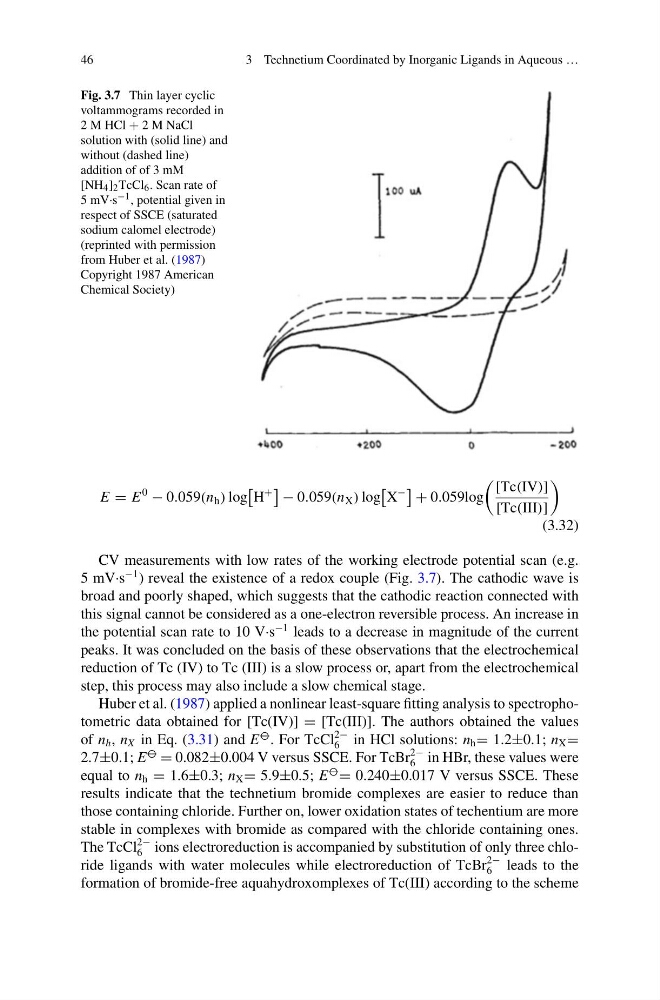
Fig. 3.7 Thin layer cyclic
voltammograms recorded in
2 M HCl + 2 M NaCl
solution with (solid line) and
without (dashed line)
addition of of 3 mM
[NH 4 ] 2 TcCl 6 . Scan rate of
5 mV·s −1 , potential given in
respect of SSCE (saturated
sodium calomel electrode)
(reprinted with permission
from Huber et al. (1987)
Copyright 1987 American
Chemical Society)
E = E
0
− 0.059(n h ) log
H
+
− 0.059(n X ) log
X
−
+ 0.059log
[Tc(IV)]
[Tc(III)]
(3.32)
CV measurements with low rates of the working electrode potential scan (e.g.
5 mV·s
−1 ) reveal the existence of a redox couple (Fig. 3.7). The cathodic wave is
broad and poorly shaped, which suggests that the cathodic reaction connected with
this signal cannot be considered as a one-electron reversible process. An increase in
the potential scan rate to 10 V·s
−1 leads to a decrease in magnitude of the current
peaks. It was concluded on the basis of these observations that the electrochemical
reduction of Tc (IV) to Tc (III) is a slow process or, apart from the electrochemical
step, this process may also include a slow chemical stage.
Huber et al. (1987) applied a nonlinear least-square fitting analysis to spectrophotometric data obtained for [Tc(IV)] = [Tc(III)]. The authors obtained the values
of n h , n X in Eq. (3.31) and E
⦵ . For TcCl
2−
6 in HCl solutions: n h = 1.2±0.1; n X =
2.7±0.1; E
⦵
= 0.082±0.004 V versus SSCE. For TcBr
2−
6 in HBr, these values were
equal to n h = 1.6±0.3; n X = 5.9±0.5; E
⦵
= 0.240±0.017 V versus SSCE. These
results indicate that the technetium bromide complexes are easier to reduce than
those containing chloride. Further on, lower oxidation states of techentium are more
stable in complexes with bromide as compared with the chloride containing ones.
The TcCl
2−
6 ions electroreduction is accompanied by substitution of only three chloride ligands with water molecules while electroreduction of TcBr
2−
6 leads to the
formation of bromide-free aquahydroxomplexes of Tc(III) according to the scheme
3 Technetium Coordinated by Inorganic Ligands in Aqueous …
Fig. 3.7 Thin layer cyclic
voltammograms recorded in
2 M HCl + 2 M NaCl
solution with (solid line) and
without (dashed line)
addition of of 3 mM
[NH 4 ] 2 TcCl 6 . Scan rate of
5 mV·s −1 , potential given in
respect of SSCE (saturated
sodium calomel electrode)
(reprinted with permission
from Huber et al. (1987)
Copyright 1987 American
Chemical Society)
E = E
0
− 0.059(n h ) log
H
+
− 0.059(n X ) log
X
−
+ 0.059log
[Tc(IV)]
[Tc(III)]
(3.32)
CV measurements with low rates of the working electrode potential scan (e.g.
5 mV·s
−1 ) reveal the existence of a redox couple (Fig. 3.7). The cathodic wave is
broad and poorly shaped, which suggests that the cathodic reaction connected with
this signal cannot be considered as a one-electron reversible process. An increase in
the potential scan rate to 10 V·s
−1 leads to a decrease in magnitude of the current
peaks. It was concluded on the basis of these observations that the electrochemical
reduction of Tc (IV) to Tc (III) is a slow process or, apart from the electrochemical
step, this process may also include a slow chemical stage.
Huber et al. (1987) applied a nonlinear least-square fitting analysis to spectrophotometric data obtained for [Tc(IV)] = [Tc(III)]. The authors obtained the values
of n h , n X in Eq. (3.31) and E
⦵ . For TcCl
2−
6 in HCl solutions: n h = 1.2±0.1; n X =
2.7±0.1; E
⦵
= 0.082±0.004 V versus SSCE. For TcBr
2−
6 in HBr, these values were
equal to n h = 1.6±0.3; n X = 5.9±0.5; E
⦵
= 0.240±0.017 V versus SSCE. These
results indicate that the technetium bromide complexes are easier to reduce than
those containing chloride. Further on, lower oxidation states of techentium are more
stable in complexes with bromide as compared with the chloride containing ones.
The TcCl
2−
6 ions electroreduction is accompanied by substitution of only three chloride ligands with water molecules while electroreduction of TcBr
2−
6 leads to the
formation of bromide-free aquahydroxomplexes of Tc(III) according to the scheme