

50
3 Technetium Coordinated by Inorganic Ligands in Aqueous …
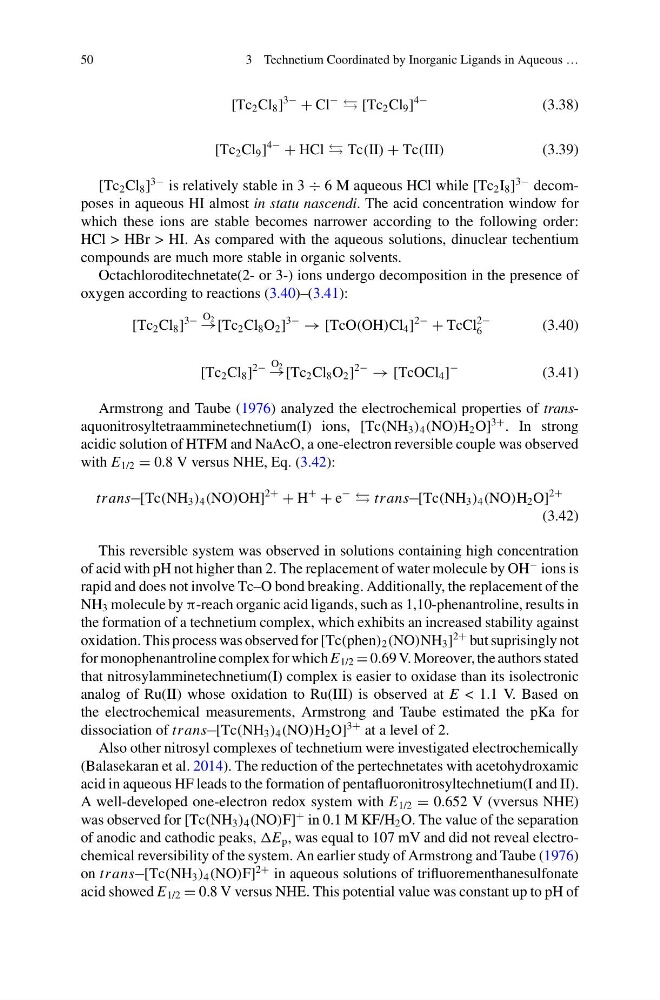
[Tc 2 Cl 8 ]
3−
+ Cl
−
[Tc 2 Cl 9 ]
4−
(3.38)
[Tc 2 Cl 9 ]
4−
+ HCl Tc(II) + Tc(III)
(3.39)
[Tc 2 Cl 8 ]
3− is relatively stable in 3 ÷ 6 M aqueous HCl while [Tc 2 I 8 ]
3− decomposes in aqueous HI almost in statu nascendi. The acid concentration window for
which these ions are stable becomes narrower according to the following order:
HCl > HBr > HI. As compared with the aqueous solutions, dinuclear techentium
compounds are much more stable in organic solvents.
Octachloroditechnetate(2- or 3-) ions undergo decomposition in the presence of
oxygen according to reactions (3.40)–(3.41):
[Tc 2 Cl 8 ]
3− O 2
→[Tc 2 Cl 8 O 2 ]
3−
→ [TcO(OH)Cl 4 ]
2−
+ TcCl
2−
6
(3.40)
[Tc 2 Cl 8 ]
2− O 2
→[Tc 2 Cl 8 O 2 ]
2−
→ [TcOCl 4 ]
−
(3.41)
Armstrong and Taube (1976) analyzed the electrochemical properties of transaquonitrosyltetraamminetechnetium(I) ions, [Tc(NH 3 ) 4 (NO)H 2 O]
3+ . In strong
acidic solution of HTFM and NaAcO, a one-electron reversible couple was observed
with E 1/2 = 0.8 V versus NHE, Eq. (3.42):
trans−[Tc(NH 3 ) 4 (NO)OH]
2+
+ H
+
+ e
−
trans−[Tc(NH 3 ) 4 (NO)H 2 O]
2+
(3.42)
This reversible system was observed in solutions containing high concentration
of acid with pH not higher than 2. The replacement of water molecule by OH
− ions is
rapid and does not involve Tc–O bond breaking. Additionally, the replacement of the
NH 3 molecule by π-reach organic acid ligands, such as 1,10-phenantroline, results in
the formation of a technetium complex, which exhibits an increased stability against
oxidation. This process was observed for [Tc(phen) 2 (NO)NH 3 ]
2+ but suprisingly not
for monophenantroline complex for which E 1/2 = 0.69 V. Moreover, the authors stated
that nitrosylamminetechnetium(I) complex is easier to oxidase than its isolectronic
analog of Ru(II) whose oxidation to Ru(III) is observed at E < 1.1 V. Based on
the electrochemical measurements, Armstrong and Taube estimated the pKa for
dissociation of trans−[Tc(NH 3 ) 4 (NO)H 2 O]
3+ at a level of 2.
Also other nitrosyl complexes of technetium were investigated electrochemically
(Balasekaran et al. 2014). The reduction of the pertechnetates with acetohydroxamic
acid in aqueous HF leads to the formation of pentafluoronitrosyltechnetium(I and II).
A well-developed one-electron redox system with E 1/2 = 0.652 V (vversus NHE)
was observed for [Tc(NH 3 ) 4 (NO)F]
+ in 0.1 M KF/H 2 O. The value of the separation
of anodic and cathodic peaks, E p , was equal to 107 mV and did not reveal electrochemical reversibility of the system. An earlier study of Armstrong and Taube (1976)
on trans−[Tc(NH 3 ) 4 (NO)F]
2+ in aqueous solutions of trifluorementhanesulfonate
acid showed E 1/2 = 0.8 V versus NHE. This potential value was constant up to pH of
3 Technetium Coordinated by Inorganic Ligands in Aqueous …
[Tc 2 Cl 8 ]
3−
+ Cl
−
[Tc 2 Cl 9 ]
4−
(3.38)
[Tc 2 Cl 9 ]
4−
+ HCl Tc(II) + Tc(III)
(3.39)
[Tc 2 Cl 8 ]
3− is relatively stable in 3 ÷ 6 M aqueous HCl while [Tc 2 I 8 ]
3− decomposes in aqueous HI almost in statu nascendi. The acid concentration window for
which these ions are stable becomes narrower according to the following order:
HCl > HBr > HI. As compared with the aqueous solutions, dinuclear techentium
compounds are much more stable in organic solvents.
Octachloroditechnetate(2- or 3-) ions undergo decomposition in the presence of
oxygen according to reactions (3.40)–(3.41):
[Tc 2 Cl 8 ]
3− O 2
→[Tc 2 Cl 8 O 2 ]
3−
→ [TcO(OH)Cl 4 ]
2−
+ TcCl
2−
6
(3.40)
[Tc 2 Cl 8 ]
2− O 2
→[Tc 2 Cl 8 O 2 ]
2−
→ [TcOCl 4 ]
−
(3.41)
Armstrong and Taube (1976) analyzed the electrochemical properties of transaquonitrosyltetraamminetechnetium(I) ions, [Tc(NH 3 ) 4 (NO)H 2 O]
3+ . In strong
acidic solution of HTFM and NaAcO, a one-electron reversible couple was observed
with E 1/2 = 0.8 V versus NHE, Eq. (3.42):
trans−[Tc(NH 3 ) 4 (NO)OH]
2+
+ H
+
+ e
−
trans−[Tc(NH 3 ) 4 (NO)H 2 O]
2+
(3.42)
This reversible system was observed in solutions containing high concentration
of acid with pH not higher than 2. The replacement of water molecule by OH
− ions is
rapid and does not involve Tc–O bond breaking. Additionally, the replacement of the
NH 3 molecule by π-reach organic acid ligands, such as 1,10-phenantroline, results in
the formation of a technetium complex, which exhibits an increased stability against
oxidation. This process was observed for [Tc(phen) 2 (NO)NH 3 ]
2+ but suprisingly not
for monophenantroline complex for which E 1/2 = 0.69 V. Moreover, the authors stated
that nitrosylamminetechnetium(I) complex is easier to oxidase than its isolectronic
analog of Ru(II) whose oxidation to Ru(III) is observed at E < 1.1 V. Based on
the electrochemical measurements, Armstrong and Taube estimated the pKa for
dissociation of trans−[Tc(NH 3 ) 4 (NO)H 2 O]
3+ at a level of 2.
Also other nitrosyl complexes of technetium were investigated electrochemically
(Balasekaran et al. 2014). The reduction of the pertechnetates with acetohydroxamic
acid in aqueous HF leads to the formation of pentafluoronitrosyltechnetium(I and II).
A well-developed one-electron redox system with E 1/2 = 0.652 V (vversus NHE)
was observed for [Tc(NH 3 ) 4 (NO)F]
+ in 0.1 M KF/H 2 O. The value of the separation
of anodic and cathodic peaks, E p , was equal to 107 mV and did not reveal electrochemical reversibility of the system. An earlier study of Armstrong and Taube (1976)
on trans−[Tc(NH 3 ) 4 (NO)F]
2+ in aqueous solutions of trifluorementhanesulfonate
acid showed E 1/2 = 0.8 V versus NHE. This potential value was constant up to pH of