

3.1 Acidic solutions
39
∂ Ep/∂ log ν = 30; ∂ Ep/∂c = 0
(3.18)
DISP2:
A + e
−
B; B ↔ C; B + C A + D(rds)
(3.19)
∂ Ep/∂ log ν = 20; ∂ Ep/∂c = 20
(3.20)
where rds is the rate-determining step.
The measurements allowed determining ∂ Ep/∂ log ν and ∂ Ep/∂c values for the
pertechnetates reduction in the acidic solutions. These values were equal to 14 and 0,
respectively, clearly indicating that the overall process is significantly more complex
than simple ECE or DISP mechanisms.
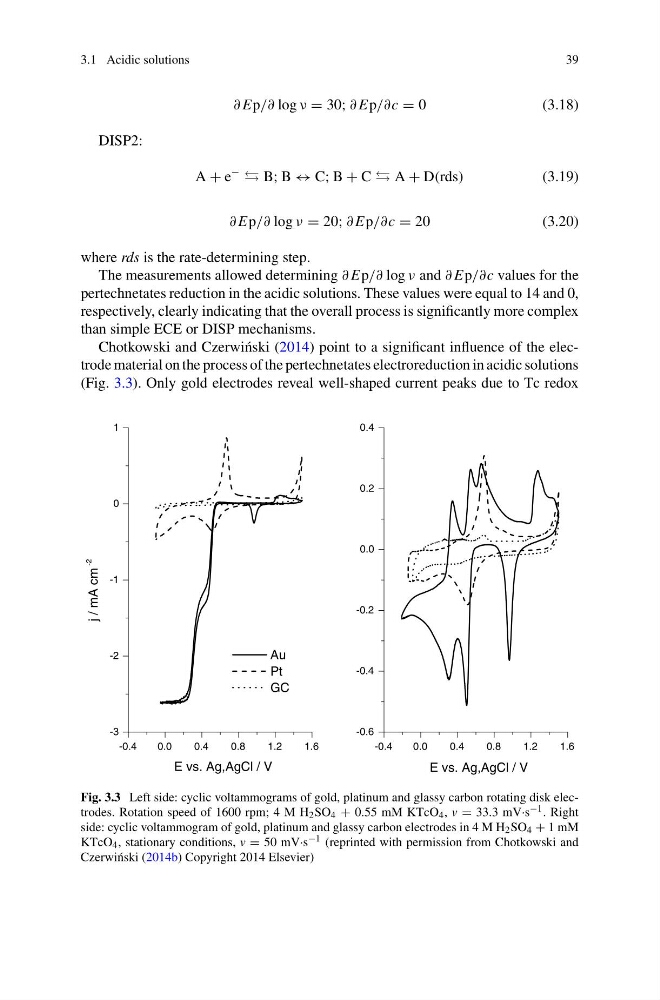
Chotkowski and Czerwi´ nski (2014) point to a significant influence of the electrode material on the process of the pertechnetates electroreduction in acidic solutions
(Fig. 3.3). Only gold electrodes reveal well-shaped current peaks due to Tc redox
-0.4
0.0
0.4
0.8
1.2
1.6
-3
-2
-1
0
1
Au
Pt
GC
j / mA cm
-2
E vs. Ag,AgCl / V
-0.4
0.0
0.4
0.8
1.2
1.6
-0.6
-0.4
-0.2
0.0
0.2
0.4
E vs. Ag,AgCl / V
Fig. 3.3 Left side: cyclic voltammograms of gold, platinum and glassy carbon rotating disk electrodes. Rotation speed of 1600 rpm; 4 M H 2 SO 4 + 0.55 mM KTcO 4 , v = 33.3 mV·s −1 . Right
side: cyclic voltammogram of gold, platinum and glassy carbon electrodes in 4 M H 2 SO 4 + 1 mM
KTcO 4 , stationary conditions, v = 50 mV·s −1 (reprinted with permission from Chotkowski and
Czerwi´ nski (2014b) Copyright 2014 Elsevier)
39
∂ Ep/∂ log ν = 30; ∂ Ep/∂c = 0
(3.18)
DISP2:
A + e
−
B; B ↔ C; B + C A + D(rds)
(3.19)
∂ Ep/∂ log ν = 20; ∂ Ep/∂c = 20
(3.20)
where rds is the rate-determining step.
The measurements allowed determining ∂ Ep/∂ log ν and ∂ Ep/∂c values for the
pertechnetates reduction in the acidic solutions. These values were equal to 14 and 0,
respectively, clearly indicating that the overall process is significantly more complex
than simple ECE or DISP mechanisms.
Chotkowski and Czerwi´ nski (2014) point to a significant influence of the electrode material on the process of the pertechnetates electroreduction in acidic solutions
(Fig. 3.3). Only gold electrodes reveal well-shaped current peaks due to Tc redox
-0.4
0.0
0.4
0.8
1.2
1.6
-3
-2
-1
0
1
Au
Pt
GC
j / mA cm
-2
E vs. Ag,AgCl / V
-0.4
0.0
0.4
0.8
1.2
1.6
-0.6
-0.4
-0.2
0.0
0.2
0.4
E vs. Ag,AgCl / V
Fig. 3.3 Left side: cyclic voltammograms of gold, platinum and glassy carbon rotating disk electrodes. Rotation speed of 1600 rpm; 4 M H 2 SO 4 + 0.55 mM KTcO 4 , v = 33.3 mV·s −1 . Right
side: cyclic voltammogram of gold, platinum and glassy carbon electrodes in 4 M H 2 SO 4 + 1 mM
KTcO 4 , stationary conditions, v = 50 mV·s −1 (reprinted with permission from Chotkowski and
Czerwi´ nski (2014b) Copyright 2014 Elsevier)