

40
3 Technetium Coordinated by Inorganic Ligands in Aqueous …
reactions, i.e., two very strong reduction waves and three oxidation signals. The electrochemical signals of TcO
−
4 reaction on a platinum electrode are very similar to those
reported for electrolytes containing rhenium (Méndez et al. 2003; Szabó and Bakos
2004). The latter reveals a strong adsorption of ReO
−
4 ions on the electrode surface
and formation of ReO 2 oxides as well as Re 2 O 5 and ReO 3 during the perrhenates
electroreduction. Currents due to oxidation and reduction of Tc on glassy carbon
(GC), which was the third type of the electrode material studied by Chotkowski and
Czerwi´ nski (2014), are much less developed as compared to Au and Pt substrates
(Fig. 3.3).
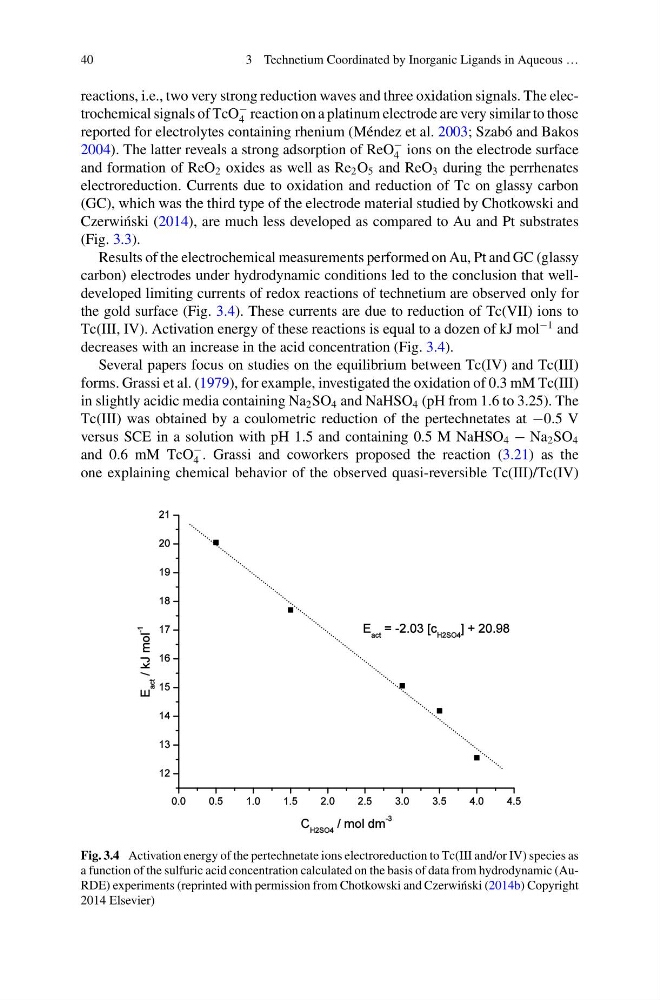
Results of the electrochemical measurements performed on Au, Pt and GC (glassy
carbon) electrodes under hydrodynamic conditions led to the conclusion that welldeveloped limiting currents of redox reactions of technetium are observed only for
the gold surface (Fig. 3.4). These currents are due to reduction of Tc(VII) ions to
Tc(III, IV). Activation energy of these reactions is equal to a dozen of kJ mol
−1 and
decreases with an increase in the acid concentration (Fig. 3.4).
Several papers focus on studies on the equilibrium between Tc(IV) and Tc(III)
forms. Grassi et al. (1979), for example, investigated the oxidation of 0.3 mM Tc(III)
in slightly acidic media containing Na 2 SO 4 and NaHSO 4 (pH from 1.6 to 3.25). The
Tc(III) was obtained by a coulometric reduction of the pertechnetates at −0.5 V
versus SCE in a solution with pH 1.5 and containing 0.5 M NaHSO 4 − Na 2 SO 4
and 0.6 mM TcO
−
4 . Grassi and coworkers proposed the reaction (3.21) as the
one explaining chemical behavior of the observed quasi-reversible Tc(III)/Tc(IV)
Fig. 3.4 Activation energy of the pertechnetate ions electroreduction to Tc(III and/or IV) species as
a function of the sulfuric acid concentration calculated on the basis of data from hydrodynamic (AuRDE) experiments (reprinted with permission from Chotkowski and Czerwi´ nski (2014b) Copyright
2014 Elsevier)
3 Technetium Coordinated by Inorganic Ligands in Aqueous …
reactions, i.e., two very strong reduction waves and three oxidation signals. The electrochemical signals of TcO
−
4 reaction on a platinum electrode are very similar to those
reported for electrolytes containing rhenium (Méndez et al. 2003; Szabó and Bakos
2004). The latter reveals a strong adsorption of ReO
−
4 ions on the electrode surface
and formation of ReO 2 oxides as well as Re 2 O 5 and ReO 3 during the perrhenates
electroreduction. Currents due to oxidation and reduction of Tc on glassy carbon
(GC), which was the third type of the electrode material studied by Chotkowski and
Czerwi´ nski (2014), are much less developed as compared to Au and Pt substrates
(Fig. 3.3).
Results of the electrochemical measurements performed on Au, Pt and GC (glassy
carbon) electrodes under hydrodynamic conditions led to the conclusion that welldeveloped limiting currents of redox reactions of technetium are observed only for
the gold surface (Fig. 3.4). These currents are due to reduction of Tc(VII) ions to
Tc(III, IV). Activation energy of these reactions is equal to a dozen of kJ mol
−1 and
decreases with an increase in the acid concentration (Fig. 3.4).
Several papers focus on studies on the equilibrium between Tc(IV) and Tc(III)
forms. Grassi et al. (1979), for example, investigated the oxidation of 0.3 mM Tc(III)
in slightly acidic media containing Na 2 SO 4 and NaHSO 4 (pH from 1.6 to 3.25). The
Tc(III) was obtained by a coulometric reduction of the pertechnetates at −0.5 V
versus SCE in a solution with pH 1.5 and containing 0.5 M NaHSO 4 − Na 2 SO 4
and 0.6 mM TcO
−
4 . Grassi and coworkers proposed the reaction (3.21) as the
one explaining chemical behavior of the observed quasi-reversible Tc(III)/Tc(IV)
Fig. 3.4 Activation energy of the pertechnetate ions electroreduction to Tc(III and/or IV) species as
a function of the sulfuric acid concentration calculated on the basis of data from hydrodynamic (AuRDE) experiments (reprinted with permission from Chotkowski and Czerwi´ nski (2014b) Copyright
2014 Elsevier)