

38
3 Technetium Coordinated by Inorganic Ligands in Aqueous …
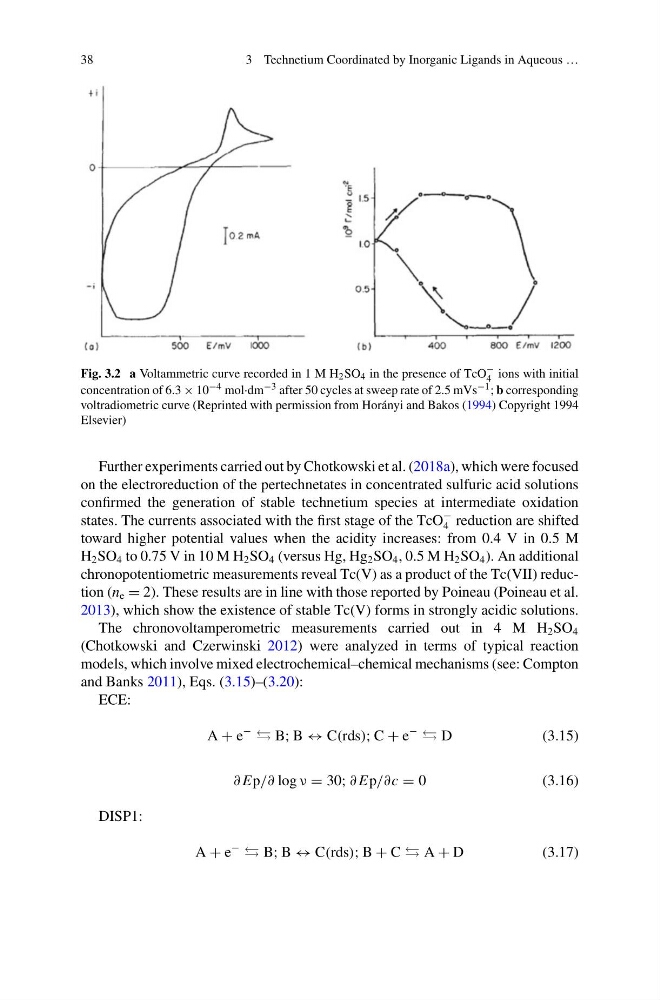
Fig. 3.2 a Voltammetric curve recorded in 1 M H 2 SO 4 in the presence of TcO
−
4 ions with initial
concentration of 6.3 × 10 −4 mol·dm −3 after 50 cycles at sweep rate of 2.5 mVs −1 ; b corresponding
voltradiometric curve (Reprinted with permission from Horányi and Bakos (1994) Copyright 1994
Elsevier)
Further experiments carried out by Chotkowski et al. (2018a), which were focused
on the electroreduction of the pertechnetates in concentrated sulfuric acid solutions
confirmed the generation of stable technetium species at intermediate oxidation
states. The currents associated with the first stage of the TcO
−
4 reduction are shifted
toward higher potential values when the acidity increases: from 0.4 V in 0.5 M
H 2 SO 4 to 0.75 V in 10 M H 2 SO 4 (versus Hg, Hg 2 SO 4 , 0.5 M H 2 SO 4 ). An additional
chronopotentiometric measurements reveal Tc(V) as a product of the Tc(VII) reduction (n e = 2). These results are in line with those reported by Poineau (Poineau et al.
2013), which show the existence of stable Tc(V) forms in strongly acidic solutions.
The chronovoltamperometric measurements carried out in 4 M H 2 SO 4
(Chotkowski and Czerwinski 2012) were analyzed in terms of typical reaction
models, which involve mixed electrochemical–chemical mechanisms (see: Compton
and Banks 2011), Eqs. (3.15)–(3.20):
ECE:
A + e
−
B; B ↔ C(rds); C + e
−
D
(3.15)
∂ Ep/∂ log ν = 30; ∂ Ep/∂c = 0
(3.16)
DISP1:
A + e
−
B; B ↔ C(rds); B + C A + D
(3.17)
3 Technetium Coordinated by Inorganic Ligands in Aqueous …
Fig. 3.2 a Voltammetric curve recorded in 1 M H 2 SO 4 in the presence of TcO
−
4 ions with initial
concentration of 6.3 × 10 −4 mol·dm −3 after 50 cycles at sweep rate of 2.5 mVs −1 ; b corresponding
voltradiometric curve (Reprinted with permission from Horányi and Bakos (1994) Copyright 1994
Elsevier)
Further experiments carried out by Chotkowski et al. (2018a), which were focused
on the electroreduction of the pertechnetates in concentrated sulfuric acid solutions
confirmed the generation of stable technetium species at intermediate oxidation
states. The currents associated with the first stage of the TcO
−
4 reduction are shifted
toward higher potential values when the acidity increases: from 0.4 V in 0.5 M
H 2 SO 4 to 0.75 V in 10 M H 2 SO 4 (versus Hg, Hg 2 SO 4 , 0.5 M H 2 SO 4 ). An additional
chronopotentiometric measurements reveal Tc(V) as a product of the Tc(VII) reduction (n e = 2). These results are in line with those reported by Poineau (Poineau et al.
2013), which show the existence of stable Tc(V) forms in strongly acidic solutions.
The chronovoltamperometric measurements carried out in 4 M H 2 SO 4
(Chotkowski and Czerwinski 2012) were analyzed in terms of typical reaction
models, which involve mixed electrochemical–chemical mechanisms (see: Compton
and Banks 2011), Eqs. (3.15)–(3.20):
ECE:
A + e
−
B; B ↔ C(rds); C + e
−
D
(3.15)
∂ Ep/∂ log ν = 30; ∂ Ep/∂c = 0
(3.16)
DISP1:
A + e
−
B; B ↔ C(rds); B + C A + D
(3.17)