

3.1 Acidic solutions
37
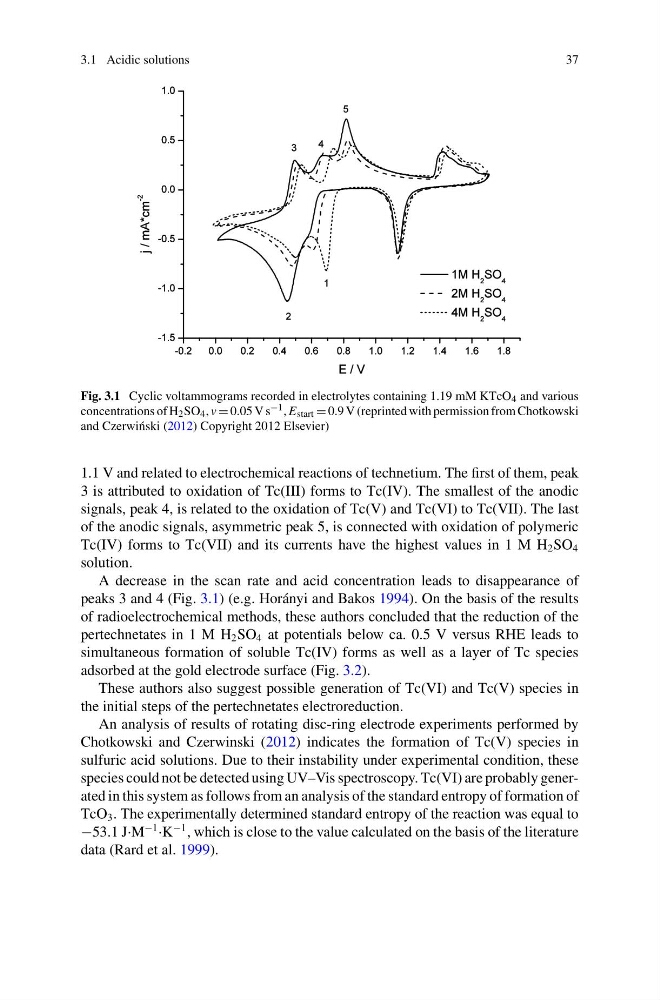
Fig. 3.1 Cyclic voltammograms recorded in electrolytes containing 1.19 mM KTcO 4 and various
concentrations of H 2 SO 4 , v = 0.05 V s −1 , E start = 0.9 V (reprinted with permission from Chotkowski
and Czerwi´ nski (2012) Copyright 2012 Elsevier)
1.1 V and related to electrochemical reactions of technetium. The first of them, peak
3 is attributed to oxidation of Tc(III) forms to Tc(IV). The smallest of the anodic
signals, peak 4, is related to the oxidation of Tc(V) and Tc(VI) to Tc(VII). The last
of the anodic signals, asymmetric peak 5, is connected with oxidation of polymeric
Tc(IV) forms to Tc(VII) and its currents have the highest values in 1 M H 2 SO 4
solution.
A decrease in the scan rate and acid concentration leads to disappearance of
peaks 3 and 4 (Fig. 3.1) (e.g. Horányi and Bakos 1994). On the basis of the results
of radioelectrochemical methods, these authors concluded that the reduction of the
pertechnetates in 1 M H 2 SO 4 at potentials below ca. 0.5 V versus RHE leads to
simultaneous formation of soluble Tc(IV) forms as well as a layer of Tc species
adsorbed at the gold electrode surface (Fig. 3.2).
These authors also suggest possible generation of Tc(VI) and Tc(V) species in
the initial steps of the pertechnetates electroreduction.
An analysis of results of rotating disc-ring electrode experiments performed by
Chotkowski and Czerwinski (2012) indicates the formation of Tc(V) species in
sulfuric acid solutions. Due to their instability under experimental condition, these
species could not be detected using UV–Vis spectroscopy. Tc(VI) are probably generated in this system as follows from an analysis of the standard entropy of formation of
TcO 3 . The experimentally determined standard entropy of the reaction was equal to
−53.1 J·M
−1 ·K
−1 , which is close to the value calculated on the basis of the literature
data (Rard et al. 1999).
37
Fig. 3.1 Cyclic voltammograms recorded in electrolytes containing 1.19 mM KTcO 4 and various
concentrations of H 2 SO 4 , v = 0.05 V s −1 , E start = 0.9 V (reprinted with permission from Chotkowski
and Czerwi´ nski (2012) Copyright 2012 Elsevier)
1.1 V and related to electrochemical reactions of technetium. The first of them, peak
3 is attributed to oxidation of Tc(III) forms to Tc(IV). The smallest of the anodic
signals, peak 4, is related to the oxidation of Tc(V) and Tc(VI) to Tc(VII). The last
of the anodic signals, asymmetric peak 5, is connected with oxidation of polymeric
Tc(IV) forms to Tc(VII) and its currents have the highest values in 1 M H 2 SO 4
solution.
A decrease in the scan rate and acid concentration leads to disappearance of
peaks 3 and 4 (Fig. 3.1) (e.g. Horányi and Bakos 1994). On the basis of the results
of radioelectrochemical methods, these authors concluded that the reduction of the
pertechnetates in 1 M H 2 SO 4 at potentials below ca. 0.5 V versus RHE leads to
simultaneous formation of soluble Tc(IV) forms as well as a layer of Tc species
adsorbed at the gold electrode surface (Fig. 3.2).
These authors also suggest possible generation of Tc(VI) and Tc(V) species in
the initial steps of the pertechnetates electroreduction.
An analysis of results of rotating disc-ring electrode experiments performed by
Chotkowski and Czerwinski (2012) indicates the formation of Tc(V) species in
sulfuric acid solutions. Due to their instability under experimental condition, these
species could not be detected using UV–Vis spectroscopy. Tc(VI) are probably generated in this system as follows from an analysis of the standard entropy of formation of
TcO 3 . The experimentally determined standard entropy of the reaction was equal to
−53.1 J·M
−1 ·K
−1 , which is close to the value calculated on the basis of the literature
data (Rard et al. 1999).