

2 Comprehensive Electrochemistry of Tc …
25
0.0
0.1
0.2
0.3
0.4
0.5
0.6
0.7
0.8
-150
-100
-50
0
50
100
150
200
Re
j/
µA cm
-2
E/V
-0.2
0.0
0.2
0.4
0.6
0.8
1.0
1.2
1.4
1.6
-150
-100
-50
0
50
100
150
200
j/
µA cm
-2
Tc
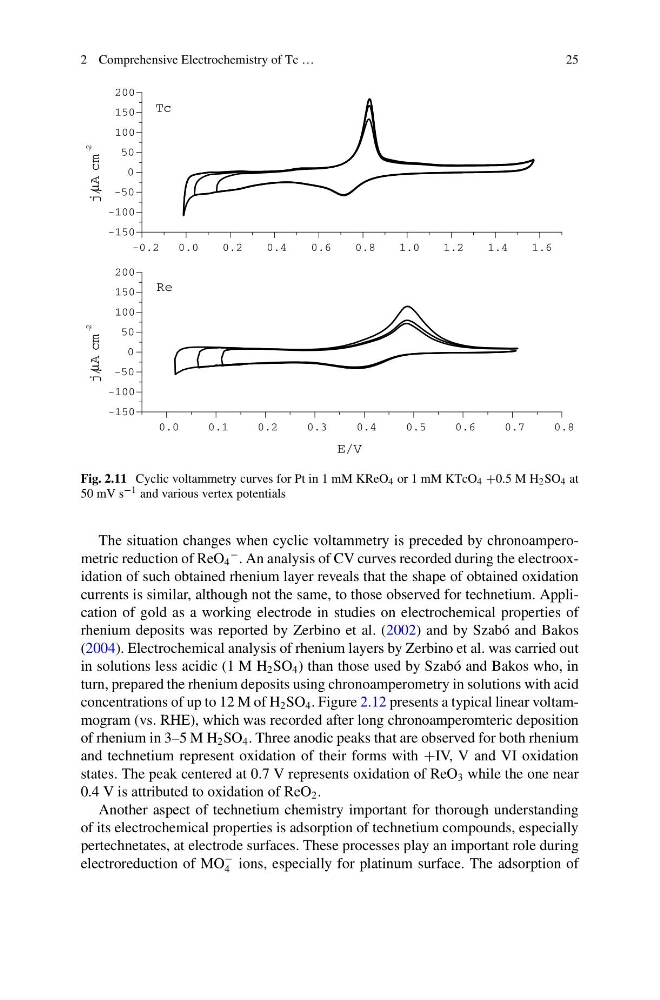
Fig. 2.11 Cyclic voltammetry curves for Pt in 1 mM KReO 4 or 1 mM KTcO 4 +0.5 M H 2 SO 4 at
50 mV s −1 and various vertex potentials
The situation changes when cyclic voltammetry is preceded by chronoamperometric reduction of ReO 4
− . An analysis of CV curves recorded during the electrooxidation of such obtained rhenium layer reveals that the shape of obtained oxidation
currents is similar, although not the same, to those observed for technetium. Application of gold as a working electrode in studies on electrochemical properties of
rhenium deposits was reported by Zerbino et al. (2002) and by Szabó and Bakos
(2004). Electrochemical analysis of rhenium layers by Zerbino et al. was carried out
in solutions less acidic (1 M H 2 SO 4 ) than those used by Szabó and Bakos who, in
turn, prepared the rhenium deposits using chronoamperometry in solutions with acid
concentrations of up to 12 M of H 2 SO 4 . Figure 2.12 presents a typical linear voltammogram (vs. RHE), which was recorded after long chronoamperomteric deposition
of rhenium in 3–5 M H 2 SO 4 . Three anodic peaks that are observed for both rhenium
and technetium represent oxidation of their forms with +IV, V and VI oxidation
states. The peak centered at 0.7 V represents oxidation of ReO 3 while the one near
0.4 V is attributed to oxidation of ReO 2 .
Another aspect of technetium chemistry important for thorough understanding
of its electrochemical properties is adsorption of technetium compounds, especially
pertechnetates, at electrode surfaces. These processes play an important role during
electroreduction of MO
−
4 ions, especially for platinum surface. The adsorption of
25
0.0
0.1
0.2
0.3
0.4
0.5
0.6
0.7
0.8
-150
-100
-50
0
50
100
150
200
Re
j/
µA cm
-2
E/V
-0.2
0.0
0.2
0.4
0.6
0.8
1.0
1.2
1.4
1.6
-150
-100
-50
0
50
100
150
200
j/
µA cm
-2
Tc
Fig. 2.11 Cyclic voltammetry curves for Pt in 1 mM KReO 4 or 1 mM KTcO 4 +0.5 M H 2 SO 4 at
50 mV s −1 and various vertex potentials
The situation changes when cyclic voltammetry is preceded by chronoamperometric reduction of ReO 4
− . An analysis of CV curves recorded during the electrooxidation of such obtained rhenium layer reveals that the shape of obtained oxidation
currents is similar, although not the same, to those observed for technetium. Application of gold as a working electrode in studies on electrochemical properties of
rhenium deposits was reported by Zerbino et al. (2002) and by Szabó and Bakos
(2004). Electrochemical analysis of rhenium layers by Zerbino et al. was carried out
in solutions less acidic (1 M H 2 SO 4 ) than those used by Szabó and Bakos who, in
turn, prepared the rhenium deposits using chronoamperometry in solutions with acid
concentrations of up to 12 M of H 2 SO 4 . Figure 2.12 presents a typical linear voltammogram (vs. RHE), which was recorded after long chronoamperomteric deposition
of rhenium in 3–5 M H 2 SO 4 . Three anodic peaks that are observed for both rhenium
and technetium represent oxidation of their forms with +IV, V and VI oxidation
states. The peak centered at 0.7 V represents oxidation of ReO 3 while the one near
0.4 V is attributed to oxidation of ReO 2 .
Another aspect of technetium chemistry important for thorough understanding
of its electrochemical properties is adsorption of technetium compounds, especially
pertechnetates, at electrode surfaces. These processes play an important role during
electroreduction of MO
−
4 ions, especially for platinum surface. The adsorption of