

26
2 Comprehensive Electrochemistry of Tc …
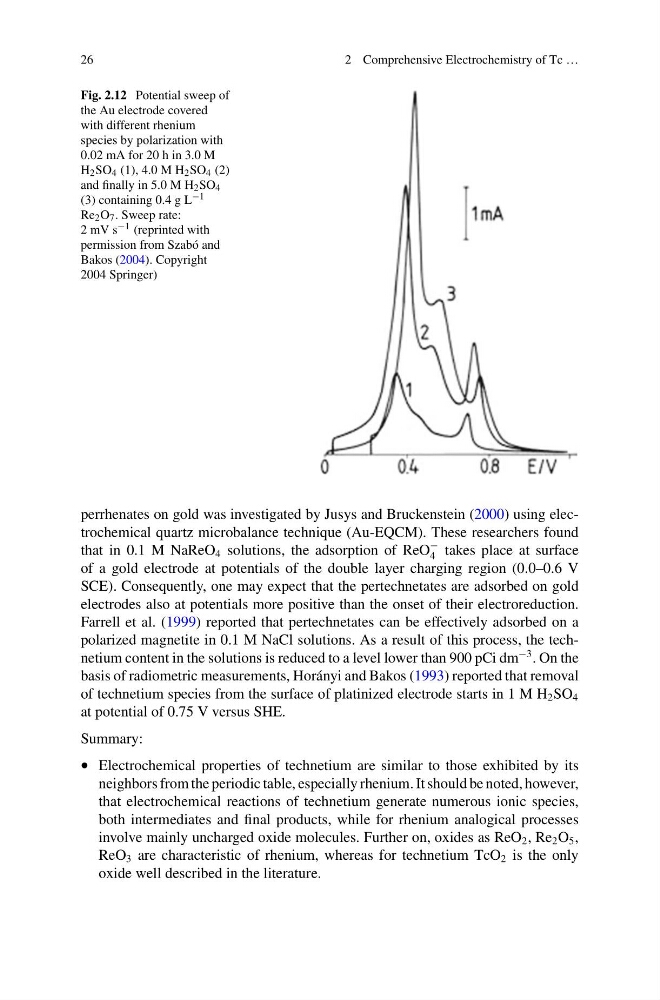
Fig. 2.12 Potential sweep of
the Au electrode covered
with different rhenium
species by polarization with
0.02 mA for 20 h in 3.0 M
H 2 SO 4 (1), 4.0 M H 2 SO 4 (2)
and finally in 5.0 M H 2 SO 4
(3) containing 0.4 g L −1
Re 2 O 7 . Sweep rate:
2 mV s −1 (reprinted with
permission from Szabó and
Bakos (2004). Copyright
2004 Springer)
perrhenates on gold was investigated by Jusys and Bruckenstein (2000) using electrochemical quartz microbalance technique (Au-EQCM). These researchers found
that in 0.1 M NaReO 4 solutions, the adsorption of ReO
−
4 takes place at surface
of a gold electrode at potentials of the double layer charging region (0.0–0.6 V
SCE). Consequently, one may expect that the pertechnetates are adsorbed on gold
electrodes also at potentials more positive than the onset of their electroreduction.
Farrell et al. (1999) reported that pertechnetates can be effectively adsorbed on a
polarized magnetite in 0.1 M NaCl solutions. As a result of this process, the technetium content in the solutions is reduced to a level lower than 900 pCi dm
−3 . On the
basis of radiometric measurements, Horányi and Bakos (1993) reported that removal
of technetium species from the surface of platinized electrode starts in 1 M H 2 SO 4
at potential of 0.75 V versus SHE.
Summary:
• Electrochemical properties of technetium are similar to those exhibited by its
neighbors from the periodic table, especially rhenium. It should be noted, however,
that electrochemical reactions of technetium generate numerous ionic species,
both intermediates and final products, while for rhenium analogical processes
involve mainly uncharged oxide molecules. Further on, oxides as ReO 2 , Re 2 O 5 ,
ReO 3 are characteristic of rhenium, whereas for technetium TcO 2 is the only
oxide well described in the literature.
2 Comprehensive Electrochemistry of Tc …
Fig. 2.12 Potential sweep of
the Au electrode covered
with different rhenium
species by polarization with
0.02 mA for 20 h in 3.0 M
H 2 SO 4 (1), 4.0 M H 2 SO 4 (2)
and finally in 5.0 M H 2 SO 4
(3) containing 0.4 g L −1
Re 2 O 7 . Sweep rate:
2 mV s −1 (reprinted with
permission from Szabó and
Bakos (2004). Copyright
2004 Springer)
perrhenates on gold was investigated by Jusys and Bruckenstein (2000) using electrochemical quartz microbalance technique (Au-EQCM). These researchers found
that in 0.1 M NaReO 4 solutions, the adsorption of ReO
−
4 takes place at surface
of a gold electrode at potentials of the double layer charging region (0.0–0.6 V
SCE). Consequently, one may expect that the pertechnetates are adsorbed on gold
electrodes also at potentials more positive than the onset of their electroreduction.
Farrell et al. (1999) reported that pertechnetates can be effectively adsorbed on a
polarized magnetite in 0.1 M NaCl solutions. As a result of this process, the technetium content in the solutions is reduced to a level lower than 900 pCi dm
−3 . On the
basis of radiometric measurements, Horányi and Bakos (1993) reported that removal
of technetium species from the surface of platinized electrode starts in 1 M H 2 SO 4
at potential of 0.75 V versus SHE.
Summary:
• Electrochemical properties of technetium are similar to those exhibited by its
neighbors from the periodic table, especially rhenium. It should be noted, however,
that electrochemical reactions of technetium generate numerous ionic species,
both intermediates and final products, while for rhenium analogical processes
involve mainly uncharged oxide molecules. Further on, oxides as ReO 2 , Re 2 O 5 ,
ReO 3 are characteristic of rhenium, whereas for technetium TcO 2 is the only
oxide well described in the literature.