

24
2 Comprehensive Electrochemistry of Tc …
0.0
0.2
0.4
0.6
0.8
1.0
1.2
1.4
1.6
1.8
-400
-200
0
200
j /
µA cm
-2
E/V
R e
Tc
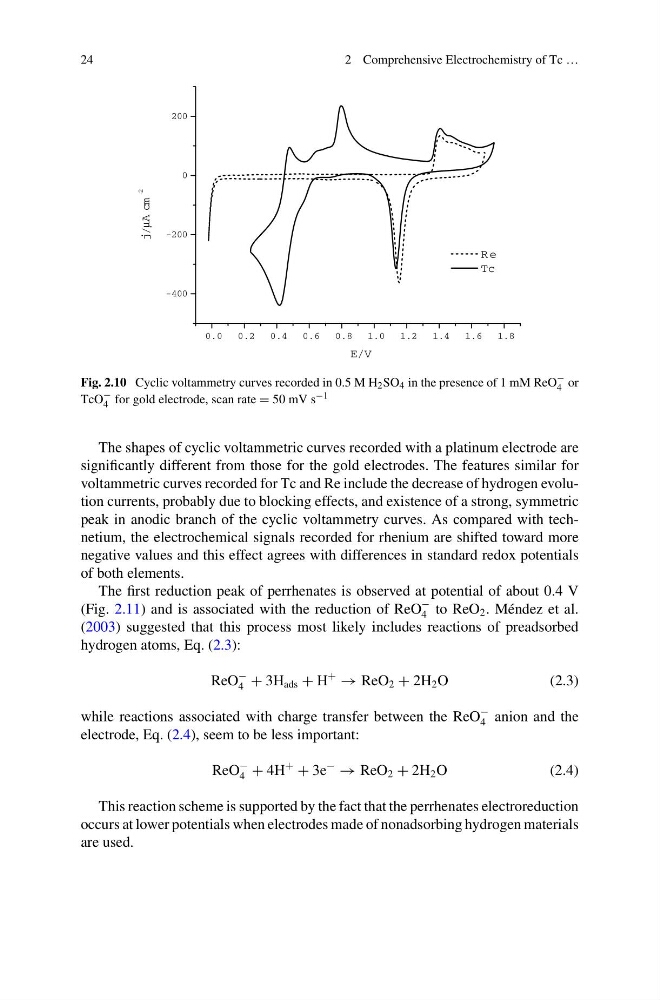
Fig. 2.10 Cyclic voltammetry curves recorded in 0.5 M H 2 SO 4 in the presence of 1 mM ReO
−
4 or
TcO
−
4 for gold electrode, scan rate = 50 mV s −1
The shapes of cyclic voltammetric curves recorded with a platinum electrode are
significantly different from those for the gold electrodes. The features similar for
voltammetric curves recorded for Tc and Re include the decrease of hydrogen evolution currents, probably due to blocking effects, and existence of a strong, symmetric
peak in anodic branch of the cyclic voltammetry curves. As compared with technetium, the electrochemical signals recorded for rhenium are shifted toward more
negative values and this effect agrees with differences in standard redox potentials
of both elements.
The first reduction peak of perrhenates is observed at potential of about 0.4 V
(Fig. 2.11) and is associated with the reduction of ReO
−
4 to ReO 2 . Méndez et al.
(2003) suggested that this process most likely includes reactions of preadsorbed
hydrogen atoms, Eq. (2.3):
ReO
−
4 + 3H ads + H
+
→ ReO 2 + 2H 2 O
(2.3)
while reactions associated with charge transfer between the ReO
−
4 anion and the
electrode, Eq. (2.4), seem to be less important:
ReO
−
4 + 4H
+
+ 3e
−
→ ReO 2 + 2H 2 O
( 2 . 4 )
This reaction scheme is supported by the fact that the perrhenates electroreduction
occurs at lower potentials when electrodes made of nonadsorbing hydrogen materials
are used.
2 Comprehensive Electrochemistry of Tc …
0.0
0.2
0.4
0.6
0.8
1.0
1.2
1.4
1.6
1.8
-400
-200
0
200
j /
µA cm
-2
E/V
R e
Tc
Fig. 2.10 Cyclic voltammetry curves recorded in 0.5 M H 2 SO 4 in the presence of 1 mM ReO
−
4 or
TcO
−
4 for gold electrode, scan rate = 50 mV s −1
The shapes of cyclic voltammetric curves recorded with a platinum electrode are
significantly different from those for the gold electrodes. The features similar for
voltammetric curves recorded for Tc and Re include the decrease of hydrogen evolution currents, probably due to blocking effects, and existence of a strong, symmetric
peak in anodic branch of the cyclic voltammetry curves. As compared with technetium, the electrochemical signals recorded for rhenium are shifted toward more
negative values and this effect agrees with differences in standard redox potentials
of both elements.
The first reduction peak of perrhenates is observed at potential of about 0.4 V
(Fig. 2.11) and is associated with the reduction of ReO
−
4 to ReO 2 . Méndez et al.
(2003) suggested that this process most likely includes reactions of preadsorbed
hydrogen atoms, Eq. (2.3):
ReO
−
4 + 3H ads + H
+
→ ReO 2 + 2H 2 O
(2.3)
while reactions associated with charge transfer between the ReO
−
4 anion and the
electrode, Eq. (2.4), seem to be less important:
ReO
−
4 + 4H
+
+ 3e
−
→ ReO 2 + 2H 2 O
( 2 . 4 )
This reaction scheme is supported by the fact that the perrhenates electroreduction
occurs at lower potentials when electrodes made of nonadsorbing hydrogen materials
are used.