

6.1 Acidic and Neutral Solutions
149
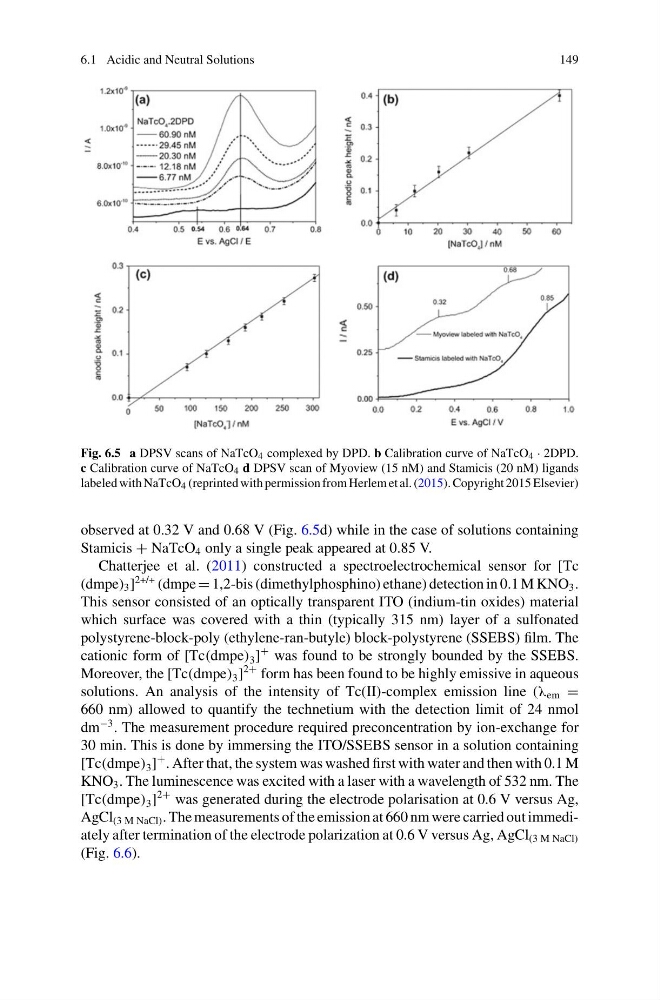
Fig. 6.5 a DPSV scans of NaTcO 4 complexed by DPD. b Calibration curve of NaTcO 4 · 2DPD.
c Calibration curve of NaTcO 4 d DPSV scan of Myoview (15 nM) and Stamicis (20 nM) ligands
labeled with NaTcO 4 (reprinted with permission from Herlem et al. (2015). Copyright 2015 Elsevier)
observed at 0.32 V and 0.68 V (Fig. 6.5d) while in the case of solutions containing
Stamicis + NaTcO 4 only a single peak appeared at 0.85 V.
Chatterjee et al. (2011) constructed a spectroelectrochemical sensor for [Tc
(dmpe) 3 ]
2+/+ (dmpe = 1,2-bis (dimethylphosphino) ethane) detection in 0.1 M KNO 3 .
This sensor consisted of an optically transparent ITO (indium-tin oxides) material
which surface was covered with a thin (typically 315 nm) layer of a sulfonated
polystyrene-block-poly (ethylene-ran-butyle) block-polystyrene (SSEBS) film. The
cationic form of [Tc(dmpe) 3 ]
+ was found to be strongly bounded by the SSEBS.
Moreover, the [Tc(dmpe) 3 ]
2+ form has been found to be highly emissive in aqueous
solutions. An analysis of the intensity of Tc(II)-complex emission line (λ em =
660 nm) allowed to quantify the technetium with the detection limit of 24 nmol
dm
−3 . The measurement procedure required preconcentration by ion-exchange for
30 min. This is done by immersing the ITO/SSEBS sensor in a solution containing
[Tc(dmpe) 3 ]
+ . After that, the system was washed first with water and then with 0.1 M
KNO 3 . The luminescence was excited with a laser with a wavelength of 532 nm. The
[Tc(dmpe) 3 ]
2+ was generated during the electrode polarisation at 0.6 V versus Ag,
AgCl (3 M NaCl) . The measurements of the emission at 660 nm were carried out immediately after termination of the electrode polarization at 0.6 V versus Ag, AgCl (3 M NaCl)
(Fig. 6.6).
149
Fig. 6.5 a DPSV scans of NaTcO 4 complexed by DPD. b Calibration curve of NaTcO 4 · 2DPD.
c Calibration curve of NaTcO 4 d DPSV scan of Myoview (15 nM) and Stamicis (20 nM) ligands
labeled with NaTcO 4 (reprinted with permission from Herlem et al. (2015). Copyright 2015 Elsevier)
observed at 0.32 V and 0.68 V (Fig. 6.5d) while in the case of solutions containing
Stamicis + NaTcO 4 only a single peak appeared at 0.85 V.
Chatterjee et al. (2011) constructed a spectroelectrochemical sensor for [Tc
(dmpe) 3 ]
2+/+ (dmpe = 1,2-bis (dimethylphosphino) ethane) detection in 0.1 M KNO 3 .
This sensor consisted of an optically transparent ITO (indium-tin oxides) material
which surface was covered with a thin (typically 315 nm) layer of a sulfonated
polystyrene-block-poly (ethylene-ran-butyle) block-polystyrene (SSEBS) film. The
cationic form of [Tc(dmpe) 3 ]
+ was found to be strongly bounded by the SSEBS.
Moreover, the [Tc(dmpe) 3 ]
2+ form has been found to be highly emissive in aqueous
solutions. An analysis of the intensity of Tc(II)-complex emission line (λ em =
660 nm) allowed to quantify the technetium with the detection limit of 24 nmol
dm
−3 . The measurement procedure required preconcentration by ion-exchange for
30 min. This is done by immersing the ITO/SSEBS sensor in a solution containing
[Tc(dmpe) 3 ]
+ . After that, the system was washed first with water and then with 0.1 M
KNO 3 . The luminescence was excited with a laser with a wavelength of 532 nm. The
[Tc(dmpe) 3 ]
2+ was generated during the electrode polarisation at 0.6 V versus Ag,
AgCl (3 M NaCl) . The measurements of the emission at 660 nm were carried out immediately after termination of the electrode polarization at 0.6 V versus Ag, AgCl (3 M NaCl)
(Fig. 6.6).