

148
6 Determination of Trace Amounts of Tc by Electrochemical Methods
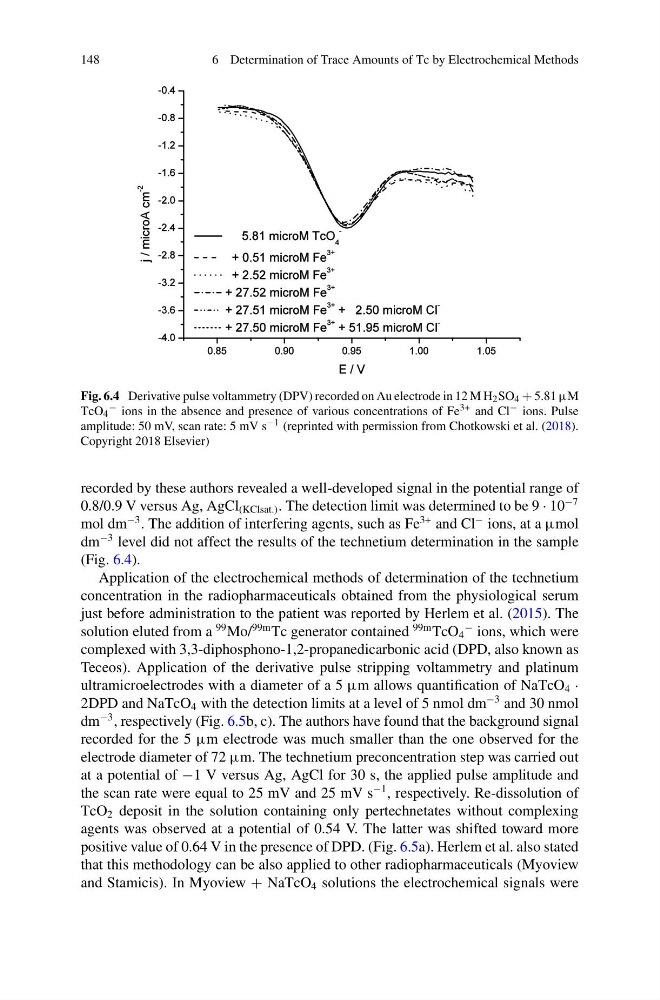
Fig. 6.4 Derivative pulse voltammetry (DPV) recorded on Au electrode in 12 M H 2 SO 4 + 5.81 μM
TcO 4
− ions in the absence and presence of various concentrations of Fe 3+ and Cl − ions. Pulse
amplitude: 50 mV, scan rate: 5 mV s −1 (reprinted with permission from Chotkowski et al. (2018).
Copyright 2018 Elsevier)
recorded by these authors revealed a well-developed signal in the potential range of
0.8/0.9 V versus Ag, AgCl (KClsat.) . The detection limit was determined to be 9 · 10
−7
mol dm
−3 . The addition of interfering agents, such as Fe
3+ and Cl
− ions, at a μmol
dm
−3 level did not affect the results of the technetium determination in the sample
(Fig. 6.4).
Application of the electrochemical methods of determination of the technetium
concentration in the radiopharmaceuticals obtained from the physiological serum
just before administration to the patient was reported by Herlem et al. (2015). The
solution eluted from a
99 Mo/
99m Tc generator contained
99m TcO 4
− ions, which were
complexed with 3,3-diphosphono-1,2-propanedicarbonic acid (DPD, also known as
Teceos). Application of the derivative pulse stripping voltammetry and platinum
ultramicroelectrodes with a diameter of a 5 μm allows quantification of NaTcO 4 ·
2DPD and NaTcO 4 with the detection limits at a level of 5 nmol dm
−3 and 30 nmol
dm
−3 , respectively (Fig. 6.5b, c). The authors have found that the background signal
recorded for the 5 μm electrode was much smaller than the one observed for the
electrode diameter of 72 μm. The technetium preconcentration step was carried out
at a potential of −1 V versus Ag, AgCl for 30 s, the applied pulse amplitude and
the scan rate were equal to 25 mV and 25 mV s
−1 , respectively. Re-dissolution of
TcO 2 deposit in the solution containing only pertechnetates without complexing
agents was observed at a potential of 0.54 V. The latter was shifted toward more
positive value of 0.64 V in the presence of DPD. (Fig. 6.5a). Herlem et al. also stated
that this methodology can be also applied to other radiopharmaceuticals (Myoview
and Stamicis). In Myoview + NaTcO 4 solutions the electrochemical signals were
6 Determination of Trace Amounts of Tc by Electrochemical Methods
Fig. 6.4 Derivative pulse voltammetry (DPV) recorded on Au electrode in 12 M H 2 SO 4 + 5.81 μM
TcO 4
− ions in the absence and presence of various concentrations of Fe 3+ and Cl − ions. Pulse
amplitude: 50 mV, scan rate: 5 mV s −1 (reprinted with permission from Chotkowski et al. (2018).
Copyright 2018 Elsevier)
recorded by these authors revealed a well-developed signal in the potential range of
0.8/0.9 V versus Ag, AgCl (KClsat.) . The detection limit was determined to be 9 · 10
−7
mol dm
−3 . The addition of interfering agents, such as Fe
3+ and Cl
− ions, at a μmol
dm
−3 level did not affect the results of the technetium determination in the sample
(Fig. 6.4).
Application of the electrochemical methods of determination of the technetium
concentration in the radiopharmaceuticals obtained from the physiological serum
just before administration to the patient was reported by Herlem et al. (2015). The
solution eluted from a
99 Mo/
99m Tc generator contained
99m TcO 4
− ions, which were
complexed with 3,3-diphosphono-1,2-propanedicarbonic acid (DPD, also known as
Teceos). Application of the derivative pulse stripping voltammetry and platinum
ultramicroelectrodes with a diameter of a 5 μm allows quantification of NaTcO 4 ·
2DPD and NaTcO 4 with the detection limits at a level of 5 nmol dm
−3 and 30 nmol
dm
−3 , respectively (Fig. 6.5b, c). The authors have found that the background signal
recorded for the 5 μm electrode was much smaller than the one observed for the
electrode diameter of 72 μm. The technetium preconcentration step was carried out
at a potential of −1 V versus Ag, AgCl for 30 s, the applied pulse amplitude and
the scan rate were equal to 25 mV and 25 mV s
−1 , respectively. Re-dissolution of
TcO 2 deposit in the solution containing only pertechnetates without complexing
agents was observed at a potential of 0.54 V. The latter was shifted toward more
positive value of 0.64 V in the presence of DPD. (Fig. 6.5a). Herlem et al. also stated
that this methodology can be also applied to other radiopharmaceuticals (Myoview
and Stamicis). In Myoview + NaTcO 4 solutions the electrochemical signals were