

6.1 Acidic and Neutral Solutions
147
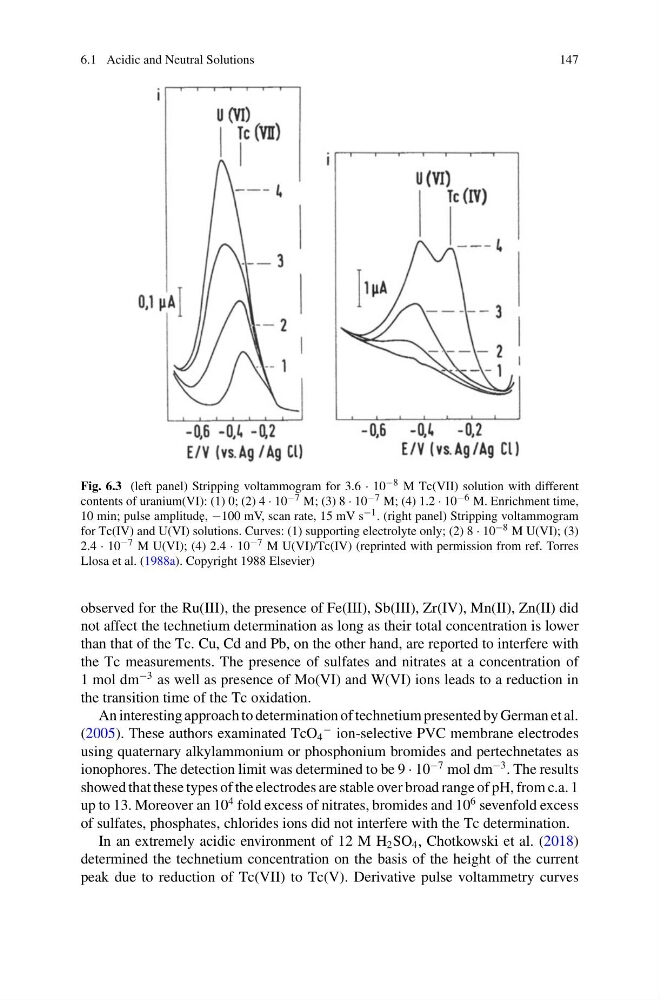
Fig. 6.3 (left panel) Stripping voltammogram for 3.6 · 10 −8 M Tc(VII) solution with different
contents of uranium(VI): (1) 0; (2) 4 · 10 −7 M; (3) 8 · 10 −7 M; (4) 1.2 · 10 −6 M. Enrichment time,
10 min; pulse amplitud˛ e, −100 mV, scan rate, 15 mV s −1 . (right panel) Stripping voltammogram
for Tc(IV) and U(VI) solutions. Curves: (1) supporting electrolyte only; (2) 8 · 10 −8 M U(VI); (3)
2.4 · 10 −7 M U(VI); (4) 2.4 · 10 −7 M U(VI)/Tc(IV) (reprinted with permission from ref. Torres
Llosa et al. (1988a). Copyright 1988 Elsevier)
observed for the Ru(III), the presence of Fe(III), Sb(III), Zr(IV), Mn(II), Zn(II) did
not affect the technetium determination as long as their total concentration is lower
than that of the Tc. Cu, Cd and Pb, on the other hand, are reported to interfere with
the Tc measurements. The presence of sulfates and nitrates at a concentration of
1 mol dm
−3 as well as presence of Mo(VI) and W(VI) ions leads to a reduction in
the transition time of the Tc oxidation.
An interesting approach to determination of technetium presented by German et al.
(2005). These authors examinated TcO 4
− ion-selective PVC membrane electrodes
using quaternary alkylammonium or phosphonium bromides and pertechnetates as
ionophores. The detection limit was determined to be 9 · 10
−7 mol dm
−3 . The results
showed that these types of the electrodes are stable over broad range of pH, from c.a. 1
up to 13. Moreover an 10
4 fold excess of nitrates, bromides and 10
6 sevenfold excess
of sulfates, phosphates, chlorides ions did not interfere with the Tc determination.
In an extremely acidic environment of 12 M H 2 SO 4 , Chotkowski et al. (2018)
determined the technetium concentration on the basis of the height of the current
peak due to reduction of Tc(VII) to Tc(V). Derivative pulse voltammetry curves
147
Fig. 6.3 (left panel) Stripping voltammogram for 3.6 · 10 −8 M Tc(VII) solution with different
contents of uranium(VI): (1) 0; (2) 4 · 10 −7 M; (3) 8 · 10 −7 M; (4) 1.2 · 10 −6 M. Enrichment time,
10 min; pulse amplitud˛ e, −100 mV, scan rate, 15 mV s −1 . (right panel) Stripping voltammogram
for Tc(IV) and U(VI) solutions. Curves: (1) supporting electrolyte only; (2) 8 · 10 −8 M U(VI); (3)
2.4 · 10 −7 M U(VI); (4) 2.4 · 10 −7 M U(VI)/Tc(IV) (reprinted with permission from ref. Torres
Llosa et al. (1988a). Copyright 1988 Elsevier)
observed for the Ru(III), the presence of Fe(III), Sb(III), Zr(IV), Mn(II), Zn(II) did
not affect the technetium determination as long as their total concentration is lower
than that of the Tc. Cu, Cd and Pb, on the other hand, are reported to interfere with
the Tc measurements. The presence of sulfates and nitrates at a concentration of
1 mol dm
−3 as well as presence of Mo(VI) and W(VI) ions leads to a reduction in
the transition time of the Tc oxidation.
An interesting approach to determination of technetium presented by German et al.
(2005). These authors examinated TcO 4
− ion-selective PVC membrane electrodes
using quaternary alkylammonium or phosphonium bromides and pertechnetates as
ionophores. The detection limit was determined to be 9 · 10
−7 mol dm
−3 . The results
showed that these types of the electrodes are stable over broad range of pH, from c.a. 1
up to 13. Moreover an 10
4 fold excess of nitrates, bromides and 10
6 sevenfold excess
of sulfates, phosphates, chlorides ions did not interfere with the Tc determination.
In an extremely acidic environment of 12 M H 2 SO 4 , Chotkowski et al. (2018)
determined the technetium concentration on the basis of the height of the current
peak due to reduction of Tc(VII) to Tc(V). Derivative pulse voltammetry curves