

146
6 Determination of Trace Amounts of Tc by Electrochemical Methods
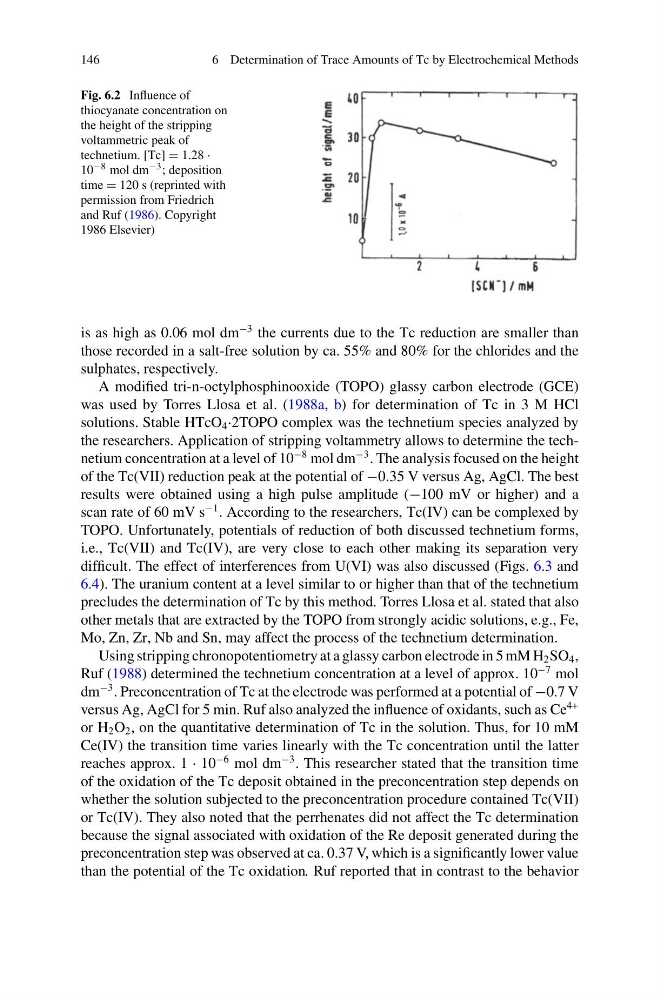
Fig. 6.2 Influence of
thiocyanate concentration on
the height of the stripping
voltammetric peak of
technetium. [Tc] = 1.28 ·
10 −8 mol dm −3 ; deposition
time = 120 s (reprinted with
permission from Friedrich
and Ruf (1986). Copyright
1986 Elsevier)
is as high as 0.06 mol dm
−3 the currents due to the Tc reduction are smaller than
those recorded in a salt-free solution by ca. 55% and 80% for the chlorides and the
sulphates, respectively.
A modified tri-n-octylphosphinooxide (TOPO) glassy carbon electrode (GCE)
was used by Torres Llosa et al. (1988a, b) for determination of Tc in 3 M HCl
solutions. Stable HTcO 4 ·2TOPO complex was the technetium species analyzed by
the researchers. Application of stripping voltammetry allows to determine the technetium concentration at a level of 10
−8 mol dm
−3 . The analysis focused on the height
of the Tc(VII) reduction peak at the potential of −0.35 V versus Ag, AgCl. The best
results were obtained using a high pulse amplitude (−100 mV or higher) and a
scan rate of 60 mV s
−1 . According to the researchers, Tc(IV) can be complexed by
TOPO. Unfortunately, potentials of reduction of both discussed technetium forms,
i.e., Tc(VII) and Tc(IV), are very close to each other making its separation very
difficult. The effect of interferences from U(VI) was also discussed (Figs. 6.3 and
6.4). The uranium content at a level similar to or higher than that of the technetium
precludes the determination of Tc by this method. Torres Llosa et al. stated that also
other metals that are extracted by the TOPO from strongly acidic solutions, e.g., Fe,
Mo, Zn, Zr, Nb and Sn, may affect the process of the technetium determination.
Using stripping chronopotentiometry at a glassy carbon electrode in 5 mM H 2 SO 4 ,
Ruf (1988) determined the technetium concentration at a level of approx. 10
−7 mol
dm
−3 . Preconcentration of Tc at the electrode was performed at a potential of −0.7 V
versus Ag, AgCl for 5 min. Ruf also analyzed the influence of oxidants, such as Ce
4+
or H 2 O 2 , on the quantitative determination of Tc in the solution. Thus, for 10 mM
Ce(IV) the transition time varies linearly with the Tc concentration until the latter
reaches approx. 1 · 10
−6 mol dm
−3 . This researcher stated that the transition time
of the oxidation of the Tc deposit obtained in the preconcentration step depends on
whether the solution subjected to the preconcentration procedure contained Tc(VII)
or Tc(IV). They also noted that the perrhenates did not affect the Tc determination
because the signal associated with oxidation of the Re deposit generated during the
preconcentration step was observed at ca. 0.37 V, which is a significantly lower value
than the potential of the Tc oxidation. Ruf reported that in contrast to the behavior
6 Determination of Trace Amounts of Tc by Electrochemical Methods
Fig. 6.2 Influence of
thiocyanate concentration on
the height of the stripping
voltammetric peak of
technetium. [Tc] = 1.28 ·
10 −8 mol dm −3 ; deposition
time = 120 s (reprinted with
permission from Friedrich
and Ruf (1986). Copyright
1986 Elsevier)
is as high as 0.06 mol dm
−3 the currents due to the Tc reduction are smaller than
those recorded in a salt-free solution by ca. 55% and 80% for the chlorides and the
sulphates, respectively.
A modified tri-n-octylphosphinooxide (TOPO) glassy carbon electrode (GCE)
was used by Torres Llosa et al. (1988a, b) for determination of Tc in 3 M HCl
solutions. Stable HTcO 4 ·2TOPO complex was the technetium species analyzed by
the researchers. Application of stripping voltammetry allows to determine the technetium concentration at a level of 10
−8 mol dm
−3 . The analysis focused on the height
of the Tc(VII) reduction peak at the potential of −0.35 V versus Ag, AgCl. The best
results were obtained using a high pulse amplitude (−100 mV or higher) and a
scan rate of 60 mV s
−1 . According to the researchers, Tc(IV) can be complexed by
TOPO. Unfortunately, potentials of reduction of both discussed technetium forms,
i.e., Tc(VII) and Tc(IV), are very close to each other making its separation very
difficult. The effect of interferences from U(VI) was also discussed (Figs. 6.3 and
6.4). The uranium content at a level similar to or higher than that of the technetium
precludes the determination of Tc by this method. Torres Llosa et al. stated that also
other metals that are extracted by the TOPO from strongly acidic solutions, e.g., Fe,
Mo, Zn, Zr, Nb and Sn, may affect the process of the technetium determination.
Using stripping chronopotentiometry at a glassy carbon electrode in 5 mM H 2 SO 4 ,
Ruf (1988) determined the technetium concentration at a level of approx. 10
−7 mol
dm
−3 . Preconcentration of Tc at the electrode was performed at a potential of −0.7 V
versus Ag, AgCl for 5 min. Ruf also analyzed the influence of oxidants, such as Ce
4+
or H 2 O 2 , on the quantitative determination of Tc in the solution. Thus, for 10 mM
Ce(IV) the transition time varies linearly with the Tc concentration until the latter
reaches approx. 1 · 10
−6 mol dm
−3 . This researcher stated that the transition time
of the oxidation of the Tc deposit obtained in the preconcentration step depends on
whether the solution subjected to the preconcentration procedure contained Tc(VII)
or Tc(IV). They also noted that the perrhenates did not affect the Tc determination
because the signal associated with oxidation of the Re deposit generated during the
preconcentration step was observed at ca. 0.37 V, which is a significantly lower value
than the potential of the Tc oxidation. Ruf reported that in contrast to the behavior