

5 Metallic Technetium, Corrosion, Technetium Alloys …
135
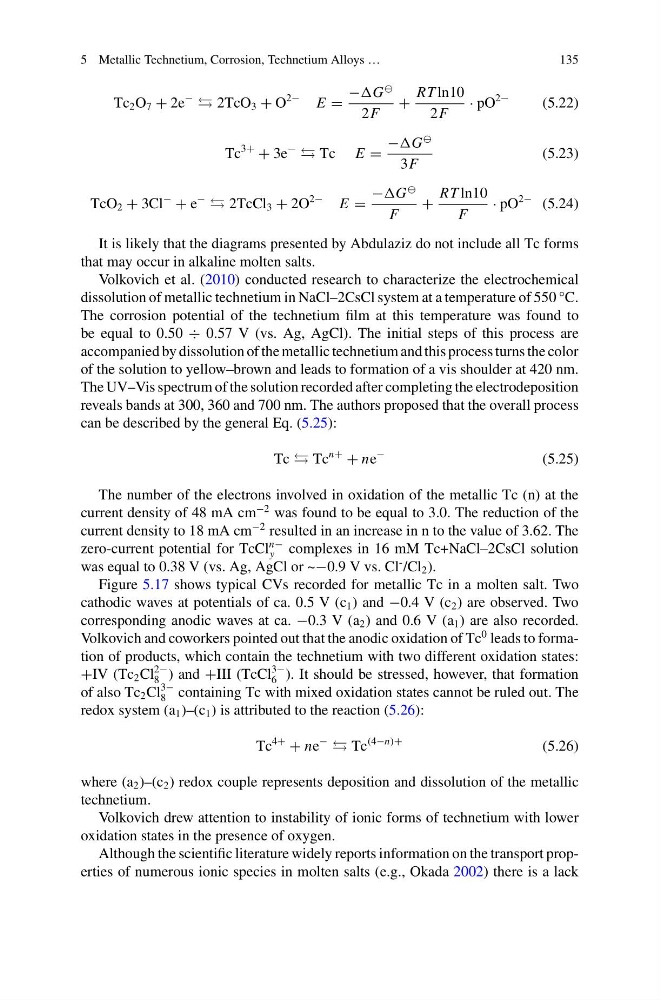
Tc 2 O 7 + 2e
−
2TcO 3 + O
2−
E =
−G
2F
+
RT ln10
2F
· pO
2−
(5.22)
Tc
3+
+ 3e
−
Tc E =
−G
3F
(5.23)
TcO 2 + 3Cl
−
+ e
−
2TcCl 3 + 2O
2−
E =
−G
F
+
RT ln10
F
· pO
2− (5.24)
It is likely that the diagrams presented by Abdulaziz do not include all Tc forms
that may occur in alkaline molten salts.
Volkovich et al. (2010) conducted research to characterize the electrochemical
dissolution of metallic technetium in NaCl–2CsCl system at a temperature of 550 °C.
The corrosion potential of the technetium film at this temperature was found to
be equal to 0.50 ÷ 0.57 V (vs. Ag, AgCl). The initial steps of this process are
accompanied by dissolution of the metallic technetium and this process turns the color
of the solution to yellow–brown and leads to formation of a vis shoulder at 420 nm.
The UV–Vis spectrum of the solution recorded after completing the electrodeposition
reveals bands at 300, 360 and 700 nm. The authors proposed that the overall process
can be described by the general Eq. (5.25):
Tc Tc
n+
+ ne
−
(5.25)
The number of the electrons involved in oxidation of the metallic Tc (n) at the
current density of 48 mA cm
−2 was found to be equal to 3.0. The reduction of the
current density to 18 mA cm
−2 resulted in an increase in n to the value of 3.62. The
zero-current potential for TcCl
n−
y complexes in 16 mM Tc+NaCl–2CsCl solution
was equal to 0.38 V (vs. Ag, AgCl or ~−0.9 V vs. Cl
- /Cl 2 ).
Figure 5.17 shows typical CVs recorded for metallic Tc in a molten salt. Two
cathodic waves at potentials of ca. 0.5 V (c 1 ) and −0.4 V (c 2 ) are observed. Two
corresponding anodic waves at ca. −0.3 V (a 2 ) and 0.6 V (a 1 ) are also recorded.
Volkovich and coworkers pointed out that the anodic oxidation of Tc
0 leads to formation of products, which contain the technetium with two different oxidation states:
+IV (Tc 2 Cl
2−
8 ) and +III (TcCl
3−
6 ). It should be stressed, however, that formation
of also Tc 2 Cl
3−
8 containing Tc with mixed oxidation states cannot be ruled out. The
redox system (a 1 )–(c 1 ) is attributed to the reaction (5.26):
Tc
4+
+ ne
−
Tc
(4−n)+
(5.26)
where (a 2 )–(c 2 ) redox couple represents deposition and dissolution of the metallic
technetium.
Volkovich drew attention to instability of ionic forms of technetium with lower
oxidation states in the presence of oxygen.
Although the scientific literature widely reports information on the transport properties of numerous ionic species in molten salts (e.g., Okada 2002) there is a lack
135
Tc 2 O 7 + 2e
−
2TcO 3 + O
2−
E =
−G
2F
+
RT ln10
2F
· pO
2−
(5.22)
Tc
3+
+ 3e
−
Tc E =
−G
3F
(5.23)
TcO 2 + 3Cl
−
+ e
−
2TcCl 3 + 2O
2−
E =
−G
F
+
RT ln10
F
· pO
2− (5.24)
It is likely that the diagrams presented by Abdulaziz do not include all Tc forms
that may occur in alkaline molten salts.
Volkovich et al. (2010) conducted research to characterize the electrochemical
dissolution of metallic technetium in NaCl–2CsCl system at a temperature of 550 °C.
The corrosion potential of the technetium film at this temperature was found to
be equal to 0.50 ÷ 0.57 V (vs. Ag, AgCl). The initial steps of this process are
accompanied by dissolution of the metallic technetium and this process turns the color
of the solution to yellow–brown and leads to formation of a vis shoulder at 420 nm.
The UV–Vis spectrum of the solution recorded after completing the electrodeposition
reveals bands at 300, 360 and 700 nm. The authors proposed that the overall process
can be described by the general Eq. (5.25):
Tc Tc
n+
+ ne
−
(5.25)
The number of the electrons involved in oxidation of the metallic Tc (n) at the
current density of 48 mA cm
−2 was found to be equal to 3.0. The reduction of the
current density to 18 mA cm
−2 resulted in an increase in n to the value of 3.62. The
zero-current potential for TcCl
n−
y complexes in 16 mM Tc+NaCl–2CsCl solution
was equal to 0.38 V (vs. Ag, AgCl or ~−0.9 V vs. Cl
- /Cl 2 ).
Figure 5.17 shows typical CVs recorded for metallic Tc in a molten salt. Two
cathodic waves at potentials of ca. 0.5 V (c 1 ) and −0.4 V (c 2 ) are observed. Two
corresponding anodic waves at ca. −0.3 V (a 2 ) and 0.6 V (a 1 ) are also recorded.
Volkovich and coworkers pointed out that the anodic oxidation of Tc
0 leads to formation of products, which contain the technetium with two different oxidation states:
+IV (Tc 2 Cl
2−
8 ) and +III (TcCl
3−
6 ). It should be stressed, however, that formation
of also Tc 2 Cl
3−
8 containing Tc with mixed oxidation states cannot be ruled out. The
redox system (a 1 )–(c 1 ) is attributed to the reaction (5.26):
Tc
4+
+ ne
−
Tc
(4−n)+
(5.26)
where (a 2 )–(c 2 ) redox couple represents deposition and dissolution of the metallic
technetium.
Volkovich drew attention to instability of ionic forms of technetium with lower
oxidation states in the presence of oxygen.
Although the scientific literature widely reports information on the transport properties of numerous ionic species in molten salts (e.g., Okada 2002) there is a lack