

136
5 Metallic Technetium, Corrosion, Technetium Alloys …
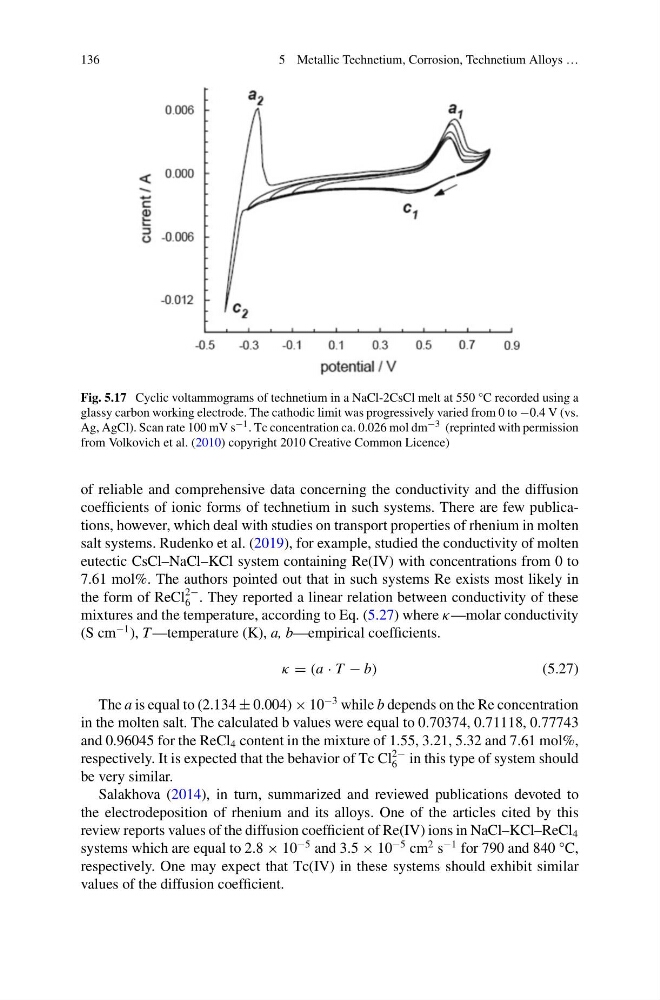
Fig. 5.17 Cyclic voltammograms of technetium in a NaCl-2CsCl melt at 550 °C recorded using a
glassy carbon working electrode. The cathodic limit was progressively varied from 0 to −0.4 V (vs.
Ag, AgCl). Scan rate 100 mV s −1 . Tc concentration ca. 0.026 mol dm −3 (reprinted with permission
from Volkovich et al. (2010) copyright 2010 Creative Common Licence)
of reliable and comprehensive data concerning the conductivity and the diffusion
coefficients of ionic forms of technetium in such systems. There are few publications, however, which deal with studies on transport properties of rhenium in molten
salt systems. Rudenko et al. (2019), for example, studied the conductivity of molten
eutectic CsCl–NaCl–KCl system containing Re(IV) with concentrations from 0 to
7.61 mol%. The authors pointed out that in such systems Re exists most likely in
the form of ReCl
2−
6 . They reported a linear relation between conductivity of these
mixtures and the temperature, according to Eq. (5.27) where κ—molar conductivity
(S cm
−1 ), T —temperature (K), a, b—empirical coefficients.
κ = (a · T − b)
(5.27)
The a is equal to (2.134 ± 0.004) × 10
−3 while b depends on the Re concentration
in the molten salt. The calculated b values were equal to 0.70374, 0.71118, 0.77743
and 0.96045 for the ReCl 4 content in the mixture of 1.55, 3.21, 5.32 and 7.61 mol%,
respectively. It is expected that the behavior of Tc Cl
2−
6 in this type of system should
be very similar.
Salakhova (2014), in turn, summarized and reviewed publications devoted to
the electrodeposition of rhenium and its alloys. One of the articles cited by this
review reports values of the diffusion coefficient of Re(IV) ions in NaCl–KCl–ReCl 4
systems which are equal to 2.8 × 10
−5 and 3.5 × 10
−5 cm
2 s
−1 for 790 and 840 °C,
respectively. One may expect that Tc(IV) in these systems should exhibit similar
values of the diffusion coefficient.
5 Metallic Technetium, Corrosion, Technetium Alloys …
Fig. 5.17 Cyclic voltammograms of technetium in a NaCl-2CsCl melt at 550 °C recorded using a
glassy carbon working electrode. The cathodic limit was progressively varied from 0 to −0.4 V (vs.
Ag, AgCl). Scan rate 100 mV s −1 . Tc concentration ca. 0.026 mol dm −3 (reprinted with permission
from Volkovich et al. (2010) copyright 2010 Creative Common Licence)
of reliable and comprehensive data concerning the conductivity and the diffusion
coefficients of ionic forms of technetium in such systems. There are few publications, however, which deal with studies on transport properties of rhenium in molten
salt systems. Rudenko et al. (2019), for example, studied the conductivity of molten
eutectic CsCl–NaCl–KCl system containing Re(IV) with concentrations from 0 to
7.61 mol%. The authors pointed out that in such systems Re exists most likely in
the form of ReCl
2−
6 . They reported a linear relation between conductivity of these
mixtures and the temperature, according to Eq. (5.27) where κ—molar conductivity
(S cm
−1 ), T —temperature (K), a, b—empirical coefficients.
κ = (a · T − b)
(5.27)
The a is equal to (2.134 ± 0.004) × 10
−3 while b depends on the Re concentration
in the molten salt. The calculated b values were equal to 0.70374, 0.71118, 0.77743
and 0.96045 for the ReCl 4 content in the mixture of 1.55, 3.21, 5.32 and 7.61 mol%,
respectively. It is expected that the behavior of Tc Cl
2−
6 in this type of system should
be very similar.
Salakhova (2014), in turn, summarized and reviewed publications devoted to
the electrodeposition of rhenium and its alloys. One of the articles cited by this
review reports values of the diffusion coefficient of Re(IV) ions in NaCl–KCl–ReCl 4
systems which are equal to 2.8 × 10
−5 and 3.5 × 10
−5 cm
2 s
−1 for 790 and 840 °C,
respectively. One may expect that Tc(IV) in these systems should exhibit similar
values of the diffusion coefficient.