

134
5 Metallic Technetium, Corrosion, Technetium Alloys …
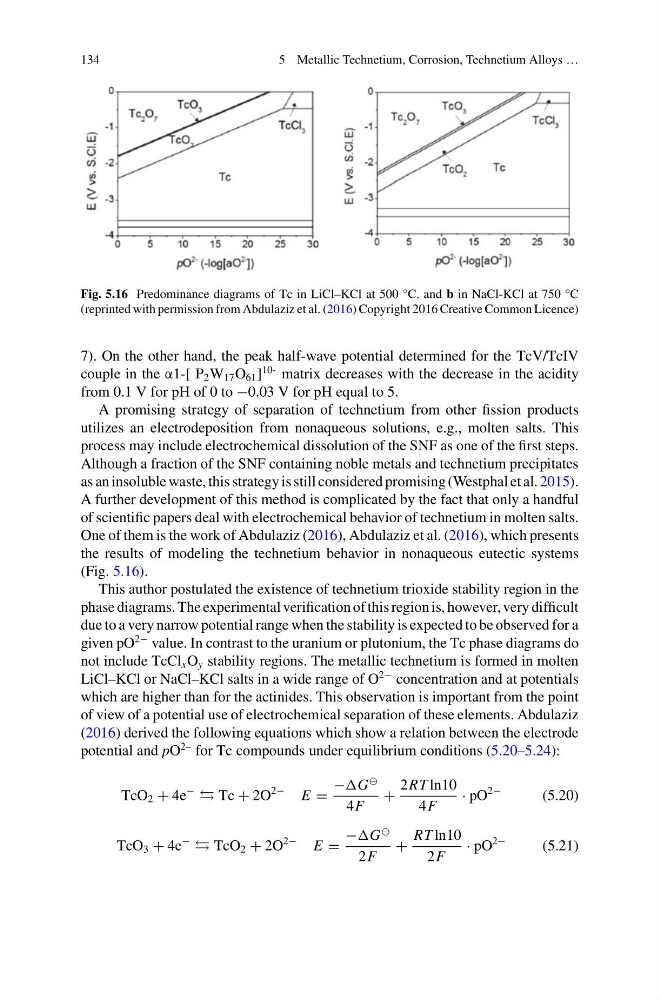
Fig. 5.16 Predominance diagrams of Tc in LiCl–KCl at 500 °C. and b in NaCl-KCl at 750 °C
(reprinted with permission from Abdulaziz et al. (2016) Copyright 2016 Creative Common Licence)
7). On the other hand, the peak half-wave potential determined for the TcV/TcIV
couple in the α1-[ P 2 W 17 O 61 ]
10- matrix decreases with the decrease in the acidity
from 0.1 V for pH of 0 to −0.03 V for pH equal to 5.
A promising strategy of separation of technetium from other fission products
utilizes an electrodeposition from nonaqueous solutions, e.g., molten salts. This
process may include electrochemical dissolution of the SNF as one of the first steps.
Although a fraction of the SNF containing noble metals and technetium precipitates
as an insoluble waste, this strategy is still considered promising (Westphal et al. 2015).
A further development of this method is complicated by the fact that only a handful
of scientific papers deal with electrochemical behavior of technetium in molten salts.
One of them is the work of Abdulaziz (2016), Abdulaziz et al. (2016), which presents
the results of modeling the technetium behavior in nonaqueous eutectic systems
(Fig. 5.16).
This author postulated the existence of technetium trioxide stability region in the
phase diagrams. The experimental verification of this region is, however, very difficult
due to a very narrow potential range when the stability is expected to be observed for a
given pO
2− value. In contrast to the uranium or plutonium, the Tc phase diagrams do
not include TcCl x O y stability regions. The metallic technetium is formed in molten
LiCl–KCl or NaCl–KCl salts in a wide range of O
2− concentration and at potentials
which are higher than for the actinides. This observation is important from the point
of view of a potential use of electrochemical separation of these elements. Abdulaziz
(2016) derived the following equations which show a relation between the electrode
potential and pO
2– for Tc compounds under equilibrium conditions (5.20–5.24):
TcO 2 + 4e
−
Tc + 2O
2−
E =
−G
4F
+
2RT ln10
4F
· pO
2−
(5.20)
TcO 3 + 4e
−
TcO 2 + 2O
2−
E =
−G
2F
+
RT ln10
2F
· pO
2−
(5.21)
5 Metallic Technetium, Corrosion, Technetium Alloys …
Fig. 5.16 Predominance diagrams of Tc in LiCl–KCl at 500 °C. and b in NaCl-KCl at 750 °C
(reprinted with permission from Abdulaziz et al. (2016) Copyright 2016 Creative Common Licence)
7). On the other hand, the peak half-wave potential determined for the TcV/TcIV
couple in the α1-[ P 2 W 17 O 61 ]
10- matrix decreases with the decrease in the acidity
from 0.1 V for pH of 0 to −0.03 V for pH equal to 5.
A promising strategy of separation of technetium from other fission products
utilizes an electrodeposition from nonaqueous solutions, e.g., molten salts. This
process may include electrochemical dissolution of the SNF as one of the first steps.
Although a fraction of the SNF containing noble metals and technetium precipitates
as an insoluble waste, this strategy is still considered promising (Westphal et al. 2015).
A further development of this method is complicated by the fact that only a handful
of scientific papers deal with electrochemical behavior of technetium in molten salts.
One of them is the work of Abdulaziz (2016), Abdulaziz et al. (2016), which presents
the results of modeling the technetium behavior in nonaqueous eutectic systems
(Fig. 5.16).
This author postulated the existence of technetium trioxide stability region in the
phase diagrams. The experimental verification of this region is, however, very difficult
due to a very narrow potential range when the stability is expected to be observed for a
given pO
2− value. In contrast to the uranium or plutonium, the Tc phase diagrams do
not include TcCl x O y stability regions. The metallic technetium is formed in molten
LiCl–KCl or NaCl–KCl salts in a wide range of O
2− concentration and at potentials
which are higher than for the actinides. This observation is important from the point
of view of a potential use of electrochemical separation of these elements. Abdulaziz
(2016) derived the following equations which show a relation between the electrode
potential and pO
2– for Tc compounds under equilibrium conditions (5.20–5.24):
TcO 2 + 4e
−
Tc + 2O
2−
E =
−G
4F
+
2RT ln10
4F
· pO
2−
(5.20)
TcO 3 + 4e
−
TcO 2 + 2O
2−
E =
−G
2F
+
RT ln10
2F
· pO
2−
(5.21)