

5 Metallic Technetium, Corrosion, Technetium Alloys …
133
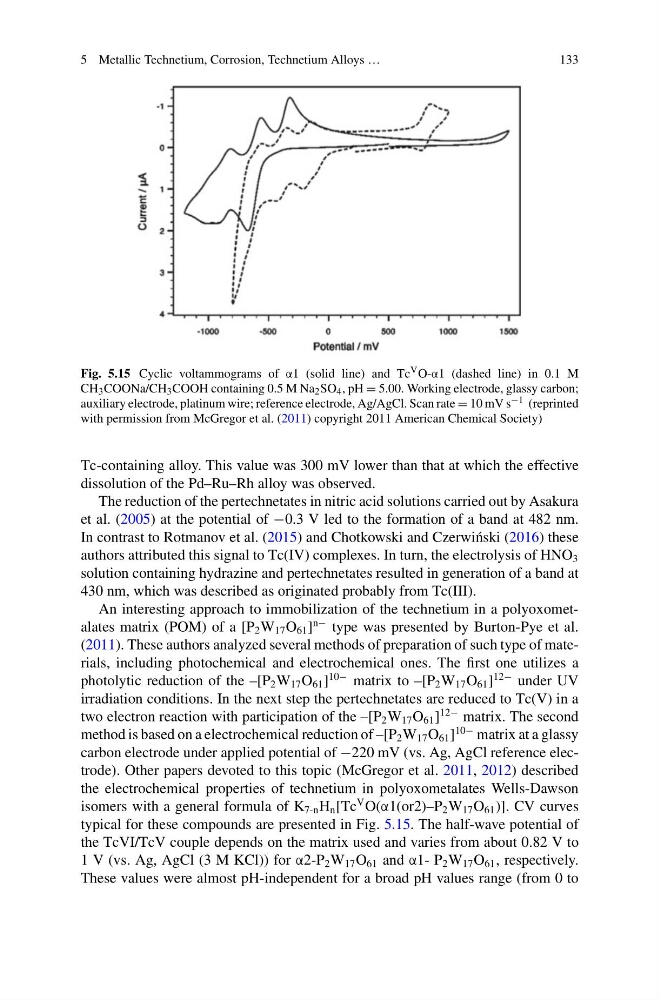
Fig. 5.15 Cyclic voltammograms of α1 (solid line) and Tc V O-α1 (dashed line) in 0.1 M
CH 3 COONa/CH 3 COOH containing 0.5 M Na 2 SO 4 , pH = 5.00. Working electrode, glassy carbon;
auxiliary electrode, platinum wire; reference electrode, Ag/AgCl. Scan rate = 10 mV s −1 (reprinted
with permission from McGregor et al. (2011) copyright 2011 American Chemical Society)
Tc-containing alloy. This value was 300 mV lower than that at which the effective
dissolution of the Pd–Ru–Rh alloy was observed.
The reduction of the pertechnetates in nitric acid solutions carried out by Asakura
et al. (2005) at the potential of −0.3 V led to the formation of a band at 482 nm.
In contrast to Rotmanov et al. (2015) and Chotkowski and Czerwi´ nski (2016) these
authors attributed this signal to Tc(IV) complexes. In turn, the electrolysis of HNO 3
solution containing hydrazine and pertechnetates resulted in generation of a band at
430 nm, which was described as originated probably from Tc(III).
An interesting approach to immobilization of the technetium in a polyoxometalates matrix (POM) of a [P 2 W 17 O 61 ]
n− type was presented by Burton-Pye et al.
(2011). These authors analyzed several methods of preparation of such type of materials, including photochemical and electrochemical ones. The first one utilizes a
photolytic reduction of the –[P 2 W 17 O 61 ]
10− matrix to –[P 2 W 17 O 61 ]
12− under UV
irradiation conditions. In the next step the pertechnetates are reduced to Tc(V) in a
two electron reaction with participation of the –[P 2 W 17 O 61 ]
12− matrix. The second
method is based on a electrochemical reduction of –[P 2 W 17 O 61 ]
10− matrix at a glassy
carbon electrode under applied potential of −220 mV (vs. Ag, AgCl reference electrode). Other papers devoted to this topic (McGregor et al. 2011, 2012) described
the electrochemical properties of technetium in polyoxometalates Wells-Dawson
isomers with a general formula of K 7-n H n [Tc
V O(α1(or2)–P 2 W 17 O 61 )]. CV curves
typical for these compounds are presented in Fig. 5.15. The half-wave potential of
the TcVI/TcV couple depends on the matrix used and varies from about 0.82 V to
1 V (vs. Ag, AgCl (3 M KCl)) for α2-P 2 W 17 O 61 and α1- P 2 W 17 O 61 , respectively.
These values were almost pH-independent for a broad pH values range (from 0 to
133
Fig. 5.15 Cyclic voltammograms of α1 (solid line) and Tc V O-α1 (dashed line) in 0.1 M
CH 3 COONa/CH 3 COOH containing 0.5 M Na 2 SO 4 , pH = 5.00. Working electrode, glassy carbon;
auxiliary electrode, platinum wire; reference electrode, Ag/AgCl. Scan rate = 10 mV s −1 (reprinted
with permission from McGregor et al. (2011) copyright 2011 American Chemical Society)
Tc-containing alloy. This value was 300 mV lower than that at which the effective
dissolution of the Pd–Ru–Rh alloy was observed.
The reduction of the pertechnetates in nitric acid solutions carried out by Asakura
et al. (2005) at the potential of −0.3 V led to the formation of a band at 482 nm.
In contrast to Rotmanov et al. (2015) and Chotkowski and Czerwi´ nski (2016) these
authors attributed this signal to Tc(IV) complexes. In turn, the electrolysis of HNO 3
solution containing hydrazine and pertechnetates resulted in generation of a band at
430 nm, which was described as originated probably from Tc(III).
An interesting approach to immobilization of the technetium in a polyoxometalates matrix (POM) of a [P 2 W 17 O 61 ]
n− type was presented by Burton-Pye et al.
(2011). These authors analyzed several methods of preparation of such type of materials, including photochemical and electrochemical ones. The first one utilizes a
photolytic reduction of the –[P 2 W 17 O 61 ]
10− matrix to –[P 2 W 17 O 61 ]
12− under UV
irradiation conditions. In the next step the pertechnetates are reduced to Tc(V) in a
two electron reaction with participation of the –[P 2 W 17 O 61 ]
12− matrix. The second
method is based on a electrochemical reduction of –[P 2 W 17 O 61 ]
10− matrix at a glassy
carbon electrode under applied potential of −220 mV (vs. Ag, AgCl reference electrode). Other papers devoted to this topic (McGregor et al. 2011, 2012) described
the electrochemical properties of technetium in polyoxometalates Wells-Dawson
isomers with a general formula of K 7-n H n [Tc
V O(α1(or2)–P 2 W 17 O 61 )]. CV curves
typical for these compounds are presented in Fig. 5.15. The half-wave potential of
the TcVI/TcV couple depends on the matrix used and varies from about 0.82 V to
1 V (vs. Ag, AgCl (3 M KCl)) for α2-P 2 W 17 O 61 and α1- P 2 W 17 O 61 , respectively.
These values were almost pH-independent for a broad pH values range (from 0 to