

5 Metallic Technetium, Corrosion, Technetium Alloys …
131
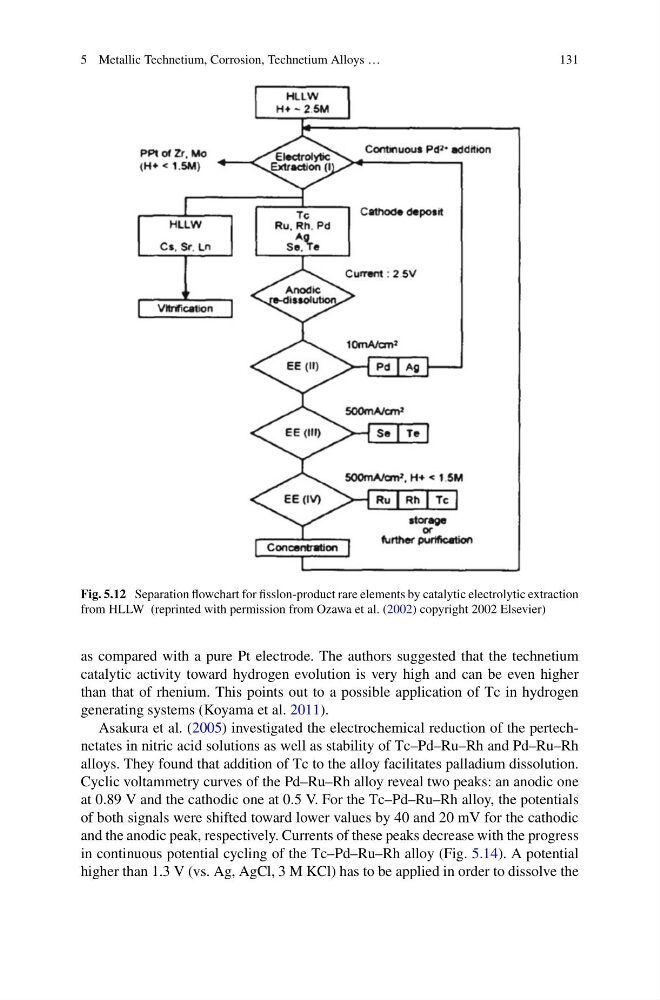
Fig. 5.12 Separation flowchart for fisslon-product rare elements by catalytic electrolytic extraction
from HLLW (reprinted with permission from Ozawa et al. (2002) copyright 2002 Elsevier)
as compared with a pure Pt electrode. The authors suggested that the technetium
catalytic activity toward hydrogen evolution is very high and can be even higher
than that of rhenium. This points out to a possible application of Tc in hydrogen
generating systems (Koyama et al. 2011).
Asakura et al. (2005) investigated the electrochemical reduction of the pertechnetates in nitric acid solutions as well as stability of Tc–Pd–Ru–Rh and Pd–Ru–Rh
alloys. They found that addition of Tc to the alloy facilitates palladium dissolution.
Cyclic voltammetry curves of the Pd–Ru–Rh alloy reveal two peaks: an anodic one
at 0.89 V and the cathodic one at 0.5 V. For the Tc–Pd–Ru–Rh alloy, the potentials
of both signals were shifted toward lower values by 40 and 20 mV for the cathodic
and the anodic peak, respectively. Currents of these peaks decrease with the progress
in continuous potential cycling of the Tc–Pd–Ru–Rh alloy (Fig. 5.14). A potential
higher than 1.3 V (vs. Ag, AgCl, 3 M KCl) has to be applied in order to dissolve the
131
Fig. 5.12 Separation flowchart for fisslon-product rare elements by catalytic electrolytic extraction
from HLLW (reprinted with permission from Ozawa et al. (2002) copyright 2002 Elsevier)
as compared with a pure Pt electrode. The authors suggested that the technetium
catalytic activity toward hydrogen evolution is very high and can be even higher
than that of rhenium. This points out to a possible application of Tc in hydrogen
generating systems (Koyama et al. 2011).
Asakura et al. (2005) investigated the electrochemical reduction of the pertechnetates in nitric acid solutions as well as stability of Tc–Pd–Ru–Rh and Pd–Ru–Rh
alloys. They found that addition of Tc to the alloy facilitates palladium dissolution.
Cyclic voltammetry curves of the Pd–Ru–Rh alloy reveal two peaks: an anodic one
at 0.89 V and the cathodic one at 0.5 V. For the Tc–Pd–Ru–Rh alloy, the potentials
of both signals were shifted toward lower values by 40 and 20 mV for the cathodic
and the anodic peak, respectively. Currents of these peaks decrease with the progress
in continuous potential cycling of the Tc–Pd–Ru–Rh alloy (Fig. 5.14). A potential
higher than 1.3 V (vs. Ag, AgCl, 3 M KCl) has to be applied in order to dissolve the