

130
5 Metallic Technetium, Corrosion, Technetium Alloys …
noticeable. The Tc(V) species generated at the electrode surface during this process
are immediatelly oxidized by Np(VI).
Additional data related to the interactions between Np and Tc species were delivered by spectrophotometric experiments. Analyzed solutions contained NpO
2+
2 ions
and selected electrogenerated reduced Tc species, e.g., TcO
2+ , Tc(III) and Tc(IV)polymer. Oxidation of the Tc species leads to the formation of unstable Tc(V) and
Np(V) ions. Tc(V) was characterized by a wave with a maximum at approx. 460 nm
while the Np(V) ions generated a signal at ca. 980 nm. It has been found that the rate
of the oxidation of the reduced Tc species strongly depends on their structure. The
slowest process was observed for the polymeric forms of Tc(IV) while Tc(III) were
oxidized by Np(VI) most rapidly.
In Japan, Masaki Ozawa and coworkers develops a concept of reprocessing of the
spent nuclear fuel with the aim of recovering of elements important to the nuclear
industry, e.g., rhenium or noble metals. This approach involves application of electrochemical techniques to deposit elements, such as Ru, Rh, Mo or Re, on cathodes
directly from HLLW. The approach is referred to as Advanced-ORIENT Advanced
Optimization by Recycling Instructive Elements Cycle strategy. Figure 5.12 presents
a general scheme of this process.
Highly acidified waste containing FP is subjected to an electrolytic extraction.
The rare metals that can be deposited on a Pt–Ti cathode in this process include
noble metals (e.g., Ag, Rh, Pd), Se, Te and Tc. A research conducted by Ozawa
et al. (2002, 2003, 2005, 2008) showed that the efficiency of their electrodeposition
increases when Pd
2+ is added to the system as a mediator (Fig. 5.13). Initially, the
procedure involved a stepwise increase in the reduction currents according to the
following scheme: 2.5 mA cm
−2 (1 h) → 25 mA cm
−2 (2 h) → 50 mA cm
−2 (2 h)
→ 100 mA cm
−2 (2 h). As a result, Ru–Rh–Pd–Re deposit was produced. Re was
deposited as ReO 3(2) , Ru in its metallic form and Tc as TcO 2 (Ozawa et al. 2005).
The maximum separation ratios of the metals of interest were as follows: >99% for
Pd and Rh, 60% for Ru, 55% for Re and 25% for Tc (Ozawa et al. 2008). In the
course of further research, the current densities flow sheet was modified to 2.5 mA
cm
−2 (1 h) → 75 mA cm
−2 (2 h) → 100 mA cm
−2 (4 h)) (Koyama et al. 2011).
To increase the recovery ratio of RuNO
3+ , TcO
−
4 and Re O
−
4 a decrease in the nitric
acid concentration is required. The addition of Pd
2+ to the galvanic bath (Pd:Tc = 5)
increases the technetium electrodeposition efficiency and reduces the negative effect
of HNO 3 content in the solution.
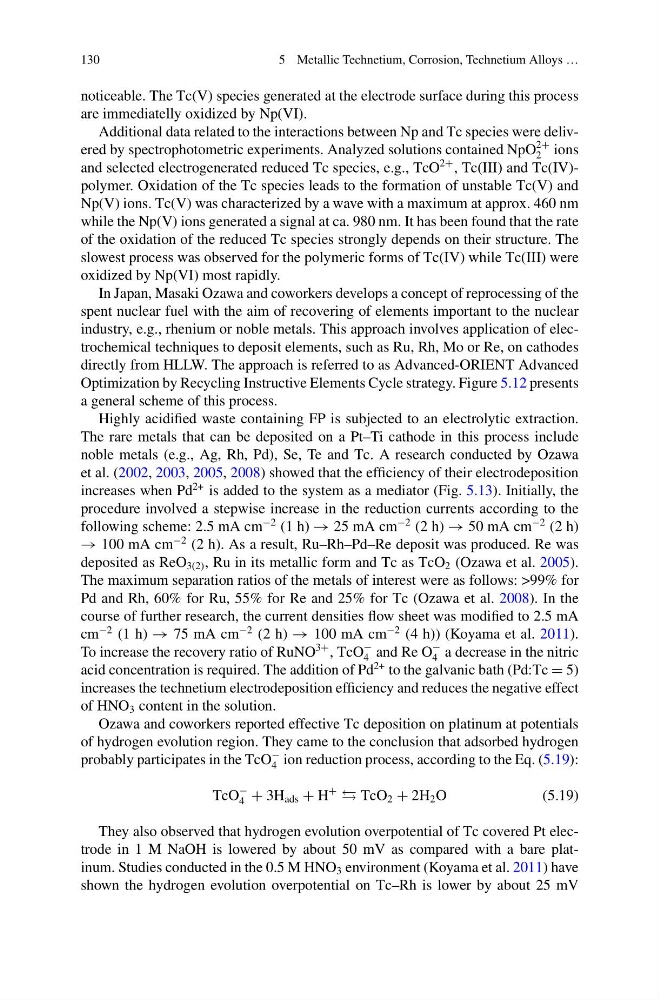
Ozawa and coworkers reported effective Tc deposition on platinum at potentials
of hydrogen evolution region. They came to the conclusion that adsorbed hydrogen
probably participates in the TcO
−
4 ion reduction process, according to the Eq. (5.19):
TcO
−
4 + 3H ads + H
+
TcO 2 + 2H 2 O
(5.19)
They also observed that hydrogen evolution overpotential of Tc covered Pt electrode in 1 M NaOH is lowered by about 50 mV as compared with a bare platinum. Studies conducted in the 0.5 M HNO 3 environment (Koyama et al. 2011) have
shown the hydrogen evolution overpotential on Tc–Rh is lower by about 25 mV
5 Metallic Technetium, Corrosion, Technetium Alloys …
noticeable. The Tc(V) species generated at the electrode surface during this process
are immediatelly oxidized by Np(VI).
Additional data related to the interactions between Np and Tc species were delivered by spectrophotometric experiments. Analyzed solutions contained NpO
2+
2 ions
and selected electrogenerated reduced Tc species, e.g., TcO
2+ , Tc(III) and Tc(IV)polymer. Oxidation of the Tc species leads to the formation of unstable Tc(V) and
Np(V) ions. Tc(V) was characterized by a wave with a maximum at approx. 460 nm
while the Np(V) ions generated a signal at ca. 980 nm. It has been found that the rate
of the oxidation of the reduced Tc species strongly depends on their structure. The
slowest process was observed for the polymeric forms of Tc(IV) while Tc(III) were
oxidized by Np(VI) most rapidly.
In Japan, Masaki Ozawa and coworkers develops a concept of reprocessing of the
spent nuclear fuel with the aim of recovering of elements important to the nuclear
industry, e.g., rhenium or noble metals. This approach involves application of electrochemical techniques to deposit elements, such as Ru, Rh, Mo or Re, on cathodes
directly from HLLW. The approach is referred to as Advanced-ORIENT Advanced
Optimization by Recycling Instructive Elements Cycle strategy. Figure 5.12 presents
a general scheme of this process.
Highly acidified waste containing FP is subjected to an electrolytic extraction.
The rare metals that can be deposited on a Pt–Ti cathode in this process include
noble metals (e.g., Ag, Rh, Pd), Se, Te and Tc. A research conducted by Ozawa
et al. (2002, 2003, 2005, 2008) showed that the efficiency of their electrodeposition
increases when Pd
2+ is added to the system as a mediator (Fig. 5.13). Initially, the
procedure involved a stepwise increase in the reduction currents according to the
following scheme: 2.5 mA cm
−2 (1 h) → 25 mA cm
−2 (2 h) → 50 mA cm
−2 (2 h)
→ 100 mA cm
−2 (2 h). As a result, Ru–Rh–Pd–Re deposit was produced. Re was
deposited as ReO 3(2) , Ru in its metallic form and Tc as TcO 2 (Ozawa et al. 2005).
The maximum separation ratios of the metals of interest were as follows: >99% for
Pd and Rh, 60% for Ru, 55% for Re and 25% for Tc (Ozawa et al. 2008). In the
course of further research, the current densities flow sheet was modified to 2.5 mA
cm
−2 (1 h) → 75 mA cm
−2 (2 h) → 100 mA cm
−2 (4 h)) (Koyama et al. 2011).
To increase the recovery ratio of RuNO
3+ , TcO
−
4 and Re O
−
4 a decrease in the nitric
acid concentration is required. The addition of Pd
2+ to the galvanic bath (Pd:Tc = 5)
increases the technetium electrodeposition efficiency and reduces the negative effect
of HNO 3 content in the solution.
Ozawa and coworkers reported effective Tc deposition on platinum at potentials
of hydrogen evolution region. They came to the conclusion that adsorbed hydrogen
probably participates in the TcO
−
4 ion reduction process, according to the Eq. (5.19):
TcO
−
4 + 3H ads + H
+
TcO 2 + 2H 2 O
(5.19)
They also observed that hydrogen evolution overpotential of Tc covered Pt electrode in 1 M NaOH is lowered by about 50 mV as compared with a bare platinum. Studies conducted in the 0.5 M HNO 3 environment (Koyama et al. 2011) have
shown the hydrogen evolution overpotential on Tc–Rh is lower by about 25 mV