

5 Metallic Technetium, Corrosion, Technetium Alloys …
129
-0.2 0.0 0.2 0.4 0.6 0.8 1.0 1.2 1.4 1.6 1.8
-4
-3
-2
-1
0
1
2
j / m A cm
-2
E / V
TcO
-
4
TcO
-
4
+ N p
3+
TcO
-
4
+ N p
4+
TcO
-
4
+ N pO
2+
2
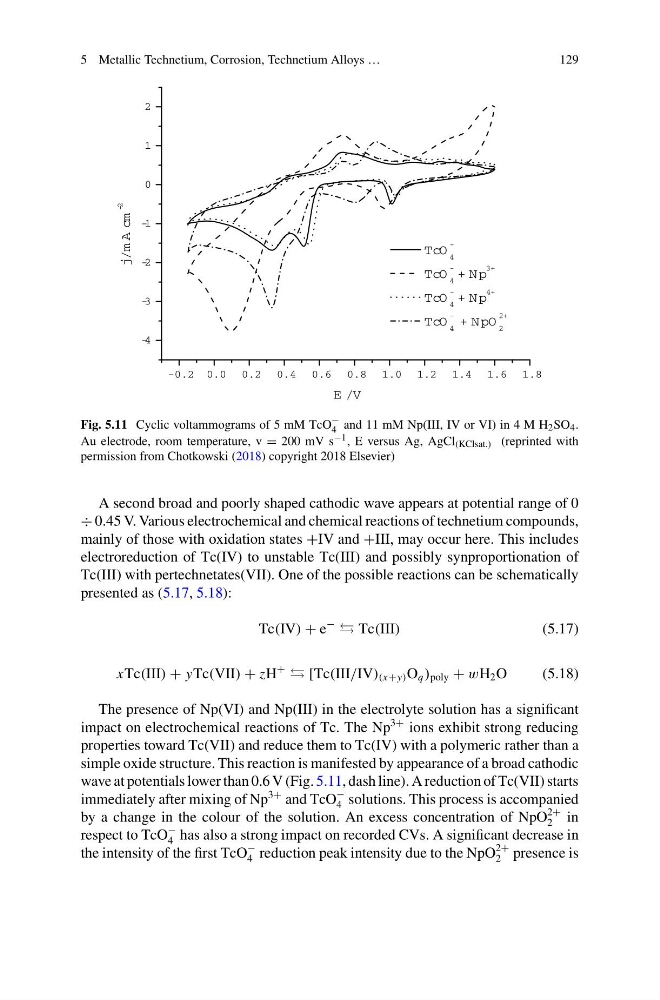
Fig. 5.11 Cyclic voltammograms of 5 mM TcO
−
4 and 11 mM Np(III, IV or VI) in 4 M H 2 SO 4 .
Au electrode, room temperature, v = 200 mV s −1 , E versus Ag, AgCl (KClsat.) (reprinted with
permission from Chotkowski (2018) copyright 2018 Elsevier)
A second broad and poorly shaped cathodic wave appears at potential range of 0
÷ 0.45 V. Various electrochemical and chemical reactions of technetium compounds,
mainly of those with oxidation states +IV and +III, may occur here. This includes
electroreduction of Tc(IV) to unstable Tc(III) and possibly synproportionation of
Tc(III) with pertechnetates(VII). One of the possible reactions can be schematically
presented as (5.17, 5.18):
Tc(IV) + e
−
Tc(III)
(5.17)
xTc(III) + yTc(VII) + zH
+
[Tc(III/IV) (x+y) O q ) poly + wH 2 O
(5.18)
The presence of Np(VI) and Np(III) in the electrolyte solution has a significant
impact on electrochemical reactions of Tc. The Np
3+ ions exhibit strong reducing
properties toward Tc(VII) and reduce them to Tc(IV) with a polymeric rather than a
simple oxide structure. This reaction is manifested by appearance of a broad cathodic
wave at potentials lower than 0.6 V (Fig. 5.11, dash line). A reduction of Tc(VII) starts
immediately after mixing of Np
3+ and TcO
−
4 solutions. This process is accompanied
by a change in the colour of the solution. An excess concentration of NpO
2+
2 in
respect to TcO
−
4 has also a strong impact on recorded CVs. A significant decrease in
the intensity of the first TcO
−
4 reduction peak intensity due to the NpO
2+
2 presence is
129
-0.2 0.0 0.2 0.4 0.6 0.8 1.0 1.2 1.4 1.6 1.8
-4
-3
-2
-1
0
1
2
j / m A cm
-2
E / V
TcO
-
4
TcO
-
4
+ N p
3+
TcO
-
4
+ N p
4+
TcO
-
4
+ N pO
2+
2
Fig. 5.11 Cyclic voltammograms of 5 mM TcO
−
4 and 11 mM Np(III, IV or VI) in 4 M H 2 SO 4 .
Au electrode, room temperature, v = 200 mV s −1 , E versus Ag, AgCl (KClsat.) (reprinted with
permission from Chotkowski (2018) copyright 2018 Elsevier)
A second broad and poorly shaped cathodic wave appears at potential range of 0
÷ 0.45 V. Various electrochemical and chemical reactions of technetium compounds,
mainly of those with oxidation states +IV and +III, may occur here. This includes
electroreduction of Tc(IV) to unstable Tc(III) and possibly synproportionation of
Tc(III) with pertechnetates(VII). One of the possible reactions can be schematically
presented as (5.17, 5.18):
Tc(IV) + e
−
Tc(III)
(5.17)
xTc(III) + yTc(VII) + zH
+
[Tc(III/IV) (x+y) O q ) poly + wH 2 O
(5.18)
The presence of Np(VI) and Np(III) in the electrolyte solution has a significant
impact on electrochemical reactions of Tc. The Np
3+ ions exhibit strong reducing
properties toward Tc(VII) and reduce them to Tc(IV) with a polymeric rather than a
simple oxide structure. This reaction is manifested by appearance of a broad cathodic
wave at potentials lower than 0.6 V (Fig. 5.11, dash line). A reduction of Tc(VII) starts
immediately after mixing of Np
3+ and TcO
−
4 solutions. This process is accompanied
by a change in the colour of the solution. An excess concentration of NpO
2+
2 in
respect to TcO
−
4 has also a strong impact on recorded CVs. A significant decrease in
the intensity of the first TcO
−
4 reduction peak intensity due to the NpO
2+
2 presence is