

128
5 Metallic Technetium, Corrosion, Technetium Alloys …
conditions and, as an effect, results reported by different groups differ from each
other. For example, German et al. (2011) investigated the catalytic properties of
technetium in Tc–(Np, Th, Zr)–N 2 H 5 NO 3 –HNO 3 . These authors obtained reduced
Tc as a result of a reaction of the pertechnetates with an excess of hydrazine in 1.5 M
HNO 3 . In the next step, Np(V) was added to such prepared solution. The authors
concluded that reactions in this system lead to the formation of Tc(V) and Np(IV).
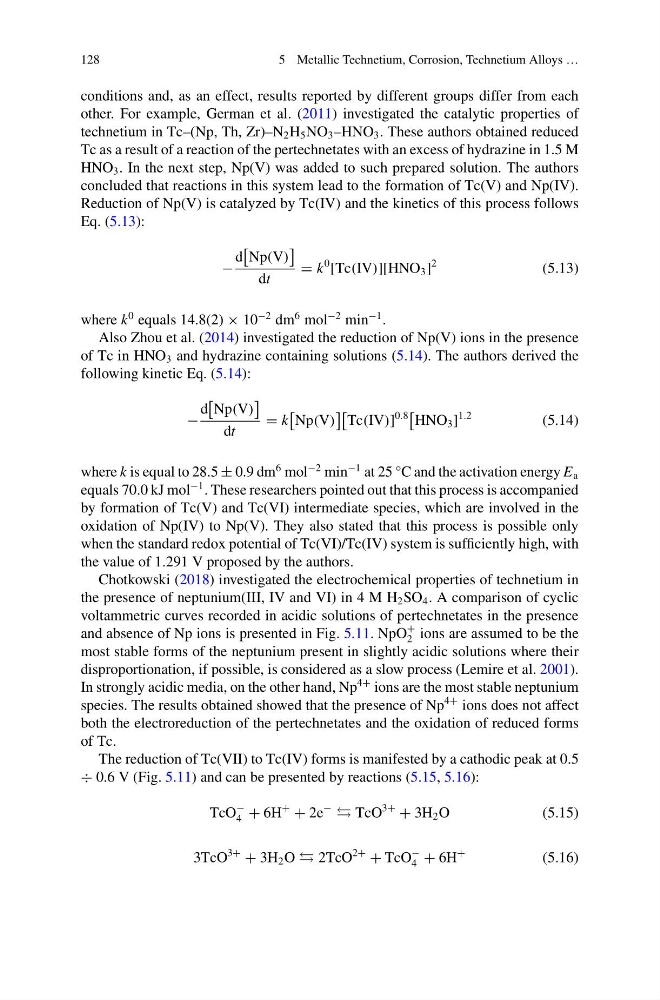
Reduction of Np(V) is catalyzed by Tc(IV) and the kinetics of this process follows
Eq. (5.13):
−
d
Np(V)
dt
= k
0 [Tc(IV)][HNO 3 ]
2
(5.13)
where k
0 equals 14.8(2) × 10
−2 dm
6 mol
−2 min
−1 .
Also Zhou et al. (2014) investigated the reduction of Np(V) ions in the presence
of Tc in HNO 3 and hydrazine containing solutions (5.14). The authors derived the
following kinetic Eq. (5.14):
−
d
Np(V)
dt
= k
Np(V)
Tc(IV)]
0.8
HNO 3 ]
1.2
(5.14)
where k is equal to 28.5 ± 0.9 dm
6 mol
−2 min
−1 at 25 °C and the activation energy E a
equals 70.0 kJ mol
−1 . These researchers pointed out that this process is accompanied
by formation of Tc(V) and Tc(VI) intermediate species, which are involved in the
oxidation of Np(IV) to Np(V). They also stated that this process is possible only
when the standard redox potential of Tc(VI)/Tc(IV) system is sufficiently high, with
the value of 1.291 V proposed by the authors.
Chotkowski (2018) investigated the electrochemical properties of technetium in
the presence of neptunium(III, IV and VI) in 4 M H 2 SO 4 . A comparison of cyclic
voltammetric curves recorded in acidic solutions of pertechnetates in the presence
and absence of Np ions is presented in Fig. 5.11. NpO
+
2 ions are assumed to be the
most stable forms of the neptunium present in slightly acidic solutions where their
disproportionation, if possible, is considered as a slow process (Lemire et al. 2001).
In strongly acidic media, on the other hand, Np
4+ ions are the most stable neptunium
species. The results obtained showed that the presence of Np
4+ ions does not affect
both the electroreduction of the pertechnetates and the oxidation of reduced forms
of Tc.
The reduction of Tc(VII) to Tc(IV) forms is manifested by a cathodic peak at 0.5
÷ 0.6 V (Fig. 5.11) and can be presented by reactions (5.15, 5.16):
TcO
−
4 + 6H
+
+ 2e
−
TcO
3+
+ 3H 2 O
(5.15)
3TcO
3+
+ 3H 2 O 2TcO
2+
+ TcO
−
4 + 6H
+
(5.16)
5 Metallic Technetium, Corrosion, Technetium Alloys …
conditions and, as an effect, results reported by different groups differ from each
other. For example, German et al. (2011) investigated the catalytic properties of
technetium in Tc–(Np, Th, Zr)–N 2 H 5 NO 3 –HNO 3 . These authors obtained reduced
Tc as a result of a reaction of the pertechnetates with an excess of hydrazine in 1.5 M
HNO 3 . In the next step, Np(V) was added to such prepared solution. The authors
concluded that reactions in this system lead to the formation of Tc(V) and Np(IV).
Reduction of Np(V) is catalyzed by Tc(IV) and the kinetics of this process follows
Eq. (5.13):
−
d
Np(V)
dt
= k
0 [Tc(IV)][HNO 3 ]
2
(5.13)
where k
0 equals 14.8(2) × 10
−2 dm
6 mol
−2 min
−1 .
Also Zhou et al. (2014) investigated the reduction of Np(V) ions in the presence
of Tc in HNO 3 and hydrazine containing solutions (5.14). The authors derived the
following kinetic Eq. (5.14):
−
d
Np(V)
dt
= k
Np(V)
Tc(IV)]
0.8
HNO 3 ]
1.2
(5.14)
where k is equal to 28.5 ± 0.9 dm
6 mol
−2 min
−1 at 25 °C and the activation energy E a
equals 70.0 kJ mol
−1 . These researchers pointed out that this process is accompanied
by formation of Tc(V) and Tc(VI) intermediate species, which are involved in the
oxidation of Np(IV) to Np(V). They also stated that this process is possible only
when the standard redox potential of Tc(VI)/Tc(IV) system is sufficiently high, with
the value of 1.291 V proposed by the authors.
Chotkowski (2018) investigated the electrochemical properties of technetium in
the presence of neptunium(III, IV and VI) in 4 M H 2 SO 4 . A comparison of cyclic
voltammetric curves recorded in acidic solutions of pertechnetates in the presence
and absence of Np ions is presented in Fig. 5.11. NpO
+
2 ions are assumed to be the
most stable forms of the neptunium present in slightly acidic solutions where their
disproportionation, if possible, is considered as a slow process (Lemire et al. 2001).
In strongly acidic media, on the other hand, Np
4+ ions are the most stable neptunium
species. The results obtained showed that the presence of Np
4+ ions does not affect
both the electroreduction of the pertechnetates and the oxidation of reduced forms
of Tc.
The reduction of Tc(VII) to Tc(IV) forms is manifested by a cathodic peak at 0.5
÷ 0.6 V (Fig. 5.11) and can be presented by reactions (5.15, 5.16):
TcO
−
4 + 6H
+
+ 2e
−
TcO
3+
+ 3H 2 O
(5.15)
3TcO
3+
+ 3H 2 O 2TcO
2+
+ TcO
−
4 + 6H
+
(5.16)