

122
5 Metallic Technetium, Corrosion, Technetium Alloys …
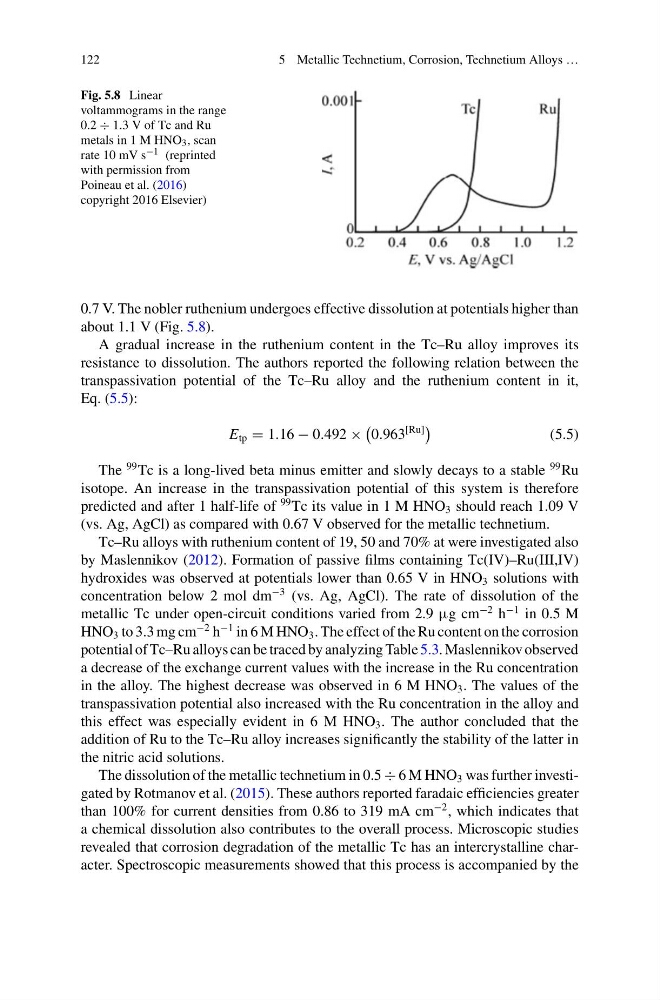
Fig. 5.8 Linear
voltammograms in the range
0.2 ÷ 1.3 V of Tc and Ru
metals in 1 M HNO 3 , scan
rate 10 mV s −1 (reprinted
with permission from
Poineau et al. (2016)
copyright 2016 Elsevier)
0.7 V. The nobler ruthenium undergoes effective dissolution at potentials higher than
about 1.1 V (Fig. 5.8).
A gradual increase in the ruthenium content in the Tc–Ru alloy improves its
resistance to dissolution. The authors reported the following relation between the
transpassivation potential of the Tc–Ru alloy and the ruthenium content in it,
Eq. (5.5):
E tp = 1.16 − 0.492 ×
0.963
[Ru]
(5.5)
The
99 Tc is a long-lived beta minus emitter and slowly decays to a stable
99 Ru
isotope. An increase in the transpassivation potential of this system is therefore
predicted and after 1 half-life of
99 Tc its value in 1 M HNO 3 should reach 1.09 V
(vs. Ag, AgCl) as compared with 0.67 V observed for the metallic technetium.
Tc–Ru alloys with ruthenium content of 19, 50 and 70% at were investigated also
by Maslennikov (2012). Formation of passive films containing Tc(IV)–Ru(III,IV)
hydroxides was observed at potentials lower than 0.65 V in HNO 3 solutions with
concentration below 2 mol dm
−3 (vs. Ag, AgCl). The rate of dissolution of the
metallic Tc under open-circuit conditions varied from 2.9 μg cm
−2 h
−1 in 0.5 M
HNO 3 to 3.3 mg cm
−2 h
−1 in 6 M HNO 3 . The effect of the Ru content on the corrosion
potential of Tc–Ru alloys can be traced by analyzing Table 5.3. Maslennikov observed
a decrease of the exchange current values with the increase in the Ru concentration
in the alloy. The highest decrease was observed in 6 M HNO 3 . The values of the
transpassivation potential also increased with the Ru concentration in the alloy and
this effect was especially evident in 6 M HNO 3 . The author concluded that the
addition of Ru to the Tc–Ru alloy increases significantly the stability of the latter in
the nitric acid solutions.
The dissolution of the metallic technetium in 0.5 ÷ 6 M HNO 3 was further investigated by Rotmanov et al. (2015). These authors reported faradaic efficiencies greater
than 100% for current densities from 0.86 to 319 mA cm
−2 , which indicates that
a chemical dissolution also contributes to the overall process. Microscopic studies
revealed that corrosion degradation of the metallic Tc has an intercrystalline character. Spectroscopic measurements showed that this process is accompanied by the
5 Metallic Technetium, Corrosion, Technetium Alloys …
Fig. 5.8 Linear
voltammograms in the range
0.2 ÷ 1.3 V of Tc and Ru
metals in 1 M HNO 3 , scan
rate 10 mV s −1 (reprinted
with permission from
Poineau et al. (2016)
copyright 2016 Elsevier)
0.7 V. The nobler ruthenium undergoes effective dissolution at potentials higher than
about 1.1 V (Fig. 5.8).
A gradual increase in the ruthenium content in the Tc–Ru alloy improves its
resistance to dissolution. The authors reported the following relation between the
transpassivation potential of the Tc–Ru alloy and the ruthenium content in it,
Eq. (5.5):
E tp = 1.16 − 0.492 ×
0.963
[Ru]
(5.5)
The
99 Tc is a long-lived beta minus emitter and slowly decays to a stable
99 Ru
isotope. An increase in the transpassivation potential of this system is therefore
predicted and after 1 half-life of
99 Tc its value in 1 M HNO 3 should reach 1.09 V
(vs. Ag, AgCl) as compared with 0.67 V observed for the metallic technetium.
Tc–Ru alloys with ruthenium content of 19, 50 and 70% at were investigated also
by Maslennikov (2012). Formation of passive films containing Tc(IV)–Ru(III,IV)
hydroxides was observed at potentials lower than 0.65 V in HNO 3 solutions with
concentration below 2 mol dm
−3 (vs. Ag, AgCl). The rate of dissolution of the
metallic Tc under open-circuit conditions varied from 2.9 μg cm
−2 h
−1 in 0.5 M
HNO 3 to 3.3 mg cm
−2 h
−1 in 6 M HNO 3 . The effect of the Ru content on the corrosion
potential of Tc–Ru alloys can be traced by analyzing Table 5.3. Maslennikov observed
a decrease of the exchange current values with the increase in the Ru concentration
in the alloy. The highest decrease was observed in 6 M HNO 3 . The values of the
transpassivation potential also increased with the Ru concentration in the alloy and
this effect was especially evident in 6 M HNO 3 . The author concluded that the
addition of Ru to the Tc–Ru alloy increases significantly the stability of the latter in
the nitric acid solutions.
The dissolution of the metallic technetium in 0.5 ÷ 6 M HNO 3 was further investigated by Rotmanov et al. (2015). These authors reported faradaic efficiencies greater
than 100% for current densities from 0.86 to 319 mA cm
−2 , which indicates that
a chemical dissolution also contributes to the overall process. Microscopic studies
revealed that corrosion degradation of the metallic Tc has an intercrystalline character. Spectroscopic measurements showed that this process is accompanied by the