

5 Metallic Technetium, Corrosion, Technetium Alloys …
121
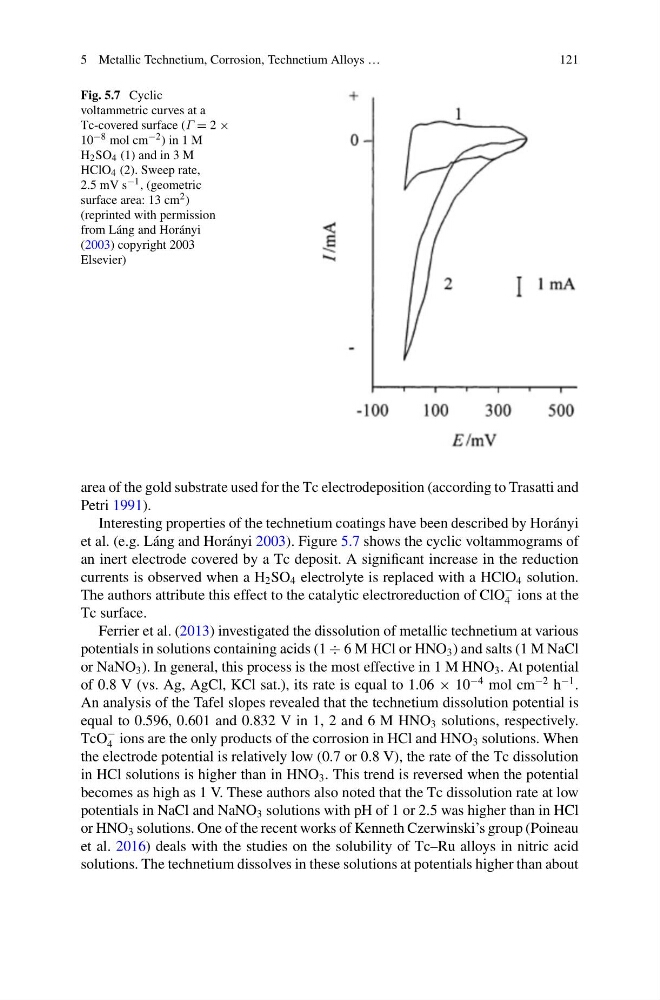
Fig. 5.7 Cyclic
voltammetric curves at a
Tc-covered surface (G = 2 ×
10 −8 mol cm −2 ) in 1 M
H 2 SO 4 (1) and in 3 M
HClO 4 (2). Sweep rate,
2.5 mV s −1 , (geometric
surface area: 13 cm 2 )
(reprinted with permission
from Láng and Horányi
(2003) copyright 2003
Elsevier)
area of the gold substrate used for the Tc electrodeposition (according to Trasatti and
Petri 1991).
Interesting properties of the technetium coatings have been described by Horányi
et al. (e.g. Láng and Horányi 2003). Figure 5.7 shows the cyclic voltammograms of
an inert electrode covered by a Tc deposit. A significant increase in the reduction
currents is observed when a H 2 SO 4 electrolyte is replaced with a HClO 4 solution.
The authors attribute this effect to the catalytic electroreduction of ClO
−
4 ions at the
Tc surface.
Ferrier et al. (2013) investigated the dissolution of metallic technetium at various
potentials in solutions containing acids (1 ÷ 6 M HCl or HNO 3 ) and salts (1 M NaCl
or NaNO 3 ). In general, this process is the most effective in 1 M HNO 3 . At potential
of 0.8 V (vs. Ag, AgCl, KCl sat.), its rate is equal to 1.06 × 10
−4 mol cm
−2 h
−1 .
An analysis of the Tafel slopes revealed that the technetium dissolution potential is
equal to 0.596, 0.601 and 0.832 V in 1, 2 and 6 M HNO 3 solutions, respectively.
TcO
−
4 ions are the only products of the corrosion in HCl and HNO 3 solutions. When
the electrode potential is relatively low (0.7 or 0.8 V), the rate of the Tc dissolution
in HCl solutions is higher than in HNO 3 . This trend is reversed when the potential
becomes as high as 1 V. These authors also noted that the Tc dissolution rate at low
potentials in NaCl and NaNO 3 solutions with pH of 1 or 2.5 was higher than in HCl
or HNO 3 solutions. One of the recent works of Kenneth Czerwinski’s group (Poineau
et al. 2016) deals with the studies on the solubility of Tc–Ru alloys in nitric acid
solutions. The technetium dissolves in these solutions at potentials higher than about
121
Fig. 5.7 Cyclic
voltammetric curves at a
Tc-covered surface (G = 2 ×
10 −8 mol cm −2 ) in 1 M
H 2 SO 4 (1) and in 3 M
HClO 4 (2). Sweep rate,
2.5 mV s −1 , (geometric
surface area: 13 cm 2 )
(reprinted with permission
from Láng and Horányi
(2003) copyright 2003
Elsevier)
area of the gold substrate used for the Tc electrodeposition (according to Trasatti and
Petri 1991).
Interesting properties of the technetium coatings have been described by Horányi
et al. (e.g. Láng and Horányi 2003). Figure 5.7 shows the cyclic voltammograms of
an inert electrode covered by a Tc deposit. A significant increase in the reduction
currents is observed when a H 2 SO 4 electrolyte is replaced with a HClO 4 solution.
The authors attribute this effect to the catalytic electroreduction of ClO
−
4 ions at the
Tc surface.
Ferrier et al. (2013) investigated the dissolution of metallic technetium at various
potentials in solutions containing acids (1 ÷ 6 M HCl or HNO 3 ) and salts (1 M NaCl
or NaNO 3 ). In general, this process is the most effective in 1 M HNO 3 . At potential
of 0.8 V (vs. Ag, AgCl, KCl sat.), its rate is equal to 1.06 × 10
−4 mol cm
−2 h
−1 .
An analysis of the Tafel slopes revealed that the technetium dissolution potential is
equal to 0.596, 0.601 and 0.832 V in 1, 2 and 6 M HNO 3 solutions, respectively.
TcO
−
4 ions are the only products of the corrosion in HCl and HNO 3 solutions. When
the electrode potential is relatively low (0.7 or 0.8 V), the rate of the Tc dissolution
in HCl solutions is higher than in HNO 3 . This trend is reversed when the potential
becomes as high as 1 V. These authors also noted that the Tc dissolution rate at low
potentials in NaCl and NaNO 3 solutions with pH of 1 or 2.5 was higher than in HCl
or HNO 3 solutions. One of the recent works of Kenneth Czerwinski’s group (Poineau
et al. 2016) deals with the studies on the solubility of Tc–Ru alloys in nitric acid
solutions. The technetium dissolves in these solutions at potentials higher than about