

120
5 Metallic Technetium, Corrosion, Technetium Alloys …
-1.0
-0.8
-0.6
-0.4
-0.2
0.0
0.2
-0.3
-0.2
-0.1
0.0
0.1
0.2
0.3
0.4
j /
m A cm
-2
E/ V vs. SH E
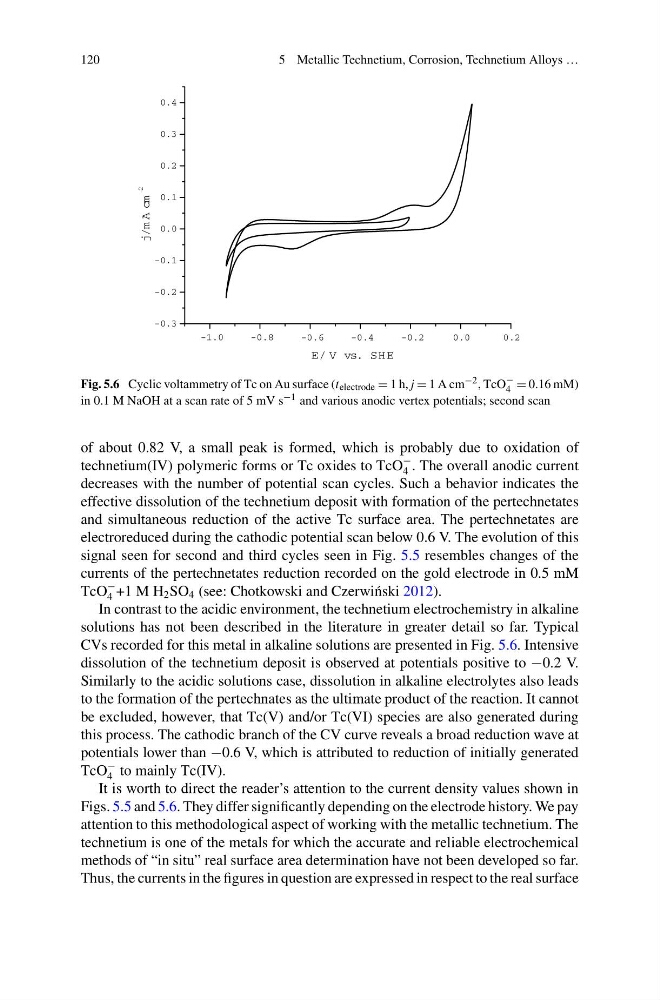
Fig. 5.6 Cyclic voltammetry of Tc on Au surface (t electrode = 1 h, j = 1 A cm −2 , TcO
−
4 = 0.16 mM)
in 0.1 M NaOH at a scan rate of 5 mV s −1 and various anodic vertex potentials; second scan
of about 0.82 V, a small peak is formed, which is probably due to oxidation of
technetium(IV) polymeric forms or Tc oxides to TcO
−
4 . The overall anodic current
decreases with the number of potential scan cycles. Such a behavior indicates the
effective dissolution of the technetium deposit with formation of the pertechnetates
and simultaneous reduction of the active Tc surface area. The pertechnetates are
electroreduced during the cathodic potential scan below 0.6 V. The evolution of this
signal seen for second and third cycles seen in Fig. 5.5 resembles changes of the
currents of the pertechnetates reduction recorded on the gold electrode in 0.5 mM
TcO
−
4 +1 M H 2 SO 4 (see: Chotkowski and Czerwi´ nski 2012).
In contrast to the acidic environment, the technetium electrochemistry in alkaline
solutions has not been described in the literature in greater detail so far. Typical
CVs recorded for this metal in alkaline solutions are presented in Fig. 5.6. Intensive
dissolution of the technetium deposit is observed at potentials positive to −0.2 V.
Similarly to the acidic solutions case, dissolution in alkaline electrolytes also leads
to the formation of the pertechnates as the ultimate product of the reaction. It cannot
be excluded, however, that Tc(V) and/or Tc(VI) species are also generated during
this process. The cathodic branch of the CV curve reveals a broad reduction wave at
potentials lower than −0.6 V, which is attributed to reduction of initially generated
TcO
−
4 to mainly Tc(IV).
It is worth to direct the reader’s attention to the current density values shown in
Figs. 5.5 and 5.6. They differ significantly depending on the electrode history. We pay
attention to this methodological aspect of working with the metallic technetium. The
technetium is one of the metals for which the accurate and reliable electrochemical
methods of “in situ” real surface area determination have not been developed so far.
Thus, the currents in the figures in question are expressed in respect to the real surface
5 Metallic Technetium, Corrosion, Technetium Alloys …
-1.0
-0.8
-0.6
-0.4
-0.2
0.0
0.2
-0.3
-0.2
-0.1
0.0
0.1
0.2
0.3
0.4
j /
m A cm
-2
E/ V vs. SH E
Fig. 5.6 Cyclic voltammetry of Tc on Au surface (t electrode = 1 h, j = 1 A cm −2 , TcO
−
4 = 0.16 mM)
in 0.1 M NaOH at a scan rate of 5 mV s −1 and various anodic vertex potentials; second scan
of about 0.82 V, a small peak is formed, which is probably due to oxidation of
technetium(IV) polymeric forms or Tc oxides to TcO
−
4 . The overall anodic current
decreases with the number of potential scan cycles. Such a behavior indicates the
effective dissolution of the technetium deposit with formation of the pertechnetates
and simultaneous reduction of the active Tc surface area. The pertechnetates are
electroreduced during the cathodic potential scan below 0.6 V. The evolution of this
signal seen for second and third cycles seen in Fig. 5.5 resembles changes of the
currents of the pertechnetates reduction recorded on the gold electrode in 0.5 mM
TcO
−
4 +1 M H 2 SO 4 (see: Chotkowski and Czerwi´ nski 2012).
In contrast to the acidic environment, the technetium electrochemistry in alkaline
solutions has not been described in the literature in greater detail so far. Typical
CVs recorded for this metal in alkaline solutions are presented in Fig. 5.6. Intensive
dissolution of the technetium deposit is observed at potentials positive to −0.2 V.
Similarly to the acidic solutions case, dissolution in alkaline electrolytes also leads
to the formation of the pertechnates as the ultimate product of the reaction. It cannot
be excluded, however, that Tc(V) and/or Tc(VI) species are also generated during
this process. The cathodic branch of the CV curve reveals a broad reduction wave at
potentials lower than −0.6 V, which is attributed to reduction of initially generated
TcO
−
4 to mainly Tc(IV).
It is worth to direct the reader’s attention to the current density values shown in
Figs. 5.5 and 5.6. They differ significantly depending on the electrode history. We pay
attention to this methodological aspect of working with the metallic technetium. The
technetium is one of the metals for which the accurate and reliable electrochemical
methods of “in situ” real surface area determination have not been developed so far.
Thus, the currents in the figures in question are expressed in respect to the real surface