

5 Metallic Technetium, Corrosion, Technetium Alloys …
119
-0.2
0.0
0.2
0.4
0.6
0.8
1.0
1.2
-25
-20
-15
-10
-5
0
5
10
15
20
1
st scan
2
nd scan
3
rd scan
0.0
0.2
0.4
0.6
0.8
-2
-1
0
1
2
j / m A cm
-2
E / V vs. SH E
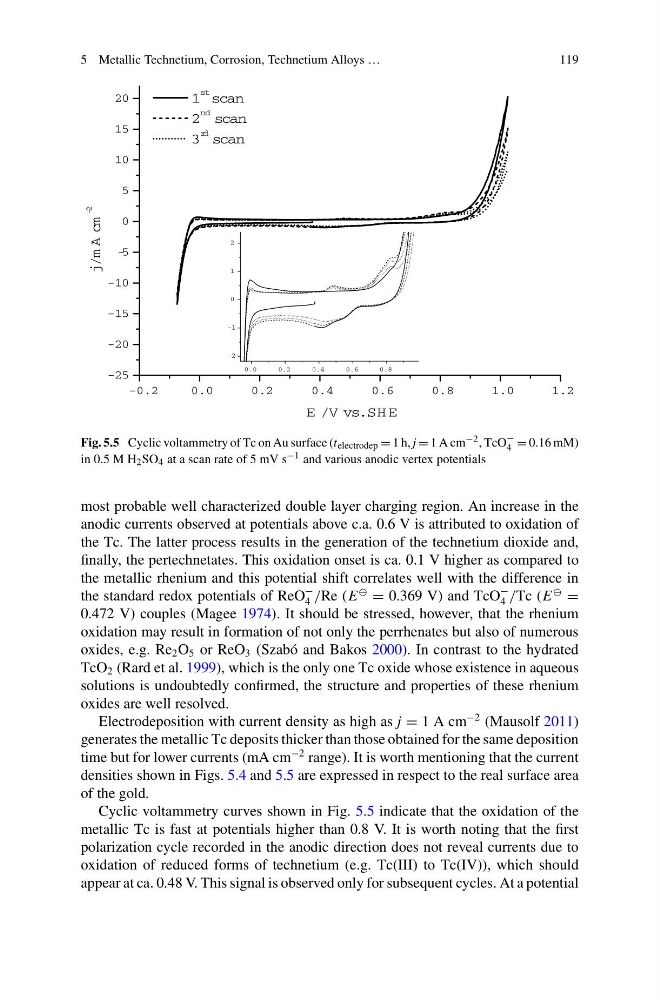
Fig. 5.5 Cyclic voltammetry of Tc on Au surface (t electrodep = 1 h, j = 1 A cm −2 , TcO
−
4 = 0.16 mM)
in 0.5 M H 2 SO 4 at a scan rate of 5 mV s −1 and various anodic vertex potentials
most probable well characterized double layer charging region. An increase in the
anodic currents observed at potentials above c.a. 0.6 V is attributed to oxidation of
the Tc. The latter process results in the generation of the technetium dioxide and,
finally, the pertechnetates. This oxidation onset is ca. 0.1 V higher as compared to
the metallic rhenium and this potential shift correlates well with the difference in
the standard redox potentials of ReO
−
4 /Re (E
= 0.369 V) and TcO
−
4 /Tc (E
=
0.472 V) couples (Magee 1974). It should be stressed, however, that the rhenium
oxidation may result in formation of not only the perrhenates but also of numerous
oxides, e.g. Re 2 O 5 or ReO 3 (Szabó and Bakos 2000). In contrast to the hydrated
TcO 2 (Rard et al. 1999), which is the only one Tc oxide whose existence in aqueous
solutions is undoubtedly confirmed, the structure and properties of these rhenium
oxides are well resolved.
Electrodeposition with current density as high as j = 1 A cm
−2 (Mausolf 2011)
generates the metallic Tc deposits thicker than those obtained for the same deposition
time but for lower currents (mA cm
−2 range). It is worth mentioning that the current
densities shown in Figs. 5.4 and 5.5 are expressed in respect to the real surface area
of the gold.
Cyclic voltammetry curves shown in Fig. 5.5 indicate that the oxidation of the
metallic Tc is fast at potentials higher than 0.8 V. It is worth noting that the first
polarization cycle recorded in the anodic direction does not reveal currents due to
oxidation of reduced forms of technetium (e.g. Tc(III) to Tc(IV)), which should
appear at ca. 0.48 V. This signal is observed only for subsequent cycles. At a potential
119
-0.2
0.0
0.2
0.4
0.6
0.8
1.0
1.2
-25
-20
-15
-10
-5
0
5
10
15
20
1
st scan
2
nd scan
3
rd scan
0.0
0.2
0.4
0.6
0.8
-2
-1
0
1
2
j / m A cm
-2
E / V vs. SH E
Fig. 5.5 Cyclic voltammetry of Tc on Au surface (t electrodep = 1 h, j = 1 A cm −2 , TcO
−
4 = 0.16 mM)
in 0.5 M H 2 SO 4 at a scan rate of 5 mV s −1 and various anodic vertex potentials
most probable well characterized double layer charging region. An increase in the
anodic currents observed at potentials above c.a. 0.6 V is attributed to oxidation of
the Tc. The latter process results in the generation of the technetium dioxide and,
finally, the pertechnetates. This oxidation onset is ca. 0.1 V higher as compared to
the metallic rhenium and this potential shift correlates well with the difference in
the standard redox potentials of ReO
−
4 /Re (E
= 0.369 V) and TcO
−
4 /Tc (E
=
0.472 V) couples (Magee 1974). It should be stressed, however, that the rhenium
oxidation may result in formation of not only the perrhenates but also of numerous
oxides, e.g. Re 2 O 5 or ReO 3 (Szabó and Bakos 2000). In contrast to the hydrated
TcO 2 (Rard et al. 1999), which is the only one Tc oxide whose existence in aqueous
solutions is undoubtedly confirmed, the structure and properties of these rhenium
oxides are well resolved.
Electrodeposition with current density as high as j = 1 A cm
−2 (Mausolf 2011)
generates the metallic Tc deposits thicker than those obtained for the same deposition
time but for lower currents (mA cm
−2 range). It is worth mentioning that the current
densities shown in Figs. 5.4 and 5.5 are expressed in respect to the real surface area
of the gold.
Cyclic voltammetry curves shown in Fig. 5.5 indicate that the oxidation of the
metallic Tc is fast at potentials higher than 0.8 V. It is worth noting that the first
polarization cycle recorded in the anodic direction does not reveal currents due to
oxidation of reduced forms of technetium (e.g. Tc(III) to Tc(IV)), which should
appear at ca. 0.48 V. This signal is observed only for subsequent cycles. At a potential