

118
5 Metallic Technetium, Corrosion, Technetium Alloys …
-0.2
0.0
0.2
0.4
0.6
0.8
-0.4
-0.3
-0.2
-0.1
0.0
0.1
0.2
j / m A cm
-2
E/ V vs.SH E
-0. 2
0 . 0
0 . 2
0 . 4
0 . 6
0 . 8
1 . 0
1 . 2
0
2
4
6
8
j / m A cm
-2
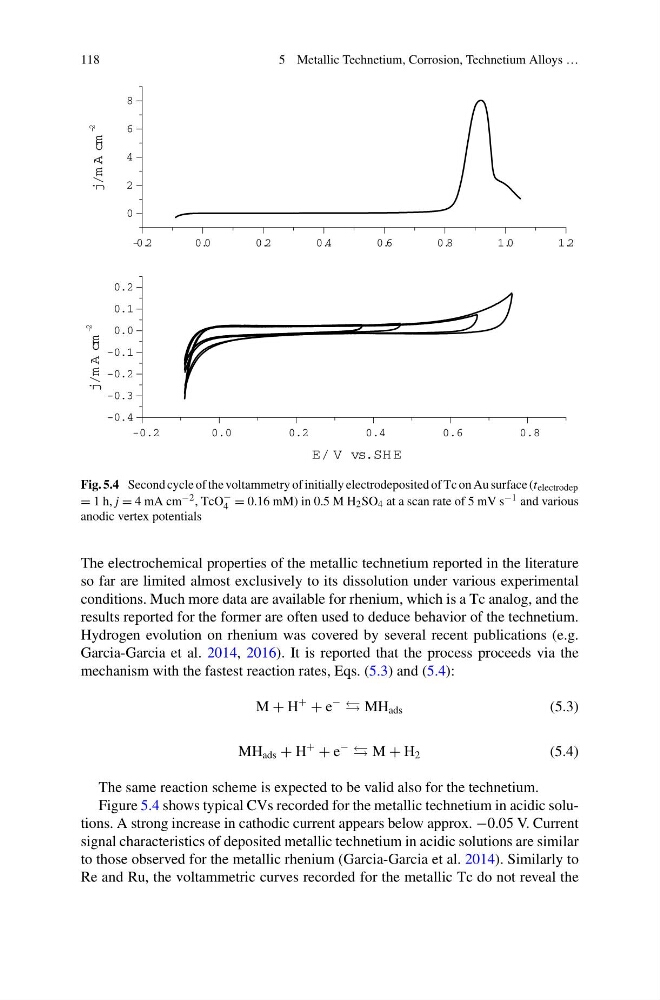
Fig. 5.4 Second cycle of the voltammetry of initially electrodeposited of Tc on Au surface (t electrodep
= 1 h, j = 4 mA cm −2 , TcO
−
4 = 0.16 mM) in 0.5 M H 2 SO 4 at a scan rate of 5 mV s −1 and various
anodic vertex potentials
The electrochemical properties of the metallic technetium reported in the literature
so far are limited almost exclusively to its dissolution under various experimental
conditions. Much more data are available for rhenium, which is a Tc analog, and the
results reported for the former are often used to deduce behavior of the technetium.
Hydrogen evolution on rhenium was covered by several recent publications (e.g.
Garcia-Garcia et al. 2014, 2016). It is reported that the process proceeds via the
mechanism with the fastest reaction rates, Eqs. (5.3) and (5.4):
M + H
+
+ e
−
MH ads
(5.3)
MH ads + H
+
+ e
−
M + H 2
(5.4)
The same reaction scheme is expected to be valid also for the technetium.
Figure 5.4 shows typical CVs recorded for the metallic technetium in acidic solutions. A strong increase in cathodic current appears below approx. −0.05 V. Current
signal characteristics of deposited metallic technetium in acidic solutions are similar
to those observed for the metallic rhenium (Garcia-Garcia et al. 2014). Similarly to
Re and Ru, the voltammetric curves recorded for the metallic Tc do not reveal the
5 Metallic Technetium, Corrosion, Technetium Alloys …
-0.2
0.0
0.2
0.4
0.6
0.8
-0.4
-0.3
-0.2
-0.1
0.0
0.1
0.2
j / m A cm
-2
E/ V vs.SH E
-0. 2
0 . 0
0 . 2
0 . 4
0 . 6
0 . 8
1 . 0
1 . 2
0
2
4
6
8
j / m A cm
-2
Fig. 5.4 Second cycle of the voltammetry of initially electrodeposited of Tc on Au surface (t electrodep
= 1 h, j = 4 mA cm −2 , TcO
−
4 = 0.16 mM) in 0.5 M H 2 SO 4 at a scan rate of 5 mV s −1 and various
anodic vertex potentials
The electrochemical properties of the metallic technetium reported in the literature
so far are limited almost exclusively to its dissolution under various experimental
conditions. Much more data are available for rhenium, which is a Tc analog, and the
results reported for the former are often used to deduce behavior of the technetium.
Hydrogen evolution on rhenium was covered by several recent publications (e.g.
Garcia-Garcia et al. 2014, 2016). It is reported that the process proceeds via the
mechanism with the fastest reaction rates, Eqs. (5.3) and (5.4):
M + H
+
+ e
−
MH ads
(5.3)
MH ads + H
+
+ e
−
M + H 2
(5.4)
The same reaction scheme is expected to be valid also for the technetium.
Figure 5.4 shows typical CVs recorded for the metallic technetium in acidic solutions. A strong increase in cathodic current appears below approx. −0.05 V. Current
signal characteristics of deposited metallic technetium in acidic solutions are similar
to those observed for the metallic rhenium (Garcia-Garcia et al. 2014). Similarly to
Re and Ru, the voltammetric curves recorded for the metallic Tc do not reveal the