

5 Metallic Technetium, Corrosion, Technetium Alloys …
117
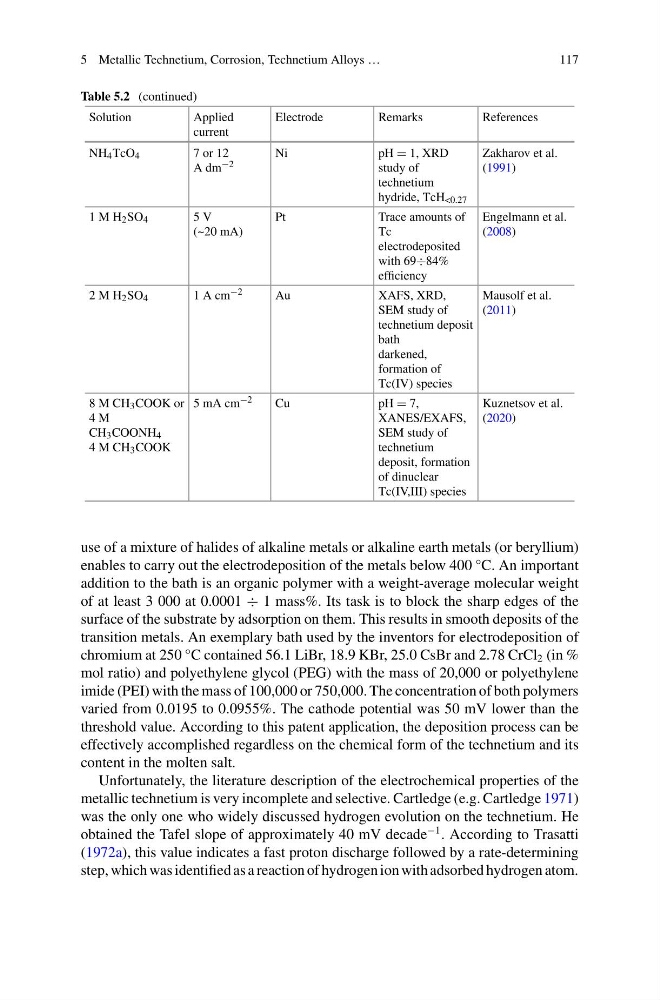
Table 5.2 (continued)
use of a mixture of halides of alkaline metals or alkaline earth metals (or beryllium)
enables to carry out the electrodeposition of the metals below 400 °C. An important
addition to the bath is an organic polymer with a weight-average molecular weight
of at least 3 000 at 0.0001 ÷ 1 mass%. Its task is to block the sharp edges of the
surface of the substrate by adsorption on them. This results in smooth deposits of the
transition metals. An exemplary bath used by the inventors for electrodeposition of
chromium at 250 °C contained 56.1 LiBr, 18.9 KBr, 25.0 CsBr and 2.78 CrCl 2 (in %
mol ratio) and polyethylene glycol (PEG) with the mass of 20,000 or polyethylene
imide (PEI) with the mass of 100,000 or 750,000. The concentration of both polymers
varied from 0.0195 to 0.0955%. The cathode potential was 50 mV lower than the
threshold value. According to this patent application, the deposition process can be
effectively accomplished regardless on the chemical form of the technetium and its
content in the molten salt.
Unfortunately, the literature description of the electrochemical properties of the
metallic technetium is very incomplete and selective. Cartledge (e.g. Cartledge 1971)
was the only one who widely discussed hydrogen evolution on the technetium. He
obtained the Tafel slope of approximately 40 mV decade
−1 . According to Trasatti
(1972a), this value indicates a fast proton discharge followed by a rate-determining
step, which was identified as a reaction of hydrogen ion with adsorbed hydrogen atom.
117
Table 5.2 (continued)
use of a mixture of halides of alkaline metals or alkaline earth metals (or beryllium)
enables to carry out the electrodeposition of the metals below 400 °C. An important
addition to the bath is an organic polymer with a weight-average molecular weight
of at least 3 000 at 0.0001 ÷ 1 mass%. Its task is to block the sharp edges of the
surface of the substrate by adsorption on them. This results in smooth deposits of the
transition metals. An exemplary bath used by the inventors for electrodeposition of
chromium at 250 °C contained 56.1 LiBr, 18.9 KBr, 25.0 CsBr and 2.78 CrCl 2 (in %
mol ratio) and polyethylene glycol (PEG) with the mass of 20,000 or polyethylene
imide (PEI) with the mass of 100,000 or 750,000. The concentration of both polymers
varied from 0.0195 to 0.0955%. The cathode potential was 50 mV lower than the
threshold value. According to this patent application, the deposition process can be
effectively accomplished regardless on the chemical form of the technetium and its
content in the molten salt.
Unfortunately, the literature description of the electrochemical properties of the
metallic technetium is very incomplete and selective. Cartledge (e.g. Cartledge 1971)
was the only one who widely discussed hydrogen evolution on the technetium. He
obtained the Tafel slope of approximately 40 mV decade
−1 . According to Trasatti
(1972a), this value indicates a fast proton discharge followed by a rate-determining
step, which was identified as a reaction of hydrogen ion with adsorbed hydrogen atom.