

5 Metallic Technetium, Corrosion, Technetium Alloys …
123
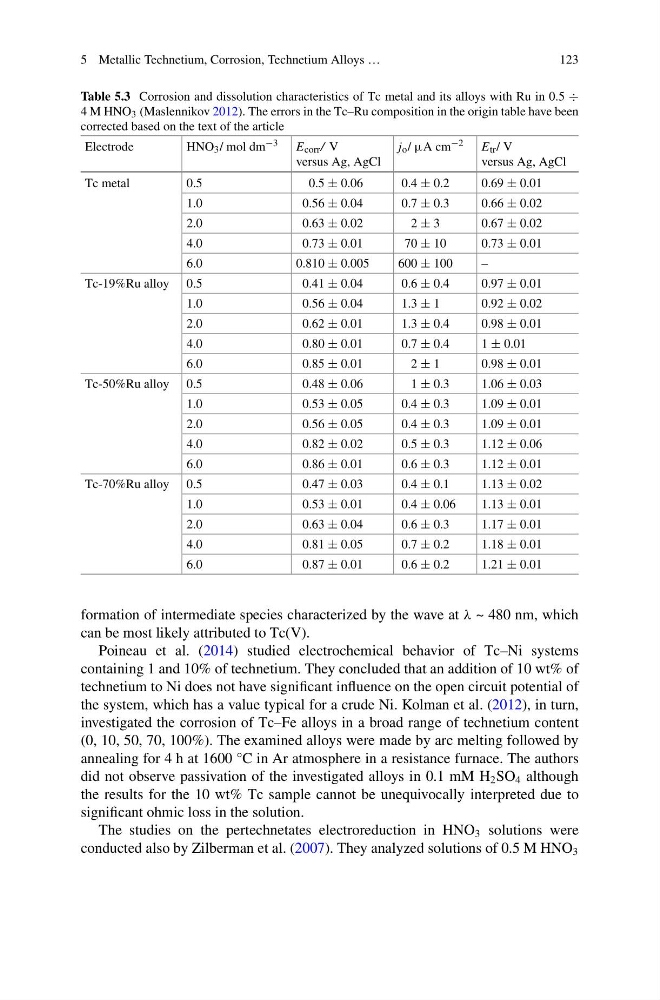
Table 5.3 Corrosion and dissolution characteristics of Tc metal and its alloys with Ru in 0.5 ÷
4 M HNO 3 (Maslennikov 2012). The errors in the Tc–Ru composition in the origin table have been
corrected based on the text of the article
Electrode
HNO 3 / mol dm −3 E corr / V
versus Ag, AgCl
j o / μA cm −2 E tr / V
versus Ag, AgCl
Tc metal
0.5
0.5 ± 0.06
0.4 ± 0.2
0.69 ± 0.01
1.0
0.56 ± 0.04
0.7 ± 0.3
0.66 ± 0.02
2.0
0.63 ± 0.02
2 ± 3
0.67 ± 0.02
4.0
0.73 ± 0.01
70 ± 10
0.73 ± 0.01
6.0
0.810 ± 0.005
600 ± 100
–
Tc-19%Ru alloy 0.5
0.41 ± 0.04
0.6 ± 0.4
0.97 ± 0.01
1.0
0.56 ± 0.04
1.3 ± 1
0.92 ± 0.02
2.0
0.62 ± 0.01
1.3 ± 0.4
0.98 ± 0.01
4.0
0.80 ± 0.01
0.7 ± 0.4
1 ± 0.01
6.0
0.85 ± 0.01
2 ± 1
0.98 ± 0.01
Tc-50%Ru alloy 0.5
0.48 ± 0.06
1 ± 0.3
1.06 ± 0.03
1.0
0.53 ± 0.05
0.4 ± 0.3
1.09 ± 0.01
2.0
0.56 ± 0.05
0.4 ± 0.3
1.09 ± 0.01
4.0
0.82 ± 0.02
0.5 ± 0.3
1.12 ± 0.06
6.0
0.86 ± 0.01
0.6 ± 0.3
1.12 ± 0.01
Tc-70%Ru alloy 0.5
0.47 ± 0.03
0.4 ± 0.1
1.13 ± 0.02
1.0
0.53 ± 0.01
0.4 ± 0.06
1.13 ± 0.01
2.0
0.63 ± 0.04
0.6 ± 0.3
1.17 ± 0.01
4.0
0.81 ± 0.05
0.7 ± 0.2
1.18 ± 0.01
6.0
0.87 ± 0.01
0.6 ± 0.2
1.21 ± 0.01
formation of intermediate species characterized by the wave at λ ~ 480 nm, which
can be most likely attributed to Tc(V).
Poineau et al. (2014) studied electrochemical behavior of Tc–Ni systems
containing 1 and 10% of technetium. They concluded that an addition of 10 wt% of
technetium to Ni does not have significant influence on the open circuit potential of
the system, which has a value typical for a crude Ni. Kolman et al. (2012), in turn,
investigated the corrosion of Tc–Fe alloys in a broad range of technetium content
(0, 10, 50, 70, 100%). The examined alloys were made by arc melting followed by
annealing for 4 h at 1600 °C in Ar atmosphere in a resistance furnace. The authors
did not observe passivation of the investigated alloys in 0.1 mM H 2 SO 4 although
the results for the 10 wt% Tc sample cannot be unequivocally interpreted due to
significant ohmic loss in the solution.
The studies on the pertechnetates electroreduction in HNO 3 solutions were
conducted also by Zilberman et al. (2007). They analyzed solutions of 0.5 M HNO 3
123
Table 5.3 Corrosion and dissolution characteristics of Tc metal and its alloys with Ru in 0.5 ÷
4 M HNO 3 (Maslennikov 2012). The errors in the Tc–Ru composition in the origin table have been
corrected based on the text of the article
Electrode
HNO 3 / mol dm −3 E corr / V
versus Ag, AgCl
j o / μA cm −2 E tr / V
versus Ag, AgCl
Tc metal
0.5
0.5 ± 0.06
0.4 ± 0.2
0.69 ± 0.01
1.0
0.56 ± 0.04
0.7 ± 0.3
0.66 ± 0.02
2.0
0.63 ± 0.02
2 ± 3
0.67 ± 0.02
4.0
0.73 ± 0.01
70 ± 10
0.73 ± 0.01
6.0
0.810 ± 0.005
600 ± 100
–
Tc-19%Ru alloy 0.5
0.41 ± 0.04
0.6 ± 0.4
0.97 ± 0.01
1.0
0.56 ± 0.04
1.3 ± 1
0.92 ± 0.02
2.0
0.62 ± 0.01
1.3 ± 0.4
0.98 ± 0.01
4.0
0.80 ± 0.01
0.7 ± 0.4
1 ± 0.01
6.0
0.85 ± 0.01
2 ± 1
0.98 ± 0.01
Tc-50%Ru alloy 0.5
0.48 ± 0.06
1 ± 0.3
1.06 ± 0.03
1.0
0.53 ± 0.05
0.4 ± 0.3
1.09 ± 0.01
2.0
0.56 ± 0.05
0.4 ± 0.3
1.09 ± 0.01
4.0
0.82 ± 0.02
0.5 ± 0.3
1.12 ± 0.06
6.0
0.86 ± 0.01
0.6 ± 0.3
1.12 ± 0.01
Tc-70%Ru alloy 0.5
0.47 ± 0.03
0.4 ± 0.1
1.13 ± 0.02
1.0
0.53 ± 0.01
0.4 ± 0.06
1.13 ± 0.01
2.0
0.63 ± 0.04
0.6 ± 0.3
1.17 ± 0.01
4.0
0.81 ± 0.05
0.7 ± 0.2
1.18 ± 0.01
6.0
0.87 ± 0.01
0.6 ± 0.2
1.21 ± 0.01
formation of intermediate species characterized by the wave at λ ~ 480 nm, which
can be most likely attributed to Tc(V).
Poineau et al. (2014) studied electrochemical behavior of Tc–Ni systems
containing 1 and 10% of technetium. They concluded that an addition of 10 wt% of
technetium to Ni does not have significant influence on the open circuit potential of
the system, which has a value typical for a crude Ni. Kolman et al. (2012), in turn,
investigated the corrosion of Tc–Fe alloys in a broad range of technetium content
(0, 10, 50, 70, 100%). The examined alloys were made by arc melting followed by
annealing for 4 h at 1600 °C in Ar atmosphere in a resistance furnace. The authors
did not observe passivation of the investigated alloys in 0.1 mM H 2 SO 4 although
the results for the 10 wt% Tc sample cannot be unequivocally interpreted due to
significant ohmic loss in the solution.
The studies on the pertechnetates electroreduction in HNO 3 solutions were
conducted also by Zilberman et al. (2007). They analyzed solutions of 0.5 M HNO 3