

5 Metallic Technetium, Corrosion, Technetium Alloys …
111
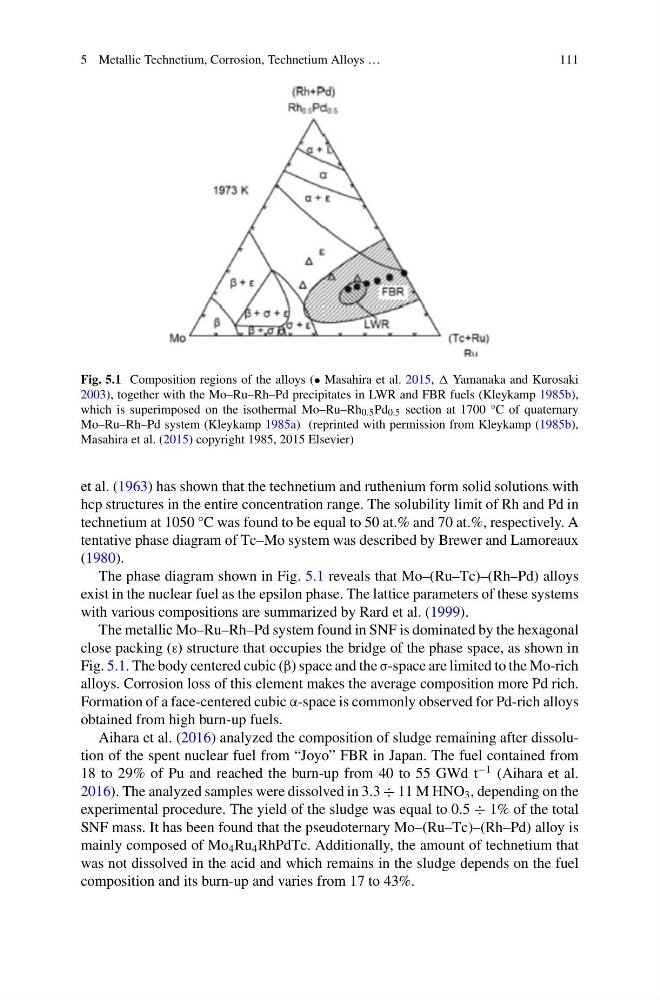
Fig. 5.1 Composition regions of the alloys (• Masahira et al. 2015, Yamanaka and Kurosaki
2003), together with the Mo–Ru–Rh–Pd precipitates in LWR and FBR fuels (Kleykamp 1985b),
which is superimposed on the isothermal Mo–Ru–Rh 0.5 Pd 0.5 section at 1700 °C of quaternary
Mo–Ru–Rh–Pd system (Kleykamp 1985a) (reprinted with permission from Kleykamp (1985b),
Masahira et al. (2015) copyright 1985, 2015 Elsevier)
et al. (1963) has shown that the technetium and ruthenium form solid solutions with
hcp structures in the entire concentration range. The solubility limit of Rh and Pd in
technetium at 1050 °C was found to be equal to 50 at.% and 70 at.%, respectively. A
tentative phase diagram of Tc–Mo system was described by Brewer and Lamoreaux
(1980).
The phase diagram shown in Fig. 5.1 reveals that Mo–(Ru–Tc)–(Rh–Pd) alloys
exist in the nuclear fuel as the epsilon phase. The lattice parameters of these systems
with various compositions are summarized by Rard et al. (1999).
The metallic Mo–Ru–Rh–Pd system found in SNF is dominated by the hexagonal
close packing (ε) structure that occupies the bridge of the phase space, as shown in
Fig. 5.1. The body centered cubic (β) space and the σ-space are limited to the Mo-rich
alloys. Corrosion loss of this element makes the average composition more Pd rich.
Formation of a face-centered cubic α-space is commonly observed for Pd-rich alloys
obtained from high burn-up fuels.
Aihara et al. (2016) analyzed the composition of sludge remaining after dissolution of the spent nuclear fuel from “Joyo” FBR in Japan. The fuel contained from
18 to 29% of Pu and reached the burn-up from 40 to 55 GWd t
−1 (Aihara et al.
2016). The analyzed samples were dissolved in 3.3 ÷ 11 M HNO 3 , depending on the
experimental procedure. The yield of the sludge was equal to 0.5 ÷ 1% of the total
SNF mass. It has been found that the pseudoternary Mo–(Ru–Tc)–(Rh–Pd) alloy is
mainly composed of Mo 4 Ru 4 RhPdTc. Additionally, the amount of technetium that
was not dissolved in the acid and which remains in the sludge depends on the fuel
composition and its burn-up and varies from 17 to 43%.
111
Fig. 5.1 Composition regions of the alloys (• Masahira et al. 2015, Yamanaka and Kurosaki
2003), together with the Mo–Ru–Rh–Pd precipitates in LWR and FBR fuels (Kleykamp 1985b),
which is superimposed on the isothermal Mo–Ru–Rh 0.5 Pd 0.5 section at 1700 °C of quaternary
Mo–Ru–Rh–Pd system (Kleykamp 1985a) (reprinted with permission from Kleykamp (1985b),
Masahira et al. (2015) copyright 1985, 2015 Elsevier)
et al. (1963) has shown that the technetium and ruthenium form solid solutions with
hcp structures in the entire concentration range. The solubility limit of Rh and Pd in
technetium at 1050 °C was found to be equal to 50 at.% and 70 at.%, respectively. A
tentative phase diagram of Tc–Mo system was described by Brewer and Lamoreaux
(1980).
The phase diagram shown in Fig. 5.1 reveals that Mo–(Ru–Tc)–(Rh–Pd) alloys
exist in the nuclear fuel as the epsilon phase. The lattice parameters of these systems
with various compositions are summarized by Rard et al. (1999).
The metallic Mo–Ru–Rh–Pd system found in SNF is dominated by the hexagonal
close packing (ε) structure that occupies the bridge of the phase space, as shown in
Fig. 5.1. The body centered cubic (β) space and the σ-space are limited to the Mo-rich
alloys. Corrosion loss of this element makes the average composition more Pd rich.
Formation of a face-centered cubic α-space is commonly observed for Pd-rich alloys
obtained from high burn-up fuels.
Aihara et al. (2016) analyzed the composition of sludge remaining after dissolution of the spent nuclear fuel from “Joyo” FBR in Japan. The fuel contained from
18 to 29% of Pu and reached the burn-up from 40 to 55 GWd t
−1 (Aihara et al.
2016). The analyzed samples were dissolved in 3.3 ÷ 11 M HNO 3 , depending on the
experimental procedure. The yield of the sludge was equal to 0.5 ÷ 1% of the total
SNF mass. It has been found that the pseudoternary Mo–(Ru–Tc)–(Rh–Pd) alloy is
mainly composed of Mo 4 Ru 4 RhPdTc. Additionally, the amount of technetium that
was not dissolved in the acid and which remains in the sludge depends on the fuel
composition and its burn-up and varies from 17 to 43%.