

112
5 Metallic Technetium, Corrosion, Technetium Alloys …
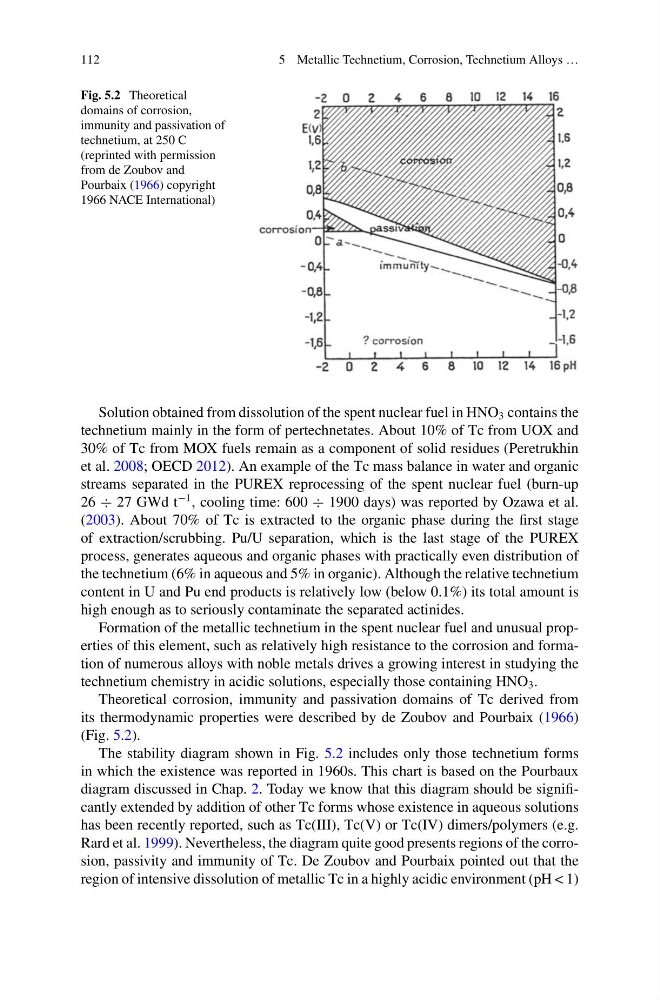
Fig. 5.2 Theoretical
domains of corrosion,
immunity and passivation of
technetium, at 250 C
(reprinted with permission
from de Zoubov and
Pourbaix (1966) copyright
1966 NACE International)
Solution obtained from dissolution of the spent nuclear fuel in HNO 3 contains the
technetium mainly in the form of pertechnetates. About 10% of Tc from UOX and
30% of Tc from MOX fuels remain as a component of solid residues (Peretrukhin
et al. 2008; OECD 2012). An example of the Tc mass balance in water and organic
streams separated in the PUREX reprocessing of the spent nuclear fuel (burn-up
26 ÷ 27 GWd t
−1 , cooling time: 600 ÷ 1900 days) was reported by Ozawa et al.
(2003). About 70% of Tc is extracted to the organic phase during the first stage
of extraction/scrubbing. Pu/U separation, which is the last stage of the PUREX
process, generates aqueous and organic phases with practically even distribution of
the technetium (6% in aqueous and 5% in organic). Although the relative technetium
content in U and Pu end products is relatively low (below 0.1%) its total amount is
high enough as to seriously contaminate the separated actinides.
Formation of the metallic technetium in the spent nuclear fuel and unusual properties of this element, such as relatively high resistance to the corrosion and formation of numerous alloys with noble metals drives a growing interest in studying the
technetium chemistry in acidic solutions, especially those containing HNO 3 .
Theoretical corrosion, immunity and passivation domains of Tc derived from
its thermodynamic properties were described by de Zoubov and Pourbaix (1966)
(Fig. 5.2).
The stability diagram shown in Fig. 5.2 includes only those technetium forms
in which the existence was reported in 1960s. This chart is based on the Pourbaux
diagram discussed in Chap. 2. Today we know that this diagram should be significantly extended by addition of other Tc forms whose existence in aqueous solutions
has been recently reported, such as Tc(III), Tc(V) or Tc(IV) dimers/polymers (e.g.
Rard et al. 1999). Nevertheless, the diagram quite good presents regions of the corrosion, passivity and immunity of Tc. De Zoubov and Pourbaix pointed out that the
region of intensive dissolution of metallic Tc in a highly acidic environment (pH < 1)
5 Metallic Technetium, Corrosion, Technetium Alloys …
Fig. 5.2 Theoretical
domains of corrosion,
immunity and passivation of
technetium, at 250 C
(reprinted with permission
from de Zoubov and
Pourbaix (1966) copyright
1966 NACE International)
Solution obtained from dissolution of the spent nuclear fuel in HNO 3 contains the
technetium mainly in the form of pertechnetates. About 10% of Tc from UOX and
30% of Tc from MOX fuels remain as a component of solid residues (Peretrukhin
et al. 2008; OECD 2012). An example of the Tc mass balance in water and organic
streams separated in the PUREX reprocessing of the spent nuclear fuel (burn-up
26 ÷ 27 GWd t
−1 , cooling time: 600 ÷ 1900 days) was reported by Ozawa et al.
(2003). About 70% of Tc is extracted to the organic phase during the first stage
of extraction/scrubbing. Pu/U separation, which is the last stage of the PUREX
process, generates aqueous and organic phases with practically even distribution of
the technetium (6% in aqueous and 5% in organic). Although the relative technetium
content in U and Pu end products is relatively low (below 0.1%) its total amount is
high enough as to seriously contaminate the separated actinides.
Formation of the metallic technetium in the spent nuclear fuel and unusual properties of this element, such as relatively high resistance to the corrosion and formation of numerous alloys with noble metals drives a growing interest in studying the
technetium chemistry in acidic solutions, especially those containing HNO 3 .
Theoretical corrosion, immunity and passivation domains of Tc derived from
its thermodynamic properties were described by de Zoubov and Pourbaix (1966)
(Fig. 5.2).
The stability diagram shown in Fig. 5.2 includes only those technetium forms
in which the existence was reported in 1960s. This chart is based on the Pourbaux
diagram discussed in Chap. 2. Today we know that this diagram should be significantly extended by addition of other Tc forms whose existence in aqueous solutions
has been recently reported, such as Tc(III), Tc(V) or Tc(IV) dimers/polymers (e.g.
Rard et al. 1999). Nevertheless, the diagram quite good presents regions of the corrosion, passivity and immunity of Tc. De Zoubov and Pourbaix pointed out that the
region of intensive dissolution of metallic Tc in a highly acidic environment (pH < 1)