

110
5 Metallic Technetium, Corrosion, Technetium Alloys …
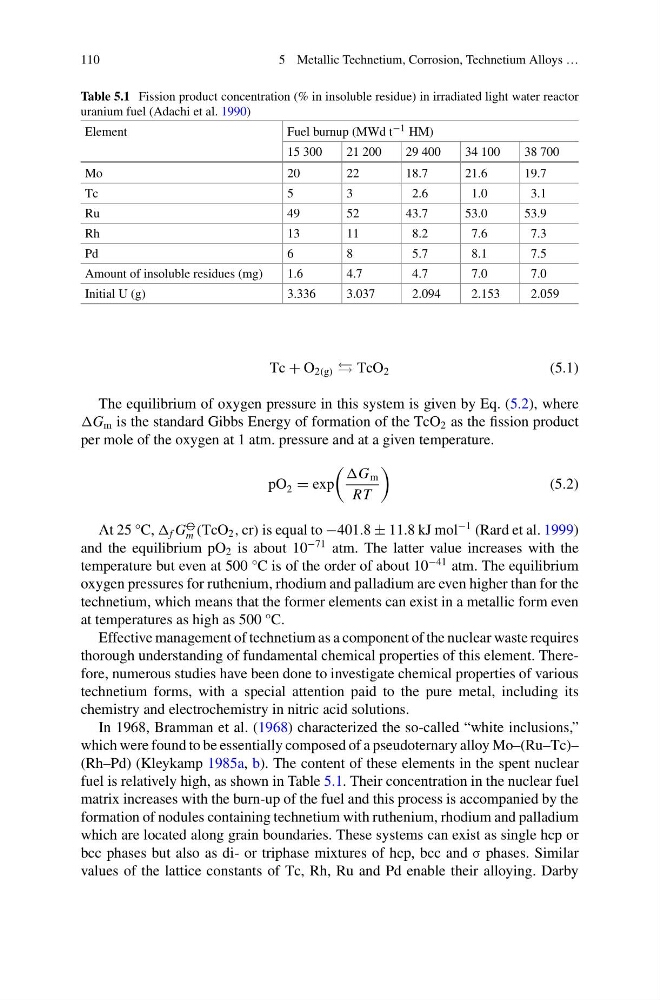
Table 5.1 Fission product concentration (% in insoluble residue) in irradiated light water reactor
uranium fuel (Adachi et al. 1990)
Element
Fuel burnup (MWd t −1 HM)
15 300
21 200
29 400
34 100
38 700
Mo
20
22
18.7
21.6
19.7
Tc
5
3
2.6
1.0
3.1
Ru
49
52
43.7
53.0
53.9
Rh
13
11
8.2
7.6
7.3
Pd
6
8
5.7
8.1
7.5
Amount of insoluble residues (mg)
1.6
4.7
4.7
7.0
7.0
Initial U (g)
3.336
3.037
2.094
2.153
2.059
Tc + O 2(g) TcO 2
(5.1)
The equilibrium of oxygen pressure in this system is given by Eq. (5.2), where
G m is the standard Gibbs Energy of formation of the TcO 2 as the fission product
per mole of the oxygen at 1 atm. pressure and at a given temperature.
pO 2 = exp
G m
RT
(5.2)
At 25 °C, f G
⦵
m (TcO 2 , cr) is equal to −401.8 ± 11.8 kJ mol
−1 (Rard et al. 1999)
and the equilibrium pO 2 is about 10
−71 atm. The latter value increases with the
temperature but even at 500 °C is of the order of about 10
−41 atm. The equilibrium
oxygen pressures for ruthenium, rhodium and palladium are even higher than for the
technetium, which means that the former elements can exist in a metallic form even
at temperatures as high as 500 °C.
Effective management of technetium as a component of the nuclear waste requires
thorough understanding of fundamental chemical properties of this element. Therefore, numerous studies have been done to investigate chemical properties of various
technetium forms, with a special attention paid to the pure metal, including its
chemistry and electrochemistry in nitric acid solutions.
In 1968, Bramman et al. (1968) characterized the so-called “white inclusions,”
which were found to be essentially composed of a pseudoternary alloy Mo–(Ru–Tc)–
(Rh–Pd) (Kleykamp 1985a, b). The content of these elements in the spent nuclear
fuel is relatively high, as shown in Table 5.1. Their concentration in the nuclear fuel
matrix increases with the burn-up of the fuel and this process is accompanied by the
formation of nodules containing technetium with ruthenium, rhodium and palladium
which are located along grain boundaries. These systems can exist as single hcp or
bcc phases but also as di- or triphase mixtures of hcp, bcc and σ phases. Similar
values of the lattice constants of Tc, Rh, Ru and Pd enable their alloying. Darby
5 Metallic Technetium, Corrosion, Technetium Alloys …
Table 5.1 Fission product concentration (% in insoluble residue) in irradiated light water reactor
uranium fuel (Adachi et al. 1990)
Element
Fuel burnup (MWd t −1 HM)
15 300
21 200
29 400
34 100
38 700
Mo
20
22
18.7
21.6
19.7
Tc
5
3
2.6
1.0
3.1
Ru
49
52
43.7
53.0
53.9
Rh
13
11
8.2
7.6
7.3
Pd
6
8
5.7
8.1
7.5
Amount of insoluble residues (mg)
1.6
4.7
4.7
7.0
7.0
Initial U (g)
3.336
3.037
2.094
2.153
2.059
Tc + O 2(g) TcO 2
(5.1)
The equilibrium of oxygen pressure in this system is given by Eq. (5.2), where
G m is the standard Gibbs Energy of formation of the TcO 2 as the fission product
per mole of the oxygen at 1 atm. pressure and at a given temperature.
pO 2 = exp
G m
RT
(5.2)
At 25 °C, f G
⦵
m (TcO 2 , cr) is equal to −401.8 ± 11.8 kJ mol
−1 (Rard et al. 1999)
and the equilibrium pO 2 is about 10
−71 atm. The latter value increases with the
temperature but even at 500 °C is of the order of about 10
−41 atm. The equilibrium
oxygen pressures for ruthenium, rhodium and palladium are even higher than for the
technetium, which means that the former elements can exist in a metallic form even
at temperatures as high as 500 °C.
Effective management of technetium as a component of the nuclear waste requires
thorough understanding of fundamental chemical properties of this element. Therefore, numerous studies have been done to investigate chemical properties of various
technetium forms, with a special attention paid to the pure metal, including its
chemistry and electrochemistry in nitric acid solutions.
In 1968, Bramman et al. (1968) characterized the so-called “white inclusions,”
which were found to be essentially composed of a pseudoternary alloy Mo–(Ru–Tc)–
(Rh–Pd) (Kleykamp 1985a, b). The content of these elements in the spent nuclear
fuel is relatively high, as shown in Table 5.1. Their concentration in the nuclear fuel
matrix increases with the burn-up of the fuel and this process is accompanied by the
formation of nodules containing technetium with ruthenium, rhodium and palladium
which are located along grain boundaries. These systems can exist as single hcp or
bcc phases but also as di- or triphase mixtures of hcp, bcc and σ phases. Similar
values of the lattice constants of Tc, Rh, Ru and Pd enable their alloying. Darby