

232
14.2.3 Volcanism
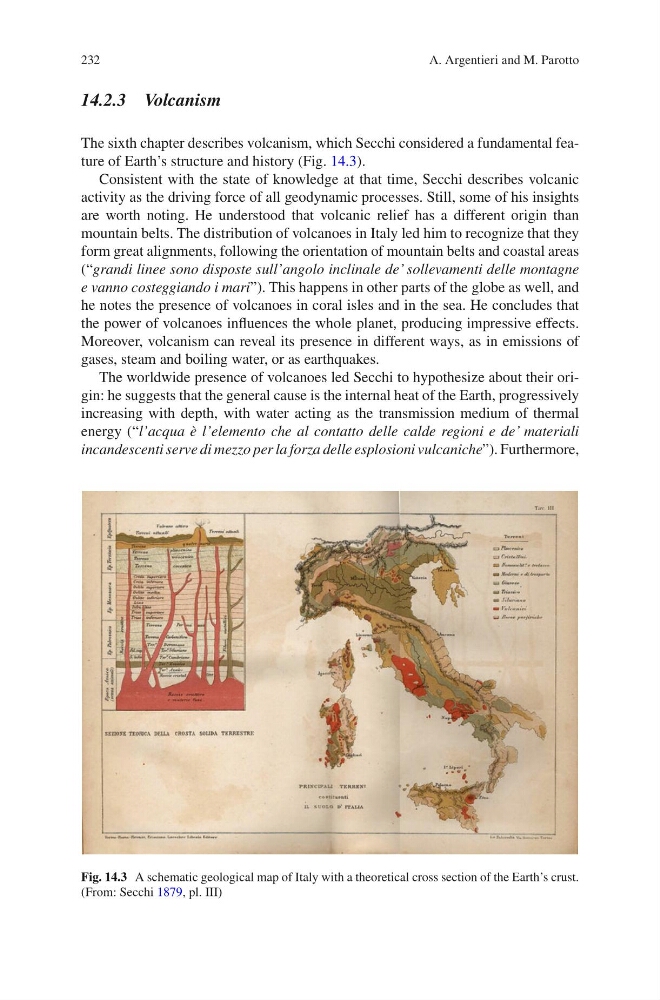
The sixth chapter describes volcanism, which Secchi considered a fundamental feature of Earth’s structure and history (Fig. 14.3).
Consistent with the state of knowledge at that time, Secchi describes volcanic
activity as the driving force of all geodynamic processes. Still, some of his insights
are worth noting. He understood that volcanic relief has a different origin than
mountain belts. The distribution of volcanoes in Italy led him to recognize that they
form great alignments, following the orientation of mountain belts and coastal areas
(“grandi linee sono disposte sull’angolo inclinale de’ sollevamenti delle montagne
e vanno costeggiando i mari”). This happens in other parts of the globe as well, and
he notes the presence of volcanoes in coral isles and in the sea. He concludes that
the power of volcanoes influences the whole planet, producing impressive effects.
Moreover, volcanism can reveal its presence in different ways, as in emissions of
gases, steam and boiling water, or as earthquakes.
The worldwide presence of volcanoes led Secchi to hypothesize about their origin: he suggests that the general cause is the internal heat of the Earth, progressively
increasing with depth, with water acting as the transmission medium of thermal
energy (“l’acqua è l’elemento che al contatto delle calde regioni e de’ materiali
incandescenti serve di mezzo per la forza delle esplosioni vulcaniche”). Furthermore,
Fig. 14.3 A schematic geological map of Italy with a theoretical cross section of the Earth’s crust.
(From: Secchi 1879, pl. III)
A. Argentieri and M. Parotto
14.2.3 Volcanism
The sixth chapter describes volcanism, which Secchi considered a fundamental feature of Earth’s structure and history (Fig. 14.3).
Consistent with the state of knowledge at that time, Secchi describes volcanic
activity as the driving force of all geodynamic processes. Still, some of his insights
are worth noting. He understood that volcanic relief has a different origin than
mountain belts. The distribution of volcanoes in Italy led him to recognize that they
form great alignments, following the orientation of mountain belts and coastal areas
(“grandi linee sono disposte sull’angolo inclinale de’ sollevamenti delle montagne
e vanno costeggiando i mari”). This happens in other parts of the globe as well, and
he notes the presence of volcanoes in coral isles and in the sea. He concludes that
the power of volcanoes influences the whole planet, producing impressive effects.
Moreover, volcanism can reveal its presence in different ways, as in emissions of
gases, steam and boiling water, or as earthquakes.
The worldwide presence of volcanoes led Secchi to hypothesize about their origin: he suggests that the general cause is the internal heat of the Earth, progressively
increasing with depth, with water acting as the transmission medium of thermal
energy (“l’acqua è l’elemento che al contatto delle calde regioni e de’ materiali
incandescenti serve di mezzo per la forza delle esplosioni vulcaniche”). Furthermore,
Fig. 14.3 A schematic geological map of Italy with a theoretical cross section of the Earth’s crust.
(From: Secchi 1879, pl. III)
A. Argentieri and M. Parotto