

109
Secchi shows several ‘capes’ and ‘tributaries’ in his work and shares the opinions in
print, suggesting the influence of this prevailing thought. Some markings later
labelled as canals appear in the drawings. Protonilus-Deuteronilus would turn out to
be an objective topographic feature, but some minor streaks could be dismissed as
illusion, examples of where the eye straining to resolve detail between two maria
subconsciously prolongs an irregular edge into a non-existent streak connecting
the two.
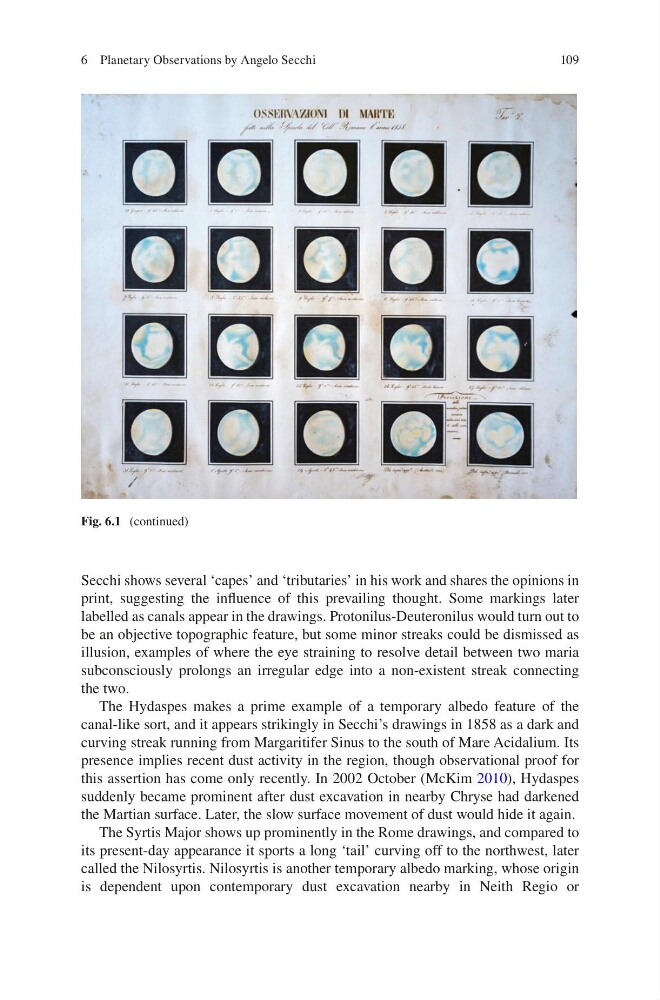
The Hydaspes makes a prime example of a temporary albedo feature of the
canal-like sort, and it appears strikingly in Secchi’s drawings in 1858 as a dark and
curving streak running from Margaritifer Sinus to the south of Mare Acidalium. Its
presence implies recent dust activity in the region, though observational proof for
this assertion has come only recently. In 2002 October (McKim 2010), Hydaspes
suddenly became prominent after dust excavation in nearby Chryse had darkened
the Martian surface. Later, the slow surface movement of dust would hide it again.
The Syrtis Major shows up prominently in the Rome drawings, and compared to
its present-day appearance it sports a long ‘tail’ curving off to the northwest, later
called the Nilosyrtis. Nilosyrtis is another temporary albedo marking, whose origin
is dependent upon contemporary dust excavation nearby in Neith Regio or
Fig. 6.1 (continued)
6 Planetary Observations by Angelo Secchi
Secchi shows several ‘capes’ and ‘tributaries’ in his work and shares the opinions in
print, suggesting the influence of this prevailing thought. Some markings later
labelled as canals appear in the drawings. Protonilus-Deuteronilus would turn out to
be an objective topographic feature, but some minor streaks could be dismissed as
illusion, examples of where the eye straining to resolve detail between two maria
subconsciously prolongs an irregular edge into a non-existent streak connecting
the two.
The Hydaspes makes a prime example of a temporary albedo feature of the
canal-like sort, and it appears strikingly in Secchi’s drawings in 1858 as a dark and
curving streak running from Margaritifer Sinus to the south of Mare Acidalium. Its
presence implies recent dust activity in the region, though observational proof for
this assertion has come only recently. In 2002 October (McKim 2010), Hydaspes
suddenly became prominent after dust excavation in nearby Chryse had darkened
the Martian surface. Later, the slow surface movement of dust would hide it again.
The Syrtis Major shows up prominently in the Rome drawings, and compared to
its present-day appearance it sports a long ‘tail’ curving off to the northwest, later
called the Nilosyrtis. Nilosyrtis is another temporary albedo marking, whose origin
is dependent upon contemporary dust excavation nearby in Neith Regio or
Fig. 6.1 (continued)
6 Planetary Observations by Angelo Secchi