

110
Utopia- Casius. On the east side of the Syrtis, another curved albedo streak,
Nepenthes, is quite prominent. The latter feature owes its origin to dust activity in
Isidis Regio- Libya. (Today, lack of such activity since the 1970s has caused
Nepenthes to remain absent for nearly 50 years.)
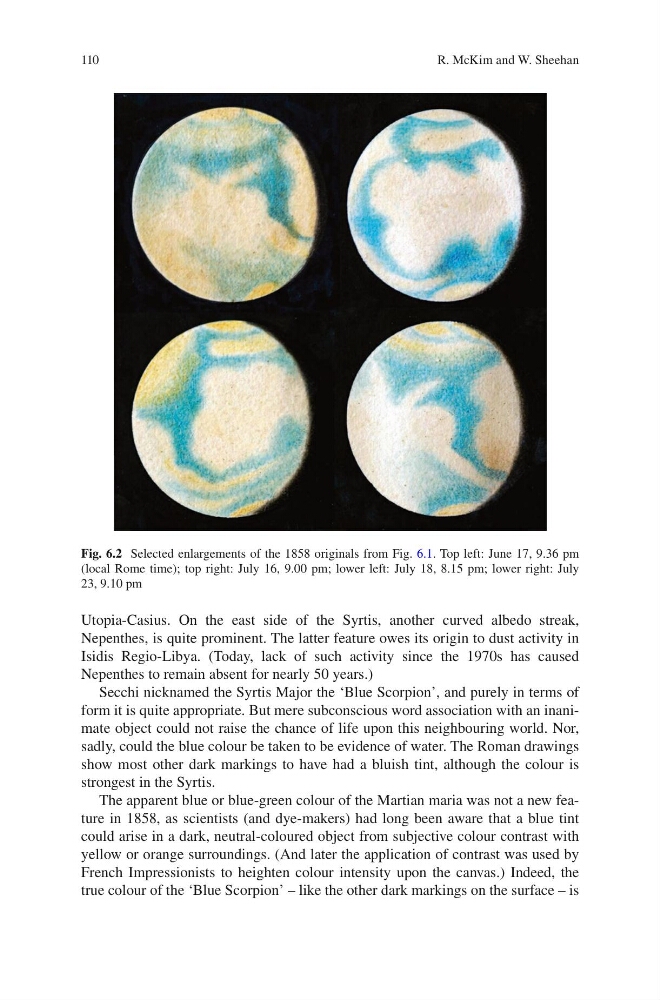
Secchi nicknamed the Syrtis Major the ‘Blue Scorpion’, and purely in terms of
form it is quite appropriate. But mere subconscious word association with an inanimate object could not raise the chance of life upon this neighbouring world. Nor,
sadly, could the blue colour be taken to be evidence of water. The Roman drawings
show most other dark markings to have had a bluish tint, although the colour is
strongest in the Syrtis.
The apparent blue or blue-green colour of the Martian maria was not a new feature in 1858, as scientists (and dye-makers) had long been aware that a blue tint
could arise in a dark, neutral-coloured object from subjective colour contrast with
yellow or orange surroundings. (And later the application of contrast was used by
French Impressionists to heighten colour intensity upon the canvas.) Indeed, the
true colour of the ‘Blue Scorpion’ – like the other dark markings on the surface – is
Fig. 6.2 Selected enlargements of the 1858 originals from Fig. 6.1. Top left: June 17, 9.36 pm
(local Rome time); top right: July 16, 9.00 pm; lower left: July 18, 8.15 pm; lower right: July
23, 9.10 pm
R. McKim and W. Sheehan
Utopia- Casius. On the east side of the Syrtis, another curved albedo streak,
Nepenthes, is quite prominent. The latter feature owes its origin to dust activity in
Isidis Regio- Libya. (Today, lack of such activity since the 1970s has caused
Nepenthes to remain absent for nearly 50 years.)
Secchi nicknamed the Syrtis Major the ‘Blue Scorpion’, and purely in terms of
form it is quite appropriate. But mere subconscious word association with an inanimate object could not raise the chance of life upon this neighbouring world. Nor,
sadly, could the blue colour be taken to be evidence of water. The Roman drawings
show most other dark markings to have had a bluish tint, although the colour is
strongest in the Syrtis.
The apparent blue or blue-green colour of the Martian maria was not a new feature in 1858, as scientists (and dye-makers) had long been aware that a blue tint
could arise in a dark, neutral-coloured object from subjective colour contrast with
yellow or orange surroundings. (And later the application of contrast was used by
French Impressionists to heighten colour intensity upon the canvas.) Indeed, the
true colour of the ‘Blue Scorpion’ – like the other dark markings on the surface – is
Fig. 6.2 Selected enlargements of the 1858 originals from Fig. 6.1. Top left: June 17, 9.36 pm
(local Rome time); top right: July 16, 9.00 pm; lower left: July 18, 8.15 pm; lower right: July
23, 9.10 pm
R. McKim and W. Sheehan