

68
T. T. Bui and S. Nakata
Figure 6 illustrates the MSEP of the velocity field of the proposed technique and
inflow/outflow by I. Federico [6]. As the figure, it can be seen that the MSEP of the
proposed technique is low with the maximum error is about 0.1% at the resolution 4x.
The performance of the MSEP is significantly lower to compare with inflow/outflow
in I. Federico [6] at three different spatial resolutions even though the resolution x
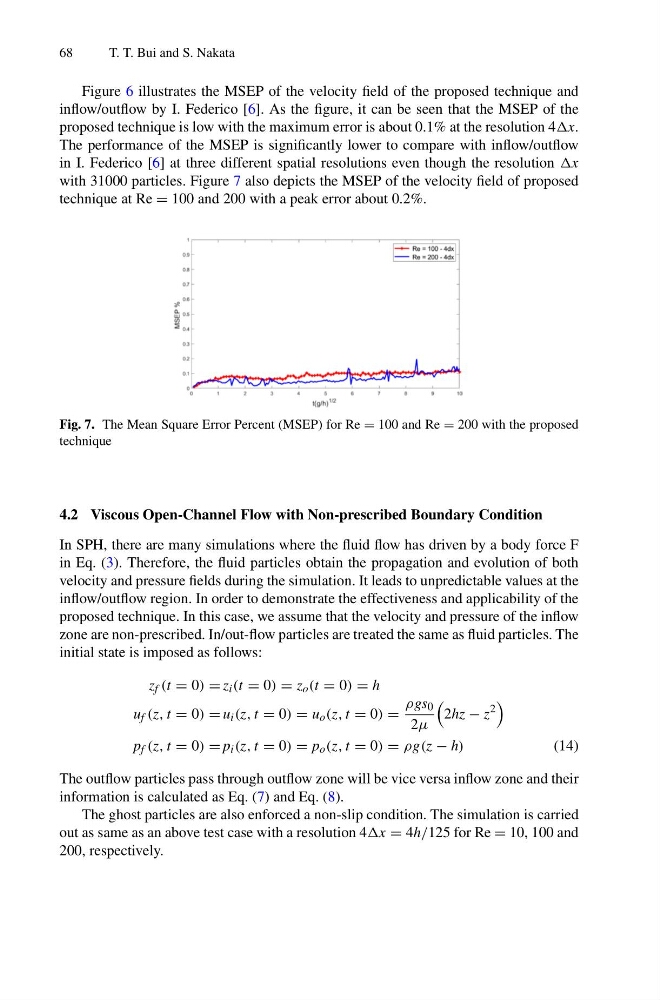
with 31000 particles. Figure 7 also depicts the MSEP of the velocity field of proposed
technique at Re = 100 and 200 with a peak error about 0.2%.
Fig. 7. The Mean Square Error Percent (MSEP) for Re = 100 and Re = 200 with the proposed
technique
4.2 Viscous Open-Channel Flow with Non-prescribed Boundary Condition
In SPH, there are many simulations where the fluid flow has driven by a body force F
in Eq. (3). Therefore, the fluid particles obtain the propagation and evolution of both
velocity and pressure fields during the simulation. It leads to unpredictable values at the
inflow/outflow region. In order to demonstrate the effectiveness and applicability of the
proposed technique. In this case, we assume that the velocity and pressure of the inflow
zone are non-prescribed. In/out-flow particles are treated the same as fluid particles. The
initial state is imposed as follows:
z f (t = 0) = z i (t = 0) = z o (t = 0) = h
u f (z, t = 0) = u i (z, t = 0) = u o (z, t = 0) =
ρgs 0
2μ
2hz − z
2
p f (z, t = 0) = p i (z, t = 0) = p o (z, t = 0) = ρg(z − h)
(14)
The outflow particles pass through outflow zone will be vice versa inflow zone and their
information is calculated as Eq. (7) and Eq. (8).
The ghost particles are also enforced a non-slip condition. The simulation is carried
out as same as an above test case with a resolution 4x = 4h/125 for Re = 10, 100 and
200, respectively.
T. T. Bui and S. Nakata
Figure 6 illustrates the MSEP of the velocity field of the proposed technique and
inflow/outflow by I. Federico [6]. As the figure, it can be seen that the MSEP of the
proposed technique is low with the maximum error is about 0.1% at the resolution 4x.
The performance of the MSEP is significantly lower to compare with inflow/outflow
in I. Federico [6] at three different spatial resolutions even though the resolution x
with 31000 particles. Figure 7 also depicts the MSEP of the velocity field of proposed
technique at Re = 100 and 200 with a peak error about 0.2%.
Fig. 7. The Mean Square Error Percent (MSEP) for Re = 100 and Re = 200 with the proposed
technique
4.2 Viscous Open-Channel Flow with Non-prescribed Boundary Condition
In SPH, there are many simulations where the fluid flow has driven by a body force F
in Eq. (3). Therefore, the fluid particles obtain the propagation and evolution of both
velocity and pressure fields during the simulation. It leads to unpredictable values at the
inflow/outflow region. In order to demonstrate the effectiveness and applicability of the
proposed technique. In this case, we assume that the velocity and pressure of the inflow
zone are non-prescribed. In/out-flow particles are treated the same as fluid particles. The
initial state is imposed as follows:
z f (t = 0) = z i (t = 0) = z o (t = 0) = h
u f (z, t = 0) = u i (z, t = 0) = u o (z, t = 0) =
ρgs 0
2μ
2hz − z
2
p f (z, t = 0) = p i (z, t = 0) = p o (z, t = 0) = ρg(z − h)
(14)
The outflow particles pass through outflow zone will be vice versa inflow zone and their
information is calculated as Eq. (7) and Eq. (8).
The ghost particles are also enforced a non-slip condition. The simulation is carried
out as same as an above test case with a resolution 4x = 4h/125 for Re = 10, 100 and
200, respectively.