

62
T. T. Bui and S. Nakata
in the pressure field, which is typical in the standard weakly compressible SPH model.
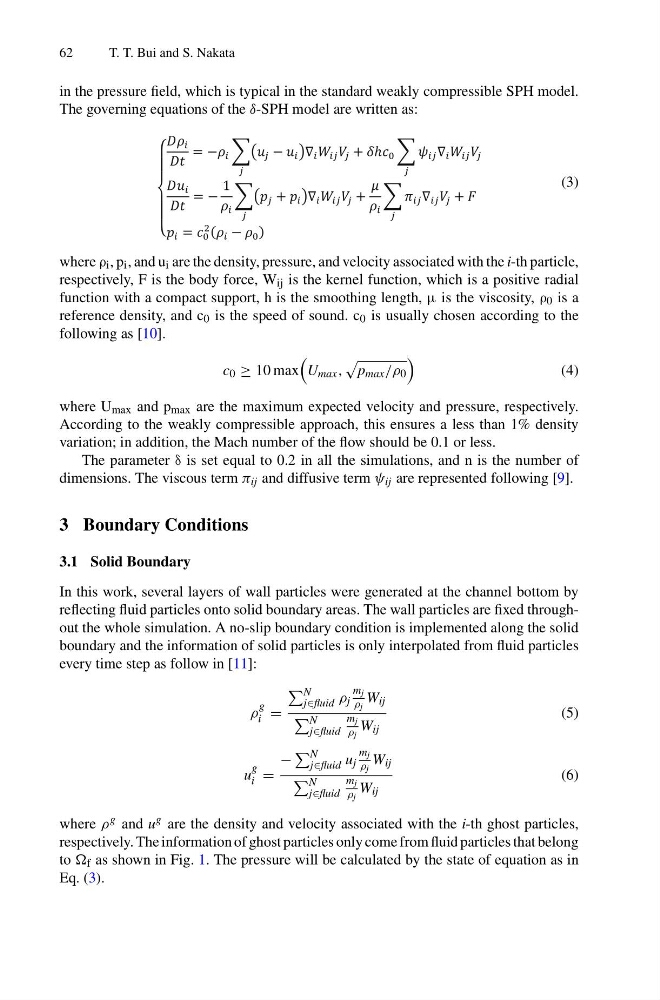
The governing equations of the δ-SPH model are written as:
(3)
where ρ i , p i , and u i are the density, pressure, and velocity associated with the i-th particle,
respectively, F is the body force, W ij is the kernel function, which is a positive radial
function with a compact support, h is the smoothing length, μ is the viscosity, ρ 0 is a
reference density, and c 0 is the speed of sound. c 0 is usually chosen according to the
following as [10].
c 0 ≥ 10 max
U max ,
p max /ρ 0
(4)
where U max and p max are the maximum expected velocity and pressure, respectively.
According to the weakly compressible approach, this ensures a less than 1% density
variation; in addition, the Mach number of the flow should be 0.1 or less.
The parameter δ is set equal to 0.2 in all the simulations, and n is the number of
dimensions. The viscous term π ij and diffusive term ψ ij are represented following [9].
3 Boundary Conditions
3.1 Solid Boundary
In this work, several layers of wall particles were generated at the channel bottom by
reflecting fluid particles onto solid boundary areas. The wall particles are fixed throughout the whole simulation. A no-slip boundary condition is implemented along the solid
boundary and the information of solid particles is only interpolated from fluid particles
every time step as follow in [11]:
ρ
g
i =
N
j∈fluid ρ j
m j
ρ j
W ij
N
j∈fluid
m j
ρ j
W ij
(5)
u
g
i =
−
N
j∈fluid u j
m j
ρ j
W ij
N
j∈fluid
m j
ρ j
W ij
(6)
where ρ g and u g are the density and velocity associated with the i-th ghost particles,
respectively. The information of ghost particles only come from fluid particles that belong
to f as shown in Fig. 1. The pressure will be calculated by the state of equation as in
Eq. (3).
T. T. Bui and S. Nakata
in the pressure field, which is typical in the standard weakly compressible SPH model.
The governing equations of the δ-SPH model are written as:
(3)
where ρ i , p i , and u i are the density, pressure, and velocity associated with the i-th particle,
respectively, F is the body force, W ij is the kernel function, which is a positive radial
function with a compact support, h is the smoothing length, μ is the viscosity, ρ 0 is a
reference density, and c 0 is the speed of sound. c 0 is usually chosen according to the
following as [10].
c 0 ≥ 10 max
U max ,
p max /ρ 0
(4)
where U max and p max are the maximum expected velocity and pressure, respectively.
According to the weakly compressible approach, this ensures a less than 1% density
variation; in addition, the Mach number of the flow should be 0.1 or less.
The parameter δ is set equal to 0.2 in all the simulations, and n is the number of
dimensions. The viscous term π ij and diffusive term ψ ij are represented following [9].
3 Boundary Conditions
3.1 Solid Boundary
In this work, several layers of wall particles were generated at the channel bottom by
reflecting fluid particles onto solid boundary areas. The wall particles are fixed throughout the whole simulation. A no-slip boundary condition is implemented along the solid
boundary and the information of solid particles is only interpolated from fluid particles
every time step as follow in [11]:
ρ
g
i =
N
j∈fluid ρ j
m j
ρ j
W ij
N
j∈fluid
m j
ρ j
W ij
(5)
u
g
i =
−
N
j∈fluid u j
m j
ρ j
W ij
N
j∈fluid
m j
ρ j
W ij
(6)
where ρ g and u g are the density and velocity associated with the i-th ghost particles,
respectively. The information of ghost particles only come from fluid particles that belong
to f as shown in Fig. 1. The pressure will be calculated by the state of equation as in
Eq. (3).