

Nonreflecting Outlet Boundary Conditions for Smoothed Particle Hydrodynamics
61
For accurate open boundary conditions, Lastiwka et al. [3] proposed a model for
the imposition of permeable boundary conditions for gas dynamics. Unfortunately, this
method is difficult to apply to hydrodynamic problems with the free surface. AlvaradoRodrıguez et al. in [4], utilizing a different formulation based on an anisotropic wave
equation for the velocity field at the outlet. Vacondio et al. [5] introduced open boundary
conditions using Riemann invariants.
Federico et al. [6], Tafuni et al. [7] presented an implementation of open boundary
conditions for a weakly compressible SPH scheme suitable for the free surface flow. In
their methods, inflow and outflow zones are respectively attached to the upstream and
downstream of the computational domain. When inflow particles cross the fluid domain,
new particles will be created in the inflow zone accordingly, while once a particle flows
out the outflow zone, it will be eliminated from the simulation. Ferrand et al. [8] and
Leroy et al. [13] introduced a different approach based on the generalization of the semianalytical boundary conditions method to impose unsteady open boundaries in a weakly
compressible and incompressible SPH model.
In the present work, we propose a fast and simple approach for nonreflecting outlet
boundary condition (NROBC) treatment using SPH. This scheme is a hybrid of in/outflow algorithm and periodic boundary condition. Instead of eliminating outflow particles
which cross outflow region, these outflow particles will be immediately transferred to
the opposite end similarly to periodic boundary condition with new physical quantities
such as densities and velocities appropriately interpolated at the inflow zone. Therefore,
the mass conservation will be satisfied and removing a violation as periodic boundary
condition. Several simulations are presented to validate the proposed technique.
2 The SPH Model
2.1 Governing Equations
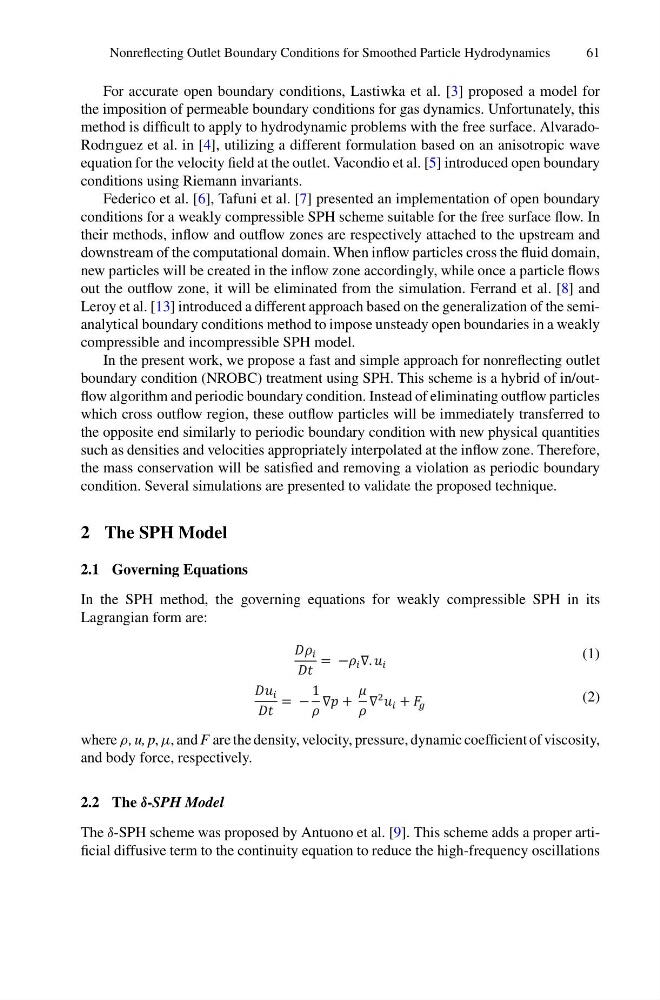
In the SPH method, the governing equations for weakly compressible SPH in its
Lagrangian form are:
(1)
(2)
where ρ, u, p, μ, and F are the density, velocity, pressure, dynamic coefficient of viscosity,
and body force, respectively.
2.2 The δ-SPH Model
The δ-SPH scheme was proposed by Antuono et al. [9]. This scheme adds a proper artificial diffusive term to the continuity equation to reduce the high-frequency oscillations
61
For accurate open boundary conditions, Lastiwka et al. [3] proposed a model for
the imposition of permeable boundary conditions for gas dynamics. Unfortunately, this
method is difficult to apply to hydrodynamic problems with the free surface. AlvaradoRodrıguez et al. in [4], utilizing a different formulation based on an anisotropic wave
equation for the velocity field at the outlet. Vacondio et al. [5] introduced open boundary
conditions using Riemann invariants.
Federico et al. [6], Tafuni et al. [7] presented an implementation of open boundary
conditions for a weakly compressible SPH scheme suitable for the free surface flow. In
their methods, inflow and outflow zones are respectively attached to the upstream and
downstream of the computational domain. When inflow particles cross the fluid domain,
new particles will be created in the inflow zone accordingly, while once a particle flows
out the outflow zone, it will be eliminated from the simulation. Ferrand et al. [8] and
Leroy et al. [13] introduced a different approach based on the generalization of the semianalytical boundary conditions method to impose unsteady open boundaries in a weakly
compressible and incompressible SPH model.
In the present work, we propose a fast and simple approach for nonreflecting outlet
boundary condition (NROBC) treatment using SPH. This scheme is a hybrid of in/outflow algorithm and periodic boundary condition. Instead of eliminating outflow particles
which cross outflow region, these outflow particles will be immediately transferred to
the opposite end similarly to periodic boundary condition with new physical quantities
such as densities and velocities appropriately interpolated at the inflow zone. Therefore,
the mass conservation will be satisfied and removing a violation as periodic boundary
condition. Several simulations are presented to validate the proposed technique.
2 The SPH Model
2.1 Governing Equations
In the SPH method, the governing equations for weakly compressible SPH in its
Lagrangian form are:
(1)
(2)
where ρ, u, p, μ, and F are the density, velocity, pressure, dynamic coefficient of viscosity,
and body force, respectively.
2.2 The δ-SPH Model
The δ-SPH scheme was proposed by Antuono et al. [9]. This scheme adds a proper artificial diffusive term to the continuity equation to reduce the high-frequency oscillations