

Optimal Design of Natural Gas Gathering Systems
265
Compressor Constraints
P min
i
+
D
C
i − 1
M ≤ P
C
i ≤ P max
i
+
1 − D
C
i
M , i ∈ I
(10)
ε min
i
≤ ε i ≤ ε max
i
, i ∈ I
(11)
P min
c
≤ P c ≤ P max
c
, c ∈ C
(12)
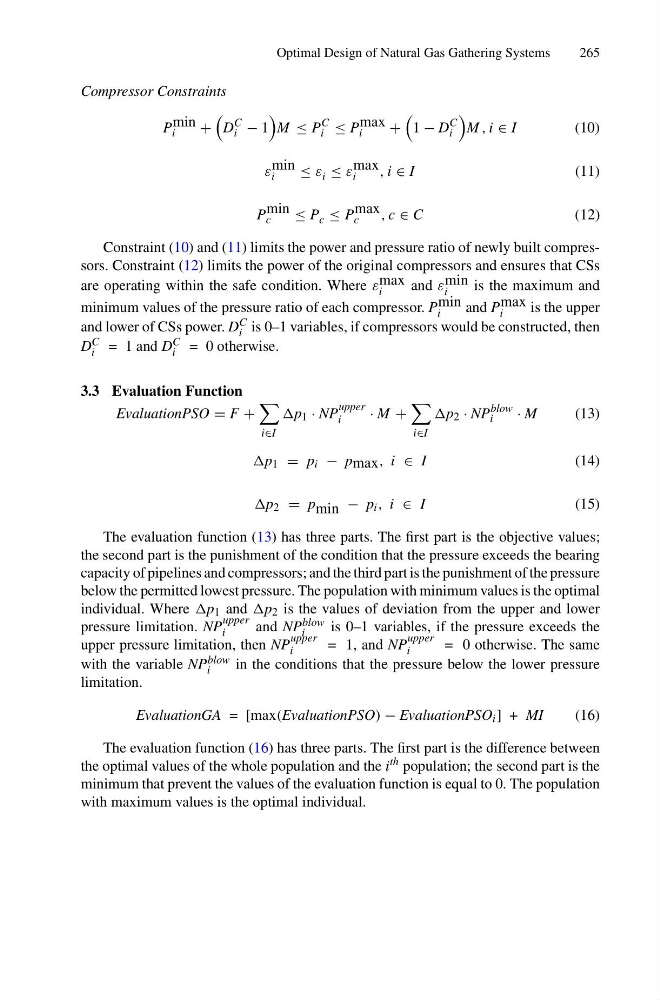
Constraint (10) and (11) limits the power and pressure ratio of newly built compressors. Constraint (12) limits the power of the original compressors and ensures that CSs
are operating within the safe condition. Where ε max
i
and ε min
i
is the maximum and
minimum values of the pressure ratio of each compressor. P min
i
and P max
i
is the upper
and lower of CSs power. D C
i is 0–1 variables, if compressors would be constructed, then
D C
i = 1 and D C
i = 0 otherwise.
3.3 Evaluation Function
EvaluationPSO = F +
i∈I
p 1 · NP
upper
i
· M +
i∈I
p 2 · NP
blow
i
· M
(13)
p 1 = p i − p max , i ∈ I
(14)
p 2 = p min − p i , i ∈ I
(15)
The evaluation function (13) has three parts. The first part is the objective values;
the second part is the punishment of the condition that the pressure exceeds the bearing
capacity of pipelines and compressors; and the third part is the punishment of the pressure
below the permitted lowest pressure. The population with minimum values is the optimal
individual. Where p 1 and p 2 is the values of deviation from the upper and lower
pressure limitation. NP
upper
i
and NP blow
i
is 0–1 variables, if the pressure exceeds the
upper pressure limitation, then NP
upper
i
= 1, and NP
upper
i
= 0 otherwise. The same
with the variable NP blow
i
in the conditions that the pressure below the lower pressure
limitation.
EvaluationGA = [max(EvaluationPSO) − EvaluationPSO i ] + MI
(16)
The evaluation function (16) has three parts. The first part is the difference between
the optimal values of the whole population and the i th population; the second part is the
minimum that prevent the values of the evaluation function is equal to 0. The population
with maximum values is the optimal individual.
265
Compressor Constraints
P min
i
+
D
C
i − 1
M ≤ P
C
i ≤ P max
i
+
1 − D
C
i
M , i ∈ I
(10)
ε min
i
≤ ε i ≤ ε max
i
, i ∈ I
(11)
P min
c
≤ P c ≤ P max
c
, c ∈ C
(12)
Constraint (10) and (11) limits the power and pressure ratio of newly built compressors. Constraint (12) limits the power of the original compressors and ensures that CSs
are operating within the safe condition. Where ε max
i
and ε min
i
is the maximum and
minimum values of the pressure ratio of each compressor. P min
i
and P max
i
is the upper
and lower of CSs power. D C
i is 0–1 variables, if compressors would be constructed, then
D C
i = 1 and D C
i = 0 otherwise.
3.3 Evaluation Function
EvaluationPSO = F +
i∈I
p 1 · NP
upper
i
· M +
i∈I
p 2 · NP
blow
i
· M
(13)
p 1 = p i − p max , i ∈ I
(14)
p 2 = p min − p i , i ∈ I
(15)
The evaluation function (13) has three parts. The first part is the objective values;
the second part is the punishment of the condition that the pressure exceeds the bearing
capacity of pipelines and compressors; and the third part is the punishment of the pressure
below the permitted lowest pressure. The population with minimum values is the optimal
individual. Where p 1 and p 2 is the values of deviation from the upper and lower
pressure limitation. NP
upper
i
and NP blow
i
is 0–1 variables, if the pressure exceeds the
upper pressure limitation, then NP
upper
i
= 1, and NP
upper
i
= 0 otherwise. The same
with the variable NP blow
i
in the conditions that the pressure below the lower pressure
limitation.
EvaluationGA = [max(EvaluationPSO) − EvaluationPSO i ] + MI
(16)
The evaluation function (16) has three parts. The first part is the difference between
the optimal values of the whole population and the i th population; the second part is the
minimum that prevent the values of the evaluation function is equal to 0. The population
with maximum values is the optimal individual.