

264
Y. Xu et al.
Constraints
Flow Constraints
j∈I
Q i,j −
j∈I
Q j,i = q i , i ∈ I
(5)
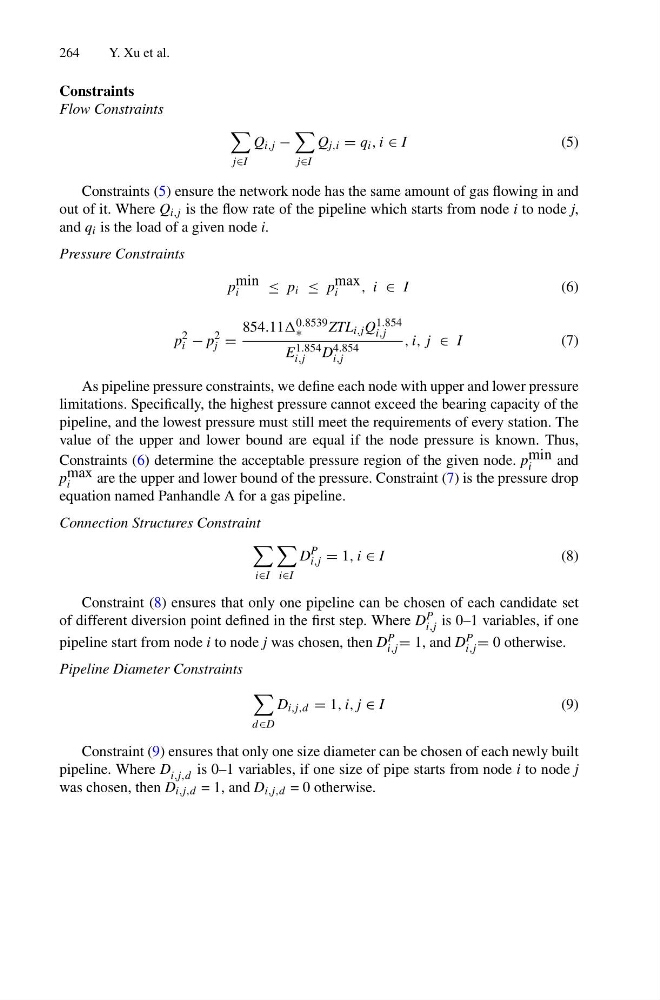
Constraints (5) ensure the network node has the same amount of gas flowing in and
out of it. Where Q i,j is the flow rate of the pipeline which starts from node i to node j,
and q i is the load of a given node i.
Pressure Constraints
p min
i
≤ p i ≤ p max
i
, i ∈ I
(6)
p
2
i − p
2
j =
854.11 0.8539
∗
ZTL i,j Q 1.854
i,j
E 1.854
i,j D 4.854
i,j
, i, j ∈ I
(7)
As pipeline pressure constraints, we define each node with upper and lower pressure
limitations. Specifically, the highest pressure cannot exceed the bearing capacity of the
pipeline, and the lowest pressure must still meet the requirements of every station. The
value of the upper and lower bound are equal if the node pressure is known. Thus,
Constraints (6) determine the acceptable pressure region of the given node. p min
i
and
p max
i
are the upper and lower bound of the pressure. Constraint (7) is the pressure drop
equation named Panhandle A for a gas pipeline.
Connection Structures Constraint
i∈I
i∈I
D
P
i,j = 1, i ∈ I
(8)
Constraint (8) ensures that only one pipeline can be chosen of each candidate set
of different diversion point defined in the first step. Where D P
i,j is 0–1 variables, if one
pipeline start from node i to node j was chosen, then D P
i,j = 1, and D P
i,j = 0 otherwise.
Pipeline Diameter Constraints
d ∈D
D i,j,d = 1, i, j ∈ I
(9)
Constraint (9) ensures that only one size diameter can be chosen of each newly built
pipeline. Where D i,j,d is 0–1 variables, if one size of pipe starts from node i to node j
was chosen, then D i,j,d = 1, and D i,j,d = 0 otherwise.
Y. Xu et al.
Constraints
Flow Constraints
j∈I
Q i,j −
j∈I
Q j,i = q i , i ∈ I
(5)
Constraints (5) ensure the network node has the same amount of gas flowing in and
out of it. Where Q i,j is the flow rate of the pipeline which starts from node i to node j,
and q i is the load of a given node i.
Pressure Constraints
p min
i
≤ p i ≤ p max
i
, i ∈ I
(6)
p
2
i − p
2
j =
854.11 0.8539
∗
ZTL i,j Q 1.854
i,j
E 1.854
i,j D 4.854
i,j
, i, j ∈ I
(7)
As pipeline pressure constraints, we define each node with upper and lower pressure
limitations. Specifically, the highest pressure cannot exceed the bearing capacity of the
pipeline, and the lowest pressure must still meet the requirements of every station. The
value of the upper and lower bound are equal if the node pressure is known. Thus,
Constraints (6) determine the acceptable pressure region of the given node. p min
i
and
p max
i
are the upper and lower bound of the pressure. Constraint (7) is the pressure drop
equation named Panhandle A for a gas pipeline.
Connection Structures Constraint
i∈I
i∈I
D
P
i,j = 1, i ∈ I
(8)
Constraint (8) ensures that only one pipeline can be chosen of each candidate set
of different diversion point defined in the first step. Where D P
i,j is 0–1 variables, if one
pipeline start from node i to node j was chosen, then D P
i,j = 1, and D P
i,j = 0 otherwise.
Pipeline Diameter Constraints
d ∈D
D i,j,d = 1, i, j ∈ I
(9)
Constraint (9) ensures that only one size diameter can be chosen of each newly built
pipeline. Where D i,j,d is 0–1 variables, if one size of pipe starts from node i to node j
was chosen, then D i,j,d = 1, and D i,j,d = 0 otherwise.