

Full-Scale Forced Vibration Tests of a Railway Bridge
229
from the time history response. Fitted curves with R 2 < 0.95 was discarded. The results
are presented in Table 2 and show similar results as the forced vibration tests with 1 kN
load amplitude.
Table 2. Modal properties based on free vibrations after train passage.
Train no.
F 1 (Hz)
ζ 1 (%)
F 2 (Hz)
ζ 2 (%)
F 3 (Hz)
ζ 3 (%)
1
8.54
0.56
12.6
3.8
14.0
2.4
2
8.53
0.56
12.5
2.9
13.9
2.1
3
8.52
0.55
12.7
3.7
13.7
3.0
4
8.52
0.55
12.7
3.6
13.9
2.3
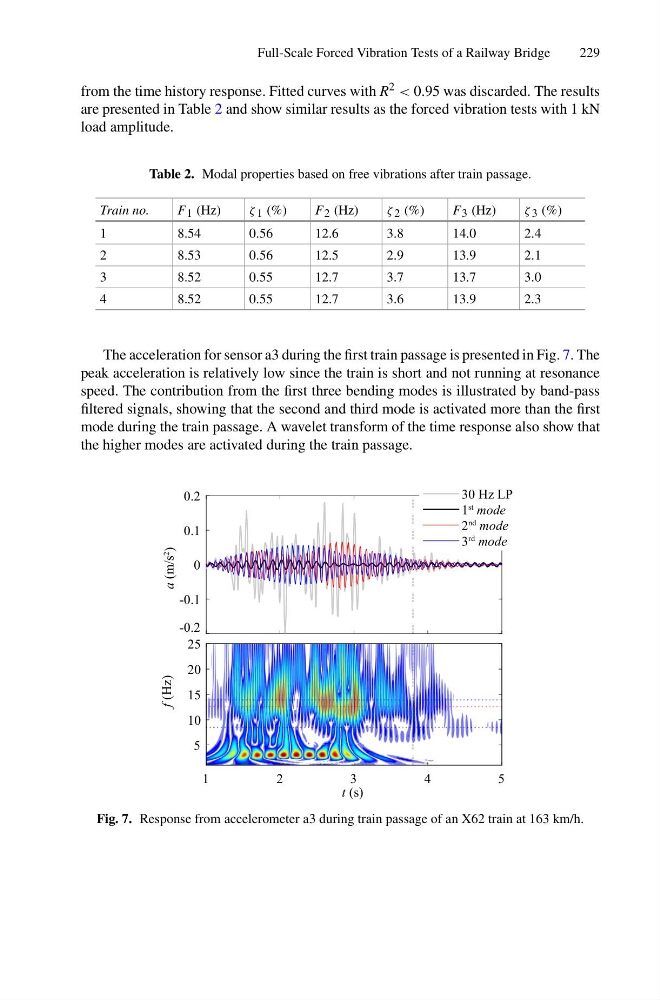
The acceleration for sensor a3 during the first train passage is presented in Fig. 7. The
peak acceleration is relatively low since the train is short and not running at resonance
speed. The contribution from the first three bending modes is illustrated by band-pass
filtered signals, showing that the second and third mode is activated more than the first
mode during the train passage. A wavelet transform of the time response also show that
the higher modes are activated during the train passage.
-0.2
-0.1
0
0.1
0.2
a (m/s
2
)
30 Hz LP
1
st mode
2
nd mode
3
rd mode
1
2
3
4
5
t (s)
5
10
15
20
25
f (Hz)
Fig. 7. Response from accelerometer a3 during train passage of an X62 train at 163 km/h.
229
from the time history response. Fitted curves with R 2 < 0.95 was discarded. The results
are presented in Table 2 and show similar results as the forced vibration tests with 1 kN
load amplitude.
Table 2. Modal properties based on free vibrations after train passage.
Train no.
F 1 (Hz)
ζ 1 (%)
F 2 (Hz)
ζ 2 (%)
F 3 (Hz)
ζ 3 (%)
1
8.54
0.56
12.6
3.8
14.0
2.4
2
8.53
0.56
12.5
2.9
13.9
2.1
3
8.52
0.55
12.7
3.7
13.7
3.0
4
8.52
0.55
12.7
3.6
13.9
2.3
The acceleration for sensor a3 during the first train passage is presented in Fig. 7. The
peak acceleration is relatively low since the train is short and not running at resonance
speed. The contribution from the first three bending modes is illustrated by band-pass
filtered signals, showing that the second and third mode is activated more than the first
mode during the train passage. A wavelet transform of the time response also show that
the higher modes are activated during the train passage.
-0.2
-0.1
0
0.1
0.2
a (m/s
2
)
30 Hz LP
1
st mode
2
nd mode
3
rd mode
1
2
3
4
5
t (s)
5
10
15
20
25
f (Hz)
Fig. 7. Response from accelerometer a3 during train passage of an X62 train at 163 km/h.