

220
G. Zhang et al.
the cut-off point gradually moves up. This is mainly because with the increase of cycle
time, the higher the temperature of drilling fluid brought into the reflux pipeline from the
annulus, the larger the convective heat transfer area required to reduce the temperature
of the reflux pipeline, that is, the longer the distance of upward reflux and the higher the
cut-off point.
3.2 Comparison of Wellbore Temperature Between CML Dual-Gradient Drilling
and Conventional Drilling
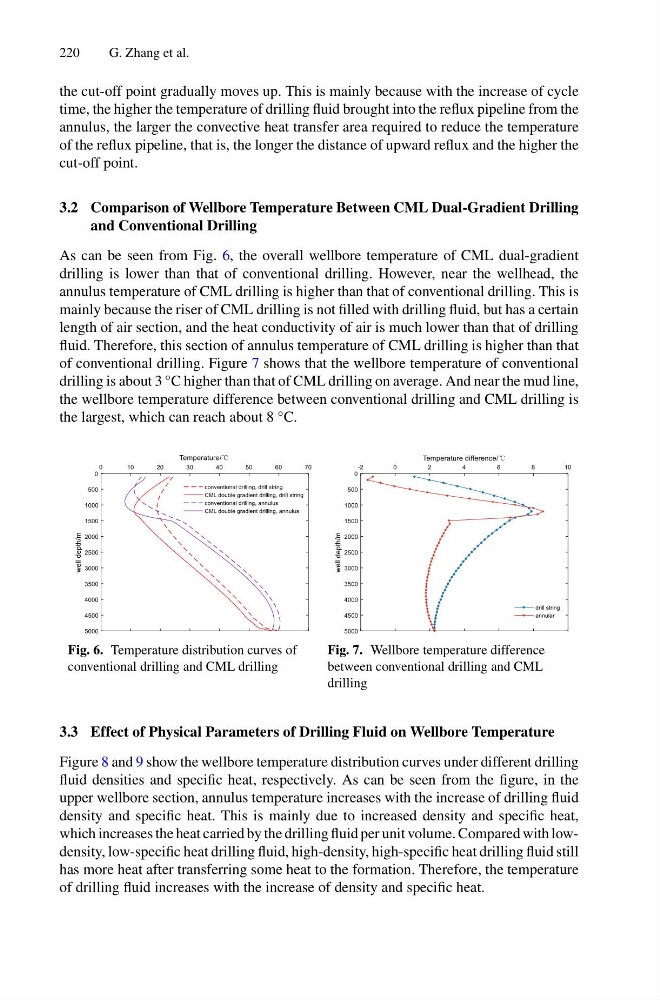
As can be seen from Fig. 6, the overall wellbore temperature of CML dual-gradient
drilling is lower than that of conventional drilling. However, near the wellhead, the
annulus temperature of CML drilling is higher than that of conventional drilling. This is
mainly because the riser of CML drilling is not filled with drilling fluid, but has a certain
length of air section, and the heat conductivity of air is much lower than that of drilling
fluid. Therefore, this section of annulus temperature of CML drilling is higher than that
of conventional drilling. Figure 7 shows that the wellbore temperature of conventional
drilling is about 3 °C higher than that of CML drilling on average. And near the mud line,
the wellbore temperature difference between conventional drilling and CML drilling is
the largest, which can reach about 8 °C.
Fig. 6. Temperature distribution curves of
conventional drilling and CML drilling
Fig. 7. Wellbore temperature difference
between conventional drilling and CML
drilling
3.3 Effect of Physical Parameters of Drilling Fluid on Wellbore Temperature
Figure 8 and 9 show the wellbore temperature distribution curves under different drilling
fluid densities and specific heat, respectively. As can be seen from the figure, in the
upper wellbore section, annulus temperature increases with the increase of drilling fluid
density and specific heat. This is mainly due to increased density and specific heat,
which increases the heat carried by the drilling fluid per unit volume. Compared with lowdensity, low-specific heat drilling fluid, high-density, high-specific heat drilling fluid still
has more heat after transferring some heat to the formation. Therefore, the temperature
of drilling fluid increases with the increase of density and specific heat.
G. Zhang et al.
the cut-off point gradually moves up. This is mainly because with the increase of cycle
time, the higher the temperature of drilling fluid brought into the reflux pipeline from the
annulus, the larger the convective heat transfer area required to reduce the temperature
of the reflux pipeline, that is, the longer the distance of upward reflux and the higher the
cut-off point.
3.2 Comparison of Wellbore Temperature Between CML Dual-Gradient Drilling
and Conventional Drilling
As can be seen from Fig. 6, the overall wellbore temperature of CML dual-gradient
drilling is lower than that of conventional drilling. However, near the wellhead, the
annulus temperature of CML drilling is higher than that of conventional drilling. This is
mainly because the riser of CML drilling is not filled with drilling fluid, but has a certain
length of air section, and the heat conductivity of air is much lower than that of drilling
fluid. Therefore, this section of annulus temperature of CML drilling is higher than that
of conventional drilling. Figure 7 shows that the wellbore temperature of conventional
drilling is about 3 °C higher than that of CML drilling on average. And near the mud line,
the wellbore temperature difference between conventional drilling and CML drilling is
the largest, which can reach about 8 °C.
Fig. 6. Temperature distribution curves of
conventional drilling and CML drilling
Fig. 7. Wellbore temperature difference
between conventional drilling and CML
drilling
3.3 Effect of Physical Parameters of Drilling Fluid on Wellbore Temperature
Figure 8 and 9 show the wellbore temperature distribution curves under different drilling
fluid densities and specific heat, respectively. As can be seen from the figure, in the
upper wellbore section, annulus temperature increases with the increase of drilling fluid
density and specific heat. This is mainly due to increased density and specific heat,
which increases the heat carried by the drilling fluid per unit volume. Compared with lowdensity, low-specific heat drilling fluid, high-density, high-specific heat drilling fluid still
has more heat after transferring some heat to the formation. Therefore, the temperature
of drilling fluid increases with the increase of density and specific heat.