

Research on Wellbore Temperature Field in Deep-Water CML
219
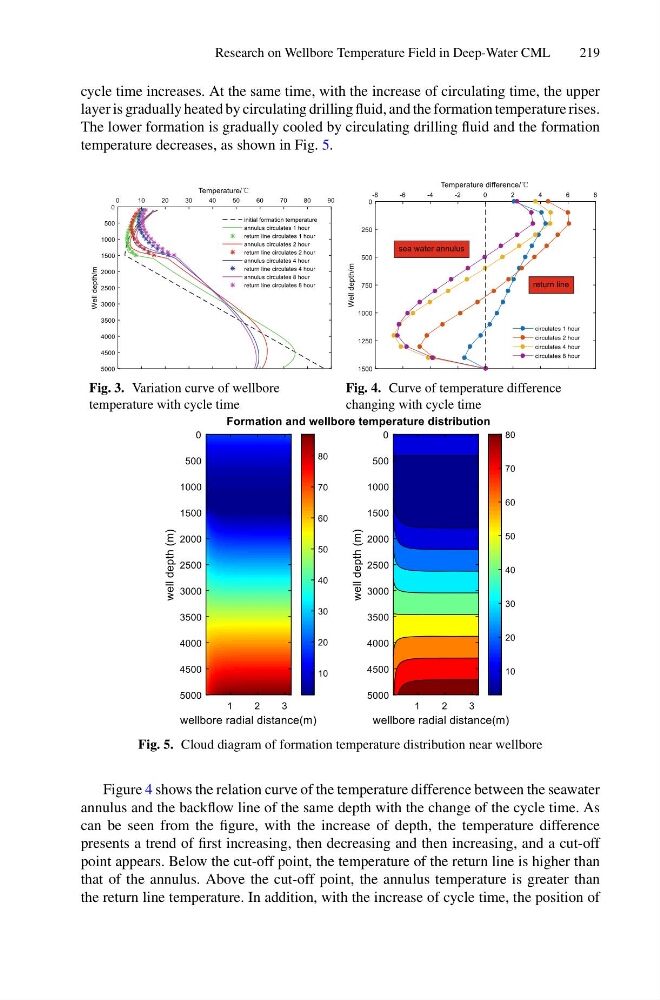
cycle time increases. At the same time, with the increase of circulating time, the upper
layer is gradually heated by circulating drilling fluid, and the formation temperature rises.
The lower formation is gradually cooled by circulating drilling fluid and the formation
temperature decreases, as shown in Fig. 5.
Fig. 3. Variation curve of wellbore
temperature with cycle time
Fig. 4. Curve of temperature difference
changing with cycle time
Fig. 5. Cloud diagram of formation temperature distribution near wellbore
Figure 4 shows the relation curve of the temperature difference between the seawater
annulus and the backflow line of the same depth with the change of the cycle time. As
can be seen from the figure, with the increase of depth, the temperature difference
presents a trend of first increasing, then decreasing and then increasing, and a cut-off
point appears. Below the cut-off point, the temperature of the return line is higher than
that of the annulus. Above the cut-off point, the annulus temperature is greater than
the return line temperature. In addition, with the increase of cycle time, the position of
219
cycle time increases. At the same time, with the increase of circulating time, the upper
layer is gradually heated by circulating drilling fluid, and the formation temperature rises.
The lower formation is gradually cooled by circulating drilling fluid and the formation
temperature decreases, as shown in Fig. 5.
Fig. 3. Variation curve of wellbore
temperature with cycle time
Fig. 4. Curve of temperature difference
changing with cycle time
Fig. 5. Cloud diagram of formation temperature distribution near wellbore
Figure 4 shows the relation curve of the temperature difference between the seawater
annulus and the backflow line of the same depth with the change of the cycle time. As
can be seen from the figure, with the increase of depth, the temperature difference
presents a trend of first increasing, then decreasing and then increasing, and a cut-off
point appears. Below the cut-off point, the temperature of the return line is higher than
that of the annulus. Above the cut-off point, the annulus temperature is greater than
the return line temperature. In addition, with the increase of cycle time, the position of