

208
K. Zhang et al.
from depositing. As a result, only very few cuttings particles are settled, and most of
the drilled cuttings will move forward in a pulsed way (wave-like). In view of the above
considerations, the pulsed gas injection method will substantially reduce the cuttings
concentration in the annulus during horizontal gas drilling process. Compared with the
constant-rate gas injection method, the pulsed gas injection method provides a much
better cuttings transport efficiency.
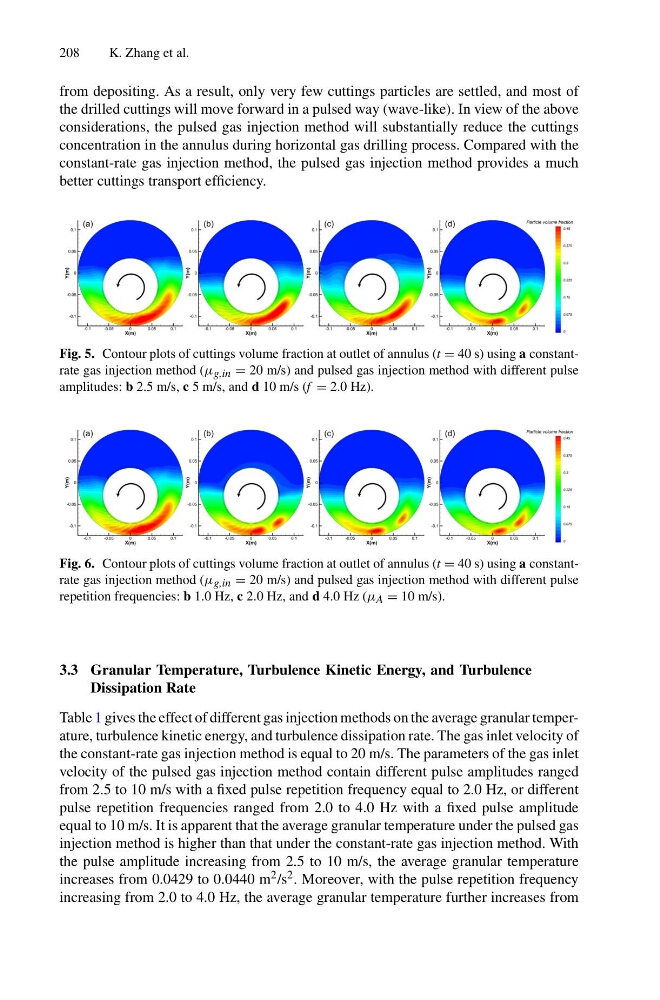
Fig. 5. Contour plots of cuttings volume fraction at outlet of annulus (t = 40 s) using a constantrate gas injection method (μ g,in = 20 m/s) and pulsed gas injection method with different pulse
amplitudes: b 2.5 m/s, c 5 m/s, and d 10 m/s (f = 2.0 Hz).
Fig. 6. Contour plots of cuttings volume fraction at outlet of annulus (t = 40 s) using a constantrate gas injection method (μ g,in = 20 m/s) and pulsed gas injection method with different pulse
repetition frequencies: b 1.0 Hz, c 2.0 Hz, and d 4.0 Hz (μ A = 10 m/s).
3.3 Granular Temperature, Turbulence Kinetic Energy, and Turbulence
Dissipation Rate
Table 1 gives the effect of different gas injection methods on the average granular temperature, turbulence kinetic energy, and turbulence dissipation rate. The gas inlet velocity of
the constant-rate gas injection method is equal to 20 m/s. The parameters of the gas inlet
velocity of the pulsed gas injection method contain different pulse amplitudes ranged
from 2.5 to 10 m/s with a fixed pulse repetition frequency equal to 2.0 Hz, or different
pulse repetition frequencies ranged from 2.0 to 4.0 Hz with a fixed pulse amplitude
equal to 10 m/s. It is apparent that the average granular temperature under the pulsed gas
injection method is higher than that under the constant-rate gas injection method. With
the pulse amplitude increasing from 2.5 to 10 m/s, the average granular temperature
increases from 0.0429 to 0.0440 m 2 /s 2 . Moreover, with the pulse repetition frequency
increasing from 2.0 to 4.0 Hz, the average granular temperature further increases from
K. Zhang et al.
from depositing. As a result, only very few cuttings particles are settled, and most of
the drilled cuttings will move forward in a pulsed way (wave-like). In view of the above
considerations, the pulsed gas injection method will substantially reduce the cuttings
concentration in the annulus during horizontal gas drilling process. Compared with the
constant-rate gas injection method, the pulsed gas injection method provides a much
better cuttings transport efficiency.
Fig. 5. Contour plots of cuttings volume fraction at outlet of annulus (t = 40 s) using a constantrate gas injection method (μ g,in = 20 m/s) and pulsed gas injection method with different pulse
amplitudes: b 2.5 m/s, c 5 m/s, and d 10 m/s (f = 2.0 Hz).
Fig. 6. Contour plots of cuttings volume fraction at outlet of annulus (t = 40 s) using a constantrate gas injection method (μ g,in = 20 m/s) and pulsed gas injection method with different pulse
repetition frequencies: b 1.0 Hz, c 2.0 Hz, and d 4.0 Hz (μ A = 10 m/s).
3.3 Granular Temperature, Turbulence Kinetic Energy, and Turbulence
Dissipation Rate
Table 1 gives the effect of different gas injection methods on the average granular temperature, turbulence kinetic energy, and turbulence dissipation rate. The gas inlet velocity of
the constant-rate gas injection method is equal to 20 m/s. The parameters of the gas inlet
velocity of the pulsed gas injection method contain different pulse amplitudes ranged
from 2.5 to 10 m/s with a fixed pulse repetition frequency equal to 2.0 Hz, or different
pulse repetition frequencies ranged from 2.0 to 4.0 Hz with a fixed pulse amplitude
equal to 10 m/s. It is apparent that the average granular temperature under the pulsed gas
injection method is higher than that under the constant-rate gas injection method. With
the pulse amplitude increasing from 2.5 to 10 m/s, the average granular temperature
increases from 0.0429 to 0.0440 m 2 /s 2 . Moreover, with the pulse repetition frequency
increasing from 2.0 to 4.0 Hz, the average granular temperature further increases from