

CFD Modelling and Simulation of Drilled Cuttings Transport Efficiency
209
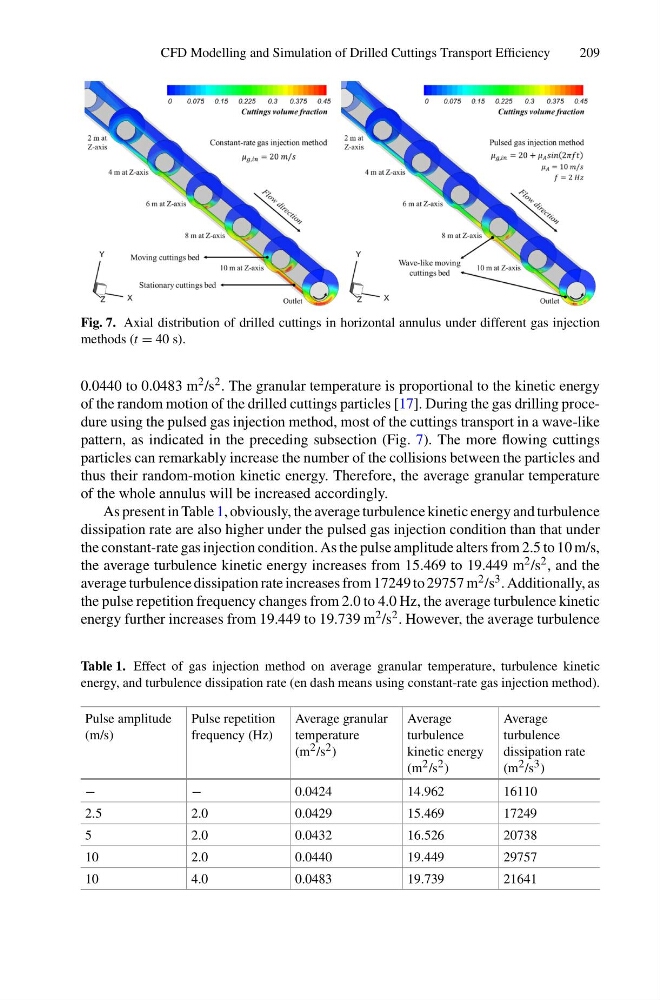
Fig. 7. Axial distribution of drilled cuttings in horizontal annulus under different gas injection
methods (t = 40 s).
0.0440 to 0.0483 m 2 /s 2 . The granular temperature is proportional to the kinetic energy
of the random motion of the drilled cuttings particles [17]. During the gas drilling procedure using the pulsed gas injection method, most of the cuttings transport in a wave-like
pattern, as indicated in the preceding subsection (Fig. 7). The more flowing cuttings
particles can remarkably increase the number of the collisions between the particles and
thus their random-motion kinetic energy. Therefore, the average granular temperature
of the whole annulus will be increased accordingly.
As present in Table 1, obviously, the average turbulence kinetic energy and turbulence
dissipation rate are also higher under the pulsed gas injection condition than that under
the constant-rate gas injection condition. As the pulse amplitude alters from 2.5 to 10 m/s,
the average turbulence kinetic energy increases from 15.469 to 19.449 m 2 /s 2 , and the
average turbulence dissipation rate increases from 17249 to 29757 m 2 /s 3 . Additionally, as
the pulse repetition frequency changes from 2.0 to 4.0 Hz, the average turbulence kinetic
energy further increases from 19.449 to 19.739 m 2 /s 2 . However, the average turbulence
Table 1. Effect of gas injection method on average granular temperature, turbulence kinetic
energy, and turbulence dissipation rate (en dash means using constant-rate gas injection method).
Pulse amplitude
(m/s)
Pulse repetition
frequency (Hz)
Average granular
temperature
(m 2 /s 2 )
Average
turbulence
kinetic energy
(m 2 /s 2 )
Average
turbulence
dissipation rate
(m 2 /s 3 )
−
−
0.0424
14.962
16110
2.5
2.0
0.0429
15.469
17249
5
2.0
0.0432
16.526
20738
10
2.0
0.0440
19.449
29757
10
4.0
0.0483
19.739
21641
209
Fig. 7. Axial distribution of drilled cuttings in horizontal annulus under different gas injection
methods (t = 40 s).
0.0440 to 0.0483 m 2 /s 2 . The granular temperature is proportional to the kinetic energy
of the random motion of the drilled cuttings particles [17]. During the gas drilling procedure using the pulsed gas injection method, most of the cuttings transport in a wave-like
pattern, as indicated in the preceding subsection (Fig. 7). The more flowing cuttings
particles can remarkably increase the number of the collisions between the particles and
thus their random-motion kinetic energy. Therefore, the average granular temperature
of the whole annulus will be increased accordingly.
As present in Table 1, obviously, the average turbulence kinetic energy and turbulence
dissipation rate are also higher under the pulsed gas injection condition than that under
the constant-rate gas injection condition. As the pulse amplitude alters from 2.5 to 10 m/s,
the average turbulence kinetic energy increases from 15.469 to 19.449 m 2 /s 2 , and the
average turbulence dissipation rate increases from 17249 to 29757 m 2 /s 3 . Additionally, as
the pulse repetition frequency changes from 2.0 to 4.0 Hz, the average turbulence kinetic
energy further increases from 19.449 to 19.739 m 2 /s 2 . However, the average turbulence
Table 1. Effect of gas injection method on average granular temperature, turbulence kinetic
energy, and turbulence dissipation rate (en dash means using constant-rate gas injection method).
Pulse amplitude
(m/s)
Pulse repetition
frequency (Hz)
Average granular
temperature
(m 2 /s 2 )
Average
turbulence
kinetic energy
(m 2 /s 2 )
Average
turbulence
dissipation rate
(m 2 /s 3 )
−
−
0.0424
14.962
16110
2.5
2.0
0.0429
15.469
17249
5
2.0
0.0432
16.526
20738
10
2.0
0.0440
19.449
29757
10
4.0
0.0483
19.739
21641