

202
K. Zhang et al.
K gs = 150
α s
1 − α g
μ g
α g d 2
s
+ 1.75
ρ g α s
v s − −
v g
d s
α g ≤ 0.8
(7)
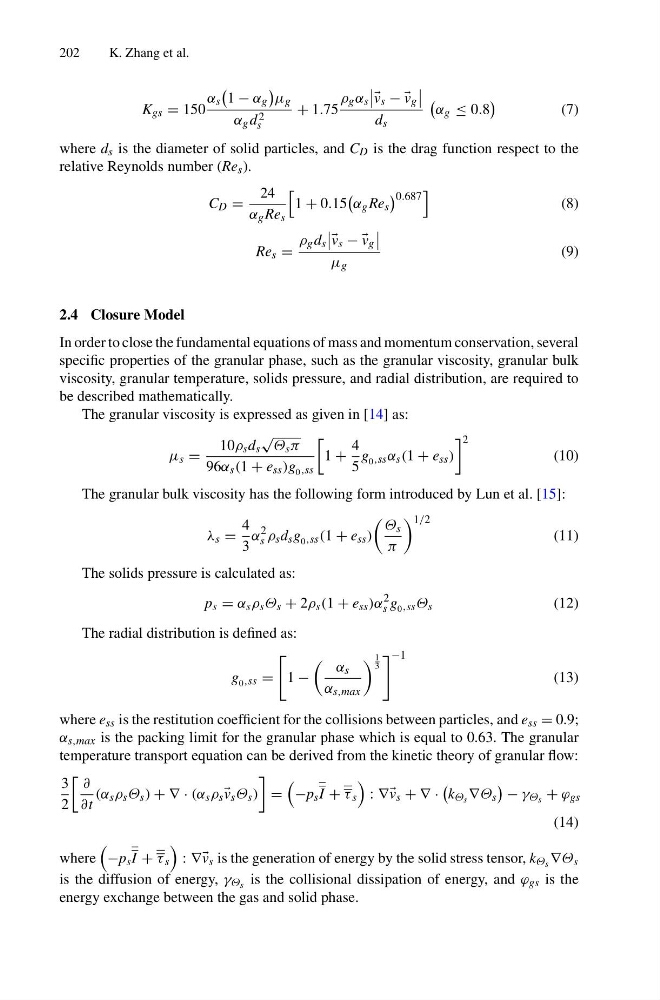
where d s is the diameter of solid particles, and C D is the drag function respect to the
relative Reynolds number (Re s ).
C D =
24
α g Re s
1 + 0.15
α g Re s
0.687
(8)
Re s =
ρ g d s
v s − −
v g
μ g
(9)
2.4 Closure Model
In order to close the fundamental equations of mass and momentum conservation, several
specific properties of the granular phase, such as the granular viscosity, granular bulk
viscosity, granular temperature, solids pressure, and radial distribution, are required to
be described mathematically.
The granular viscosity is expressed as given in [14] as:
μ s =
10ρ s d s
√
Θ s π
96α s (1 + e ss )g 0 ,ss
1 +
4
5
g 0 ,ss α s (1 + e ss )
2
(10)
The granular bulk viscosity has the following form introduced by Lun et al. [15]:
λ s =
4
3
α
2
s ρ s d s g 0 ,ss (1 + e ss )
Θ s
π
1/2
(11)
The solids pressure is calculated as:
p s = α s ρ s Θ s + 2ρ s (1 + e ss )α
2
s g 0 ,ss Θ s
(12)
The radial distribution is defined as:
g 0 ,ss =
1 −
α s
α s,max
1
3
−1
(13)
where e ss is the restitution coefficient for the collisions between particles, and e ss = 0.9;
α s,max is the packing limit for the granular phase which is equal to 0.63. The granular
temperature transport equation can be derived from the kinetic theory of granular flow:
3
2
∂
∂t
(α s ρ s Θ s ) + ∇ · (α s ρ s
v s Θ s )
=
−p s I + τ s
: ∇∇ v s + ∇ ·
k Θ s ∇Θ s
− γ Θ s + ϕ gs
(14)
where
−p s I + τ s
: ∇∇ v s is the generation of energy by the solid stress tensor, k Θ s ∇Θ s
is the diffusion of energy, γ Θ s is the collisional dissipation of energy, and ϕ gs is the
energy exchange between the gas and solid phase.
K. Zhang et al.
K gs = 150
α s
1 − α g
μ g
α g d 2
s
+ 1.75
ρ g α s
v s − −
v g
d s
α g ≤ 0.8
(7)
where d s is the diameter of solid particles, and C D is the drag function respect to the
relative Reynolds number (Re s ).
C D =
24
α g Re s
1 + 0.15
α g Re s
0.687
(8)
Re s =
ρ g d s
v s − −
v g
μ g
(9)
2.4 Closure Model
In order to close the fundamental equations of mass and momentum conservation, several
specific properties of the granular phase, such as the granular viscosity, granular bulk
viscosity, granular temperature, solids pressure, and radial distribution, are required to
be described mathematically.
The granular viscosity is expressed as given in [14] as:
μ s =
10ρ s d s
√
Θ s π
96α s (1 + e ss )g 0 ,ss
1 +
4
5
g 0 ,ss α s (1 + e ss )
2
(10)
The granular bulk viscosity has the following form introduced by Lun et al. [15]:
λ s =
4
3
α
2
s ρ s d s g 0 ,ss (1 + e ss )
Θ s
π
1/2
(11)
The solids pressure is calculated as:
p s = α s ρ s Θ s + 2ρ s (1 + e ss )α
2
s g 0 ,ss Θ s
(12)
The radial distribution is defined as:
g 0 ,ss =
1 −
α s
α s,max
1
3
−1
(13)
where e ss is the restitution coefficient for the collisions between particles, and e ss = 0.9;
α s,max is the packing limit for the granular phase which is equal to 0.63. The granular
temperature transport equation can be derived from the kinetic theory of granular flow:
3
2
∂
∂t
(α s ρ s Θ s ) + ∇ · (α s ρ s
v s Θ s )
=
−p s I + τ s
: ∇∇ v s + ∇ ·
k Θ s ∇Θ s
− γ Θ s + ϕ gs
(14)
where
−p s I + τ s
: ∇∇ v s is the generation of energy by the solid stress tensor, k Θ s ∇Θ s
is the diffusion of energy, γ Θ s is the collisional dissipation of energy, and ϕ gs is the
energy exchange between the gas and solid phase.