

CFD Modelling and Simulation of Drilled Cuttings Transport Efficiency
201
2 Mathematical Formulation
2.1 Continuity Equation
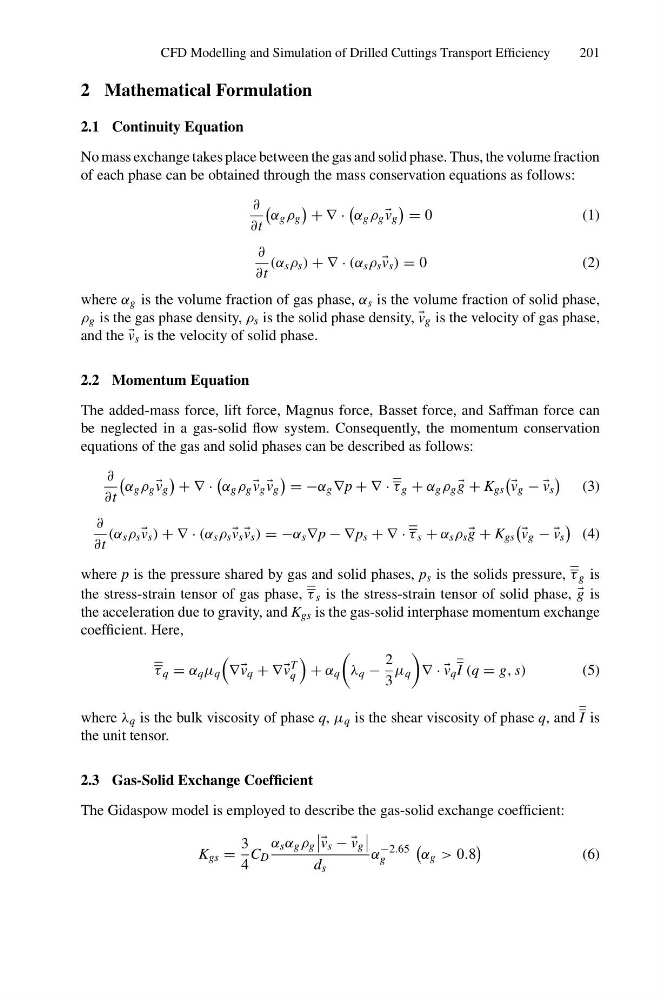
No mass exchange takes place between the gas and solid phase. Thus, the volume fraction
of each phase can be obtained through the mass conservation equations as follows:
∂
∂t
α g ρ g
+ ∇ ·
α g ρ g
v g
= 0
( 1 )
∂
∂t
(α s ρ s ) + ∇ · (α s ρ s
v s ) = 0
( 2 )
where α g is the volume fraction of gas phase, α s is the volume fraction of solid phase,
ρ g is the gas phase density, ρ s is the solid phase density,
v g is the velocity of gas phase,
and the
v s is the velocity of solid phase.
2.2 Momentum Equation
The added-mass force, lift force, Magnus force, Basset force, and Saffman force can
be neglected in a gas-solid flow system. Consequently, the momentum conservation
equations of the gas and solid phases can be described as follows:
∂
∂t
α g ρ g
v g
+ ∇ ·
α g ρ g
v g
v g
= −α g ∇p + ∇ · τ g + α g ρ g
g + K gs
v g − −
v s
(3)
∂
∂t
(α s ρ s
v s ) + ∇ · (α s ρ s
v s
v s ) = −α s ∇p − ∇p s + ∇ · τ s + α s ρ s
g + K gs
v g − −
v s
(4)
where p is the pressure shared by gas and solid phases, p s is the solids pressure, τ g is
the stress-strain tensor of gas phase, τ s is the stress-strain tensor of solid phase,
g is
the acceleration due to gravity, and K gs is the gas-solid interphase momentum exchange
coefficient. Here,
τ q = α q μ q
∇∇ v q + ∇∇ v
T
q
+ α q
λ q −
2
3
μ q
∇ · ·
v q I (q = g, s)
(5)
where λ q is the bulk viscosity of phase q, μ q is the shear viscosity of phase q, and I is
the unit tensor.
2.3 Gas-Solid Exchange Coefficient
The Gidaspow model is employed to describe the gas-solid exchange coefficient:
K gs =
3
4
C D
α s α g ρ g
v s − −
v g
d s
α
−2.65
g
α g > 0.8
(6)
201
2 Mathematical Formulation
2.1 Continuity Equation
No mass exchange takes place between the gas and solid phase. Thus, the volume fraction
of each phase can be obtained through the mass conservation equations as follows:
∂
∂t
α g ρ g
+ ∇ ·
α g ρ g
v g
= 0
( 1 )
∂
∂t
(α s ρ s ) + ∇ · (α s ρ s
v s ) = 0
( 2 )
where α g is the volume fraction of gas phase, α s is the volume fraction of solid phase,
ρ g is the gas phase density, ρ s is the solid phase density,
v g is the velocity of gas phase,
and the
v s is the velocity of solid phase.
2.2 Momentum Equation
The added-mass force, lift force, Magnus force, Basset force, and Saffman force can
be neglected in a gas-solid flow system. Consequently, the momentum conservation
equations of the gas and solid phases can be described as follows:
∂
∂t
α g ρ g
v g
+ ∇ ·
α g ρ g
v g
v g
= −α g ∇p + ∇ · τ g + α g ρ g
g + K gs
v g − −
v s
(3)
∂
∂t
(α s ρ s
v s ) + ∇ · (α s ρ s
v s
v s ) = −α s ∇p − ∇p s + ∇ · τ s + α s ρ s
g + K gs
v g − −
v s
(4)
where p is the pressure shared by gas and solid phases, p s is the solids pressure, τ g is
the stress-strain tensor of gas phase, τ s is the stress-strain tensor of solid phase,
g is
the acceleration due to gravity, and K gs is the gas-solid interphase momentum exchange
coefficient. Here,
τ q = α q μ q
∇∇ v q + ∇∇ v
T
q
+ α q
λ q −
2
3
μ q
∇ · ·
v q I (q = g, s)
(5)
where λ q is the bulk viscosity of phase q, μ q is the shear viscosity of phase q, and I is
the unit tensor.
2.3 Gas-Solid Exchange Coefficient
The Gidaspow model is employed to describe the gas-solid exchange coefficient:
K gs =
3
4
C D
α s α g ρ g
v s − −
v g
d s
α
−2.65
g
α g > 0.8
(6)